A quick trip to Burgundy
Marché de Dieppe
It is not even 8am and already the first customers are gathering around the market stalls in Dieppe. We are watching them whilst we sit eating our breakfast, croissants and coffee, outside a baker’s shop just opposite the Église Saint-Jacques
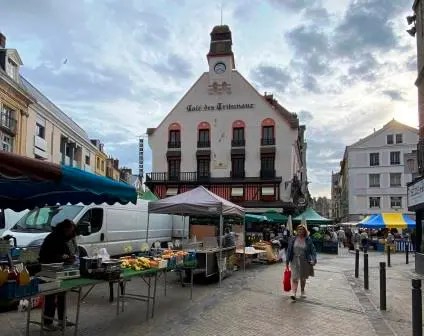
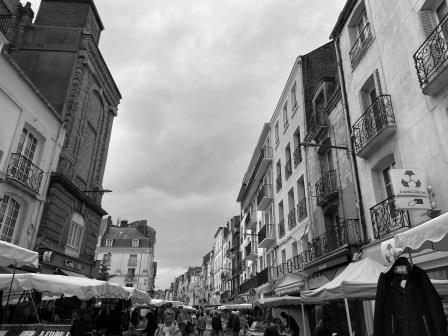
It is a Saturday morning in late July, but this market is open every week throughout the year. It is the largest in Normandy, and one of the best rated in all of France.

It is extensive too, occupying the main street and several of the surrounding ones. We wander around for more than an hour. We are not surprised to see that much of what is on offer is local produce.
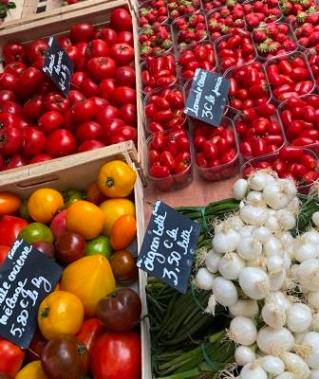
We are here mainly to take it all in, to enjoy the atmosphere, but we also have a small mission to fulfil; we are shopping for the ingredients for a picnic lunch to be enjoyed later during a train journey we will be making.
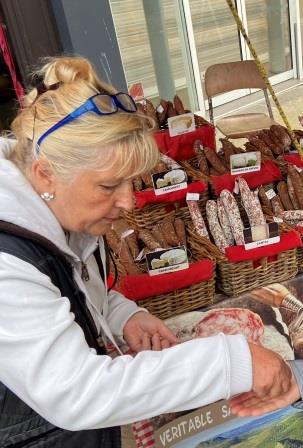
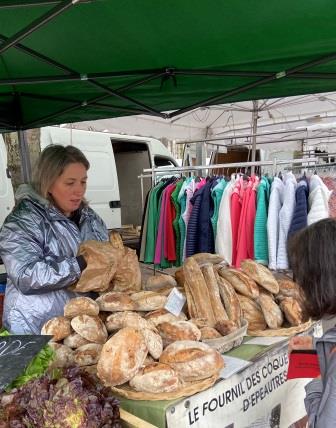
The picnic almost builds itself. Normandy tomatoes come first, then a small dry salami and a square of Bray cheese which we are surprised to find costs just one euro. We get bread, a small baguette bought from an artisan stall, then carrot salad, sliced garlic sausage and a small tub of pork rillettes.
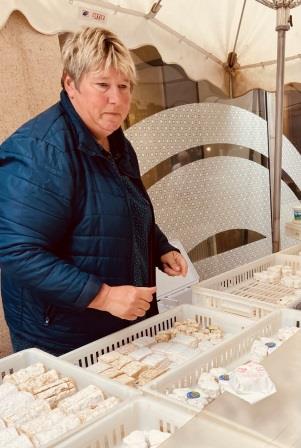
Local yoghurt and madeleines for dessert complete the picture, but then we realise we will need a small knife to cut the salami and cheese, so we hurry back to get one for two euros.
Finally, on our way to Dieppe station, we stop at a Carrefour convenience store and get a bottle of the cheap red vin d’ table, a litre and a half in a plastic bottle with a handy screw top. We are already carrying a couple of paper cups from the hotel which will serve as wine glasses.
La plus courte et la plus économique’
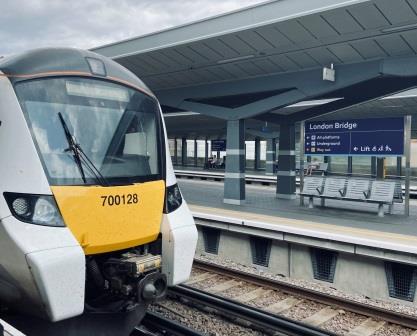
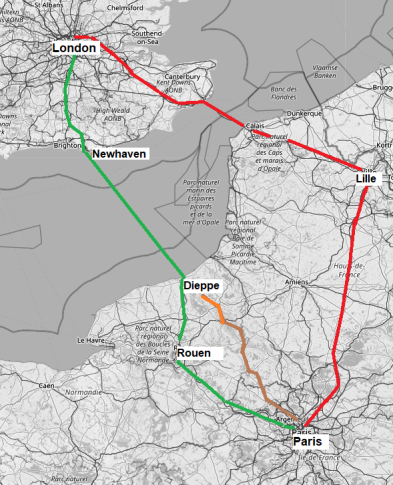
We arrived here in Dieppe at 10:30pm last night, having walked into the town from the ferry terminal about a mile away. We left London Bridge at around noon yesterday, arrived in Newhaven a few hours later and then boarded the 5pm ferry for the four hour cross channel trip. The plan now is to catch the 10am train to Paris St Lazare, a Metro to Gare Bercy and then another train to Dijon in Burgundy for a short stay.
The route we are taking to Paris is a time-honoured one. Railway companies on both sides of the channel were already promoting trips between London and Paris by the early 1840s.
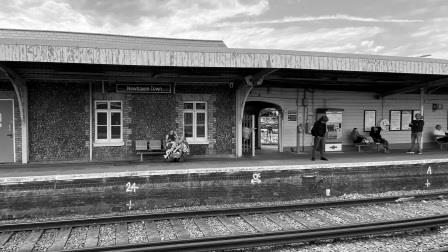
The London, Brighton and South Coast Railway (LBSCR) opened its line to Newhaven in 1847 and then together with its French counterpart, the Chemins de Fer de L’Ouest (Western Railway), began to promote London Bridge to Gare St Lazare.
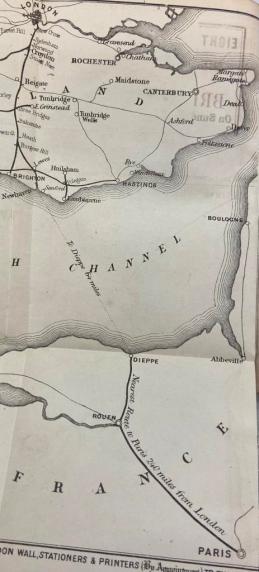
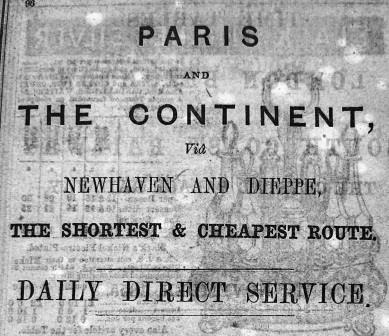
With a distance of just 240 miles from capital to capital, the two companies marketed the route as the “shortest and cheapest.” With a sea crossing of 64 miles, three times that of the rival between Dover and Calais, it was never the quickest.
The route prospered and although by the 1950s foot traffic had waned, business was boosted by the introduction of car ferries in 1964. The link has continued despite the opening of Eurotunnel, although it is now subsidised by local government in France.
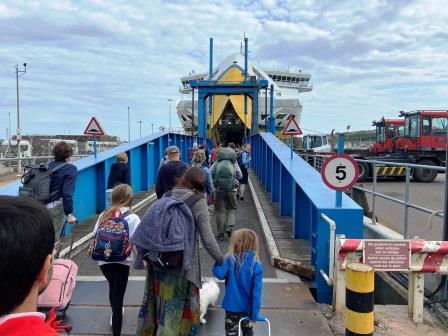
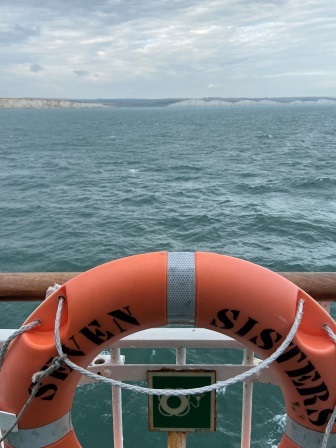
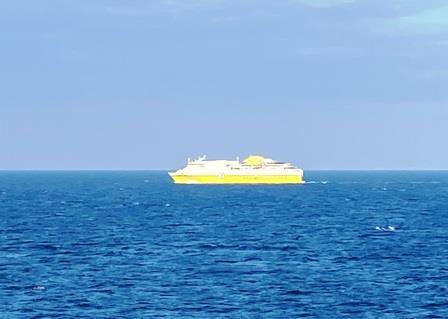
In 2023 there are up to four daily crossings each way in the summer. They are operated by DFDS and serviced by two French-crewed boats, the Seven Sisters and the Côte d’Albâtre.
The route may still be able to claim to be the cheapest. Our walk-on fares cost just £30 and adding a ticket from London and another to Paris mean we have paid less than £100. These last minute prices (available any time) compare with the cheapest remaining Eurostar one-way ticket of £270. Even after factoring in a cheap Dieppe hotel, it is still a bargin.
TER Normandie
The little station at Dieppe is quite busy. Our train, comprised of two modern 4-car “Regiolis,” diesel sets, is waiting on the platform. With ten minutes left before departure it is already quite full.
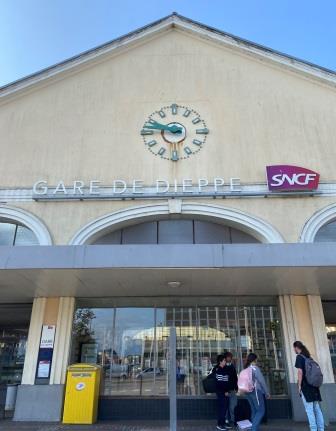
Dieppe station was opened in 1848 at the end of a branch from Rouen. This route still survives, and it is the one we will be taking today. Later a more direct line to Paris via Gisors was opened. However, it was severed at Serquex in 2006 and the track lifted. The section of old track bed south of Dieppe formed part of my walk to Pontoise in 2011.
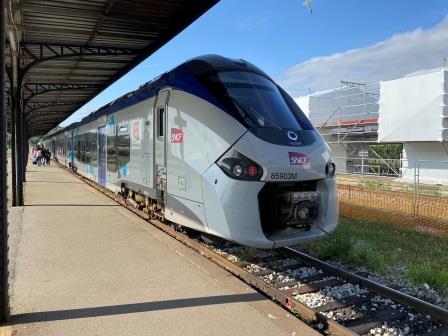
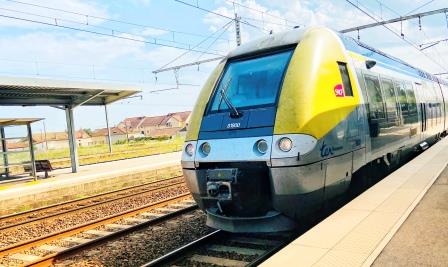
Our train is a Transport Express Régional (TER). TER is the name used by SNCF (France’s nationalised rail operator) for the local services that are subsidised by the regional councils of France. This means that as well as bearing the SNCF logo, our train has TER Normandy markings too.
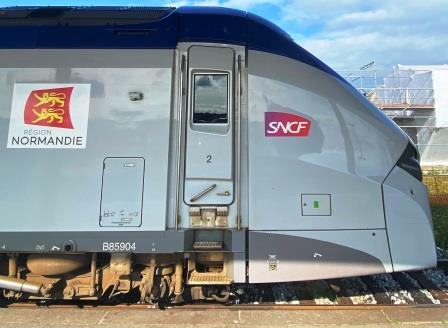
We leave on time at 10:02 and the journey takes us through some lovely Normandy countryside. After just under an hour, we join the electrified Le Havre to Paris main line and terminate at Rouen Rive Droite station. Our connection to Paris, another TER (made up of two Class Z 26500 bi-level units) making the 100 mile journey non-stop, arrives within 10 minutes.
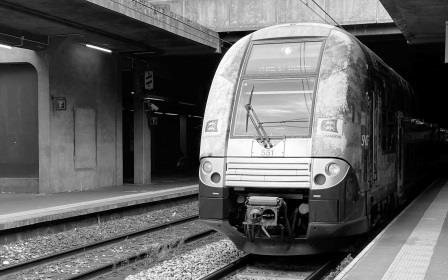
The route we are now following takes us along one of France’s earliest railways. Built under the supervision of Joseph Locke, famous for many English projects including the Woodhead Tunnel, this line between Rouen and Paris opened in 1843.
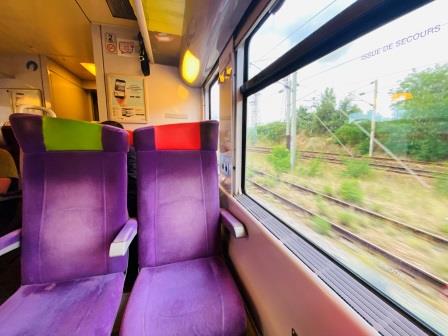
We are basically following the River Seine on the way to Paris. We cross it several times during the journey but spend the majority of our trip on its left bank. We arrive on time at Gare Saint Lazare at 12:46.
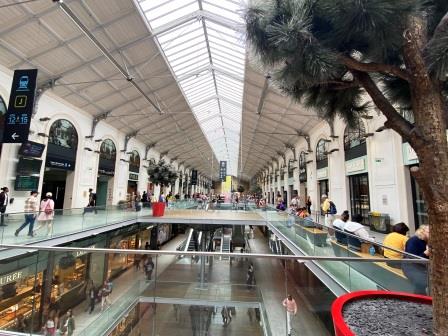
Part of Saint Lazare has been impressively reconstructed, but we don’t have time to linger, we have less than an hour to get across Paris. We board Metro Line 14, the city’s newest, and head directly for Gare Paris Bercy.
TER Bourgogne-Franche-Comté
By some, Gare de Bercy is now regarded (with St Lazare, Montparnasse, Nord, Est, Austerlitz and Lyon) as one of the French capital’s seven rail terminals. Yet it is far from being a “grand station”; it was originally opened in 1977 for car transporter trains, acting in a supporting role to Gare de Lyon on whose approach tracks it is located.
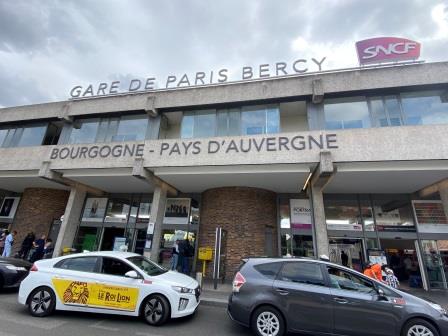
In 2012 secondary services, intercity trains to Clemont Ferrand (Auvergne region) and TER services to places in Bourgogne (Burgundy) were located here to reduce overcrowding at Gare de Lyon. In a political move aimed at appeasing the two regions it served, the station was renamed in 2016 to “Gare de Paris Bercy Bourgogne, Pays d’Auvergne.” It is a bit of a mouthful.
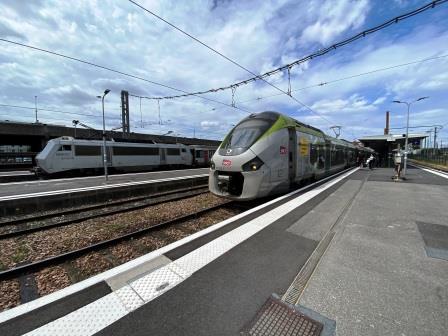
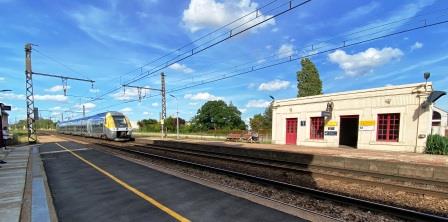
Our Metro trip from Saint Lazare is quick. With 20 minutes to go before departure, our train is waiting in the platform and people are already boarding. This is another TER service, formed of two six-car CoradiaLiner electric sets with the logo of the region Bourgogne-Franche-Comté visible on the sides.
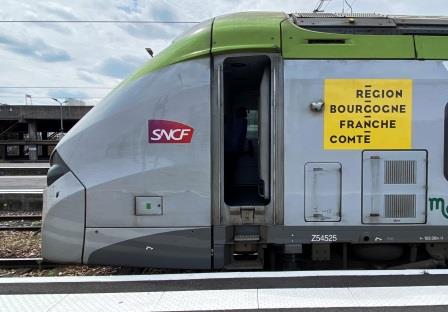
The train, destined for Lyon, is pretty full already and we have to walk down towards the front to get a seat. Eventually we find an empty bay of four and begin to set up our picnic on the table. As we assemble our food, I smile; this trip has been a long time in planning.
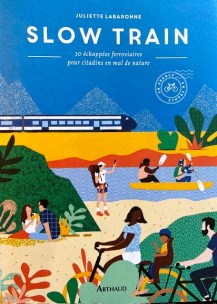
Back in 2019, I saw an interesting looking book “Slow Train” in a shop in Bordeaux. Even though it was in French (a language in which I am less than fluent), I bought a copy. Written by journalist Juliette Labaronne, it promotes travelling around France by slow train. The book has 30 suggested routes. I started to make plans to try some of them, imagining eating little picnics on the trains as I went. Then COVID intervened.
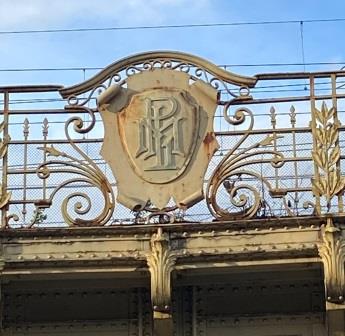
We set off on time at 13:35. Our route is the traditional line once operated by the famous Chemins de fer Paris-Lyon-Méditerranée (PLM) which linked the capital to the second and third largest cities: Lyon and Marseilles. The line opened in stages between 1847 and 1856. Paris was first connected to Dijon (almost 200 miles away) in 1851.
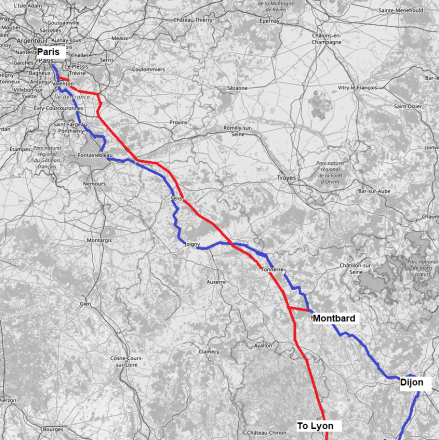
Once France’s most important railway, the line has gradually been bypassed by the opening of parallel LGV (high speed) lines since 1981, with the whole distance to Marseille covered by 2001. Whilst the original PLM line goes via Dijon, the LGV to Lyon bypasses it. Some TGVs from Paris do serve the city but use the classic line for the last stretch.
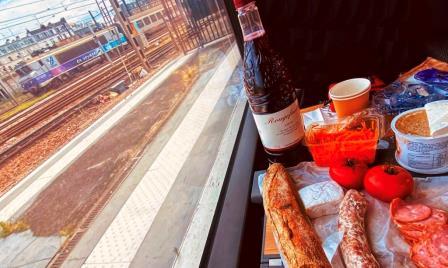
The picnic is absolutely delicious, but we drink a little more of the wine than we planned. The train doesn’t hang around and the first stop (at Sens) isn’t for an hour, by which time we are already on to dessert. The scenery gets better and better as we move south. After Montbard we are treated to fantastic views of the Burgundy hills as we approach our destination. Arrival in Dijon is on time at 16:26.
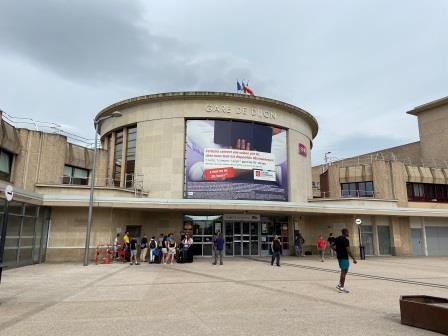
Dijon Ville
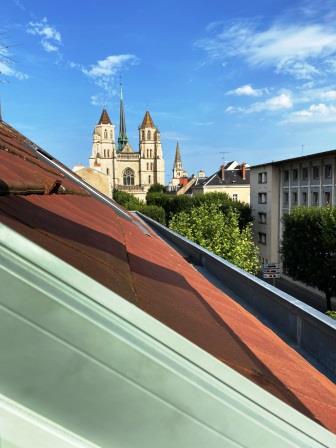
It is just a short walk from the station to the little attic studio apartment we have rented for our four-day stay. We are on the third floor and there is a great view of Cathédrale Saint-Bénigne out of the window. It is just one of several impressive churches in the city.
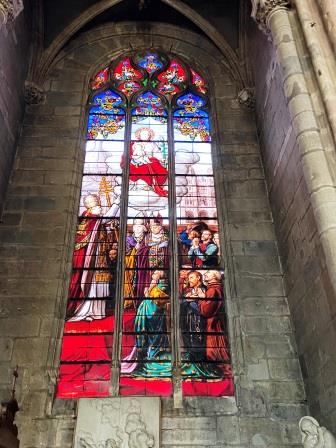
The church of Notre Dame is probably the most famous; one of its stone relief sculptures, an owl, has become both a good luck charm and a symbol of the city.

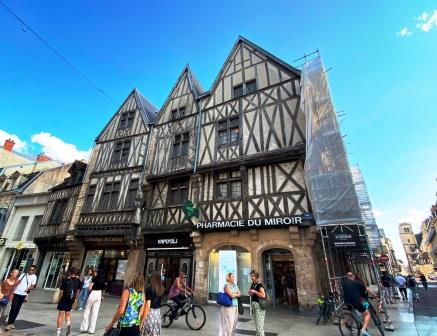
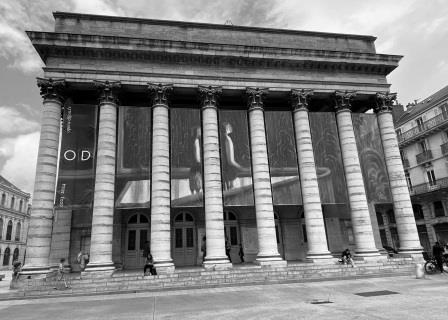
We enjoy several walks around Dijon’s well-preserved and largely pedestrianised town centre. There is a mix of architectural styles; some older half-timbered houses from the 15th century (or older) with much of the central district dating from the 18th century.
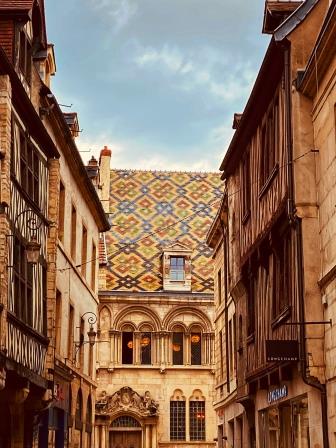
As we walk around, we notice many splendid examples of the polychrome roof tiles that Burgundy is famous for. Known as toits bourguignons, the colourful glazed terracotta tiles were originally used to decorate churches but eventually became status symbols.
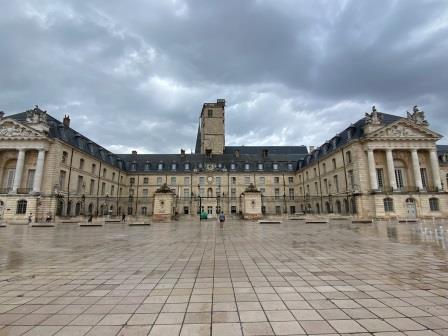
At the heart of Dijon is the Place de la Libération: a large semi-circle with the magnificent Ducal Palace at its centre point. Part of the palace houses the Musée des Beaux-Arts de Dijon.
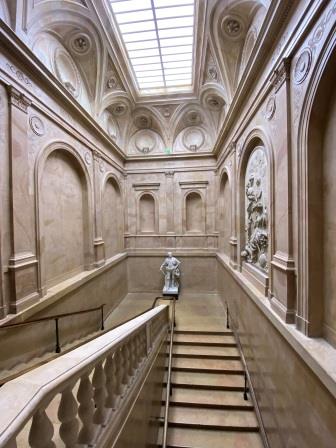
This is one of the largest museums in France. It houses a fascinating collection of sculptures, paintings and other items ranging from antiquity right up to the present day. It is free to enter, and we spend a couple of hours exploring.
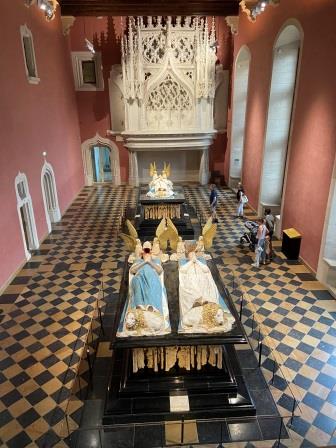
The collection is arranged chronologically and includes an impressive hall containing the tombs of two of the Dukes of Burgundy: Philip the Bold (1342–1404) and John the Fearless (1371–1419).
Cuisine bourguignonne
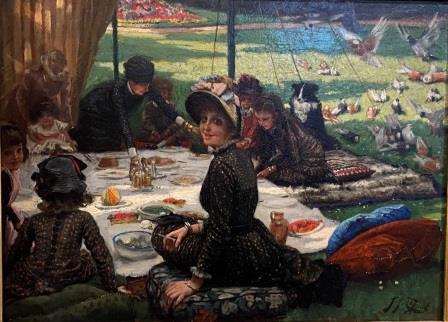
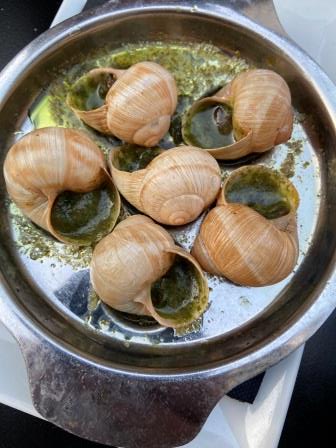
Some of the most famous French dishes originate from the Burgundy region, with coq au vin, escargots and boeuf bourguignon among them. There are also dishes associated with Dijon itself such as Poulet Gaston Gérard, designed, apparently by accident, by the Mayor’s wife in 1930.
Surprisingly, Dijon mustard is not exclusively produced here. The majority is produced industrially elsewhere, often with imported mustard seeds from places like Canada.
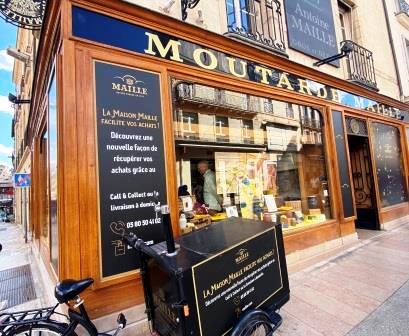
That doesn’t stop manufacturers like Maille having impressive gift shops in the city. The brand has obviously been stretched and a large range of products beyond mustard is on sale.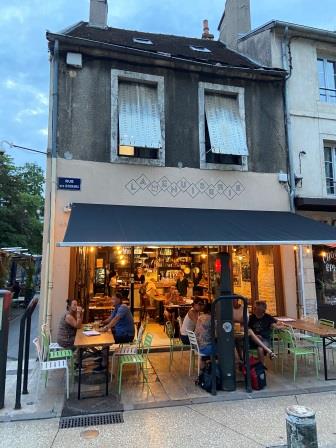
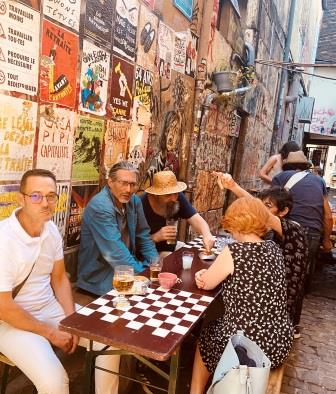
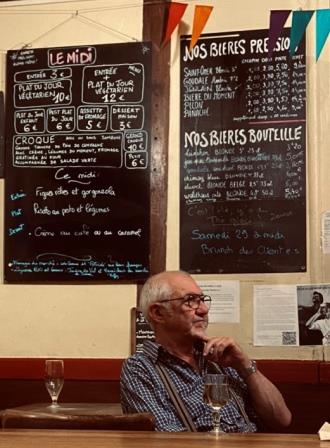
We try to seek out little bars and restaurants to test the local fayre. La Menuiserie (28 Rue des Godrans) becomes our favourite, and we return a couple of times. We choose cheaper Burgundy wine to accompany our meals but purchase a bottle of more expensive Meursault to keep in the fridge at the apartment.
We also find time to visit the Cité Internationale de la Gastronomie et du Vin (The International Gastronomy and Wine Centre) in the town centre which opened only last year.
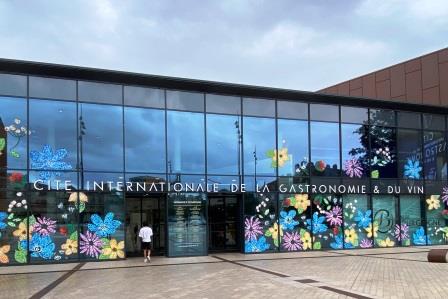
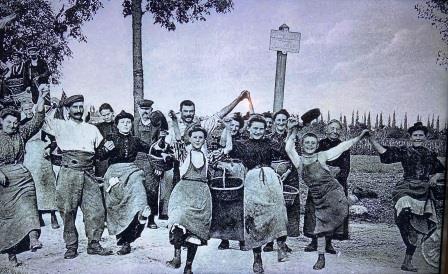
Aiming to strengthen Dijon’s reputation as a gastronomic centre, it features several immersive exhibitions on the history of food and wine, a culinary bookshop and a “village” full of food shops and restaurants.
Beaune
After Dijon the old PLM Main Line turns south, with views of Côtes de Nuits and other famous Côte d’Or wine growing areas off to the right. We board another Paris to Lyon TER train and after 20 minutes get off at Beaune.
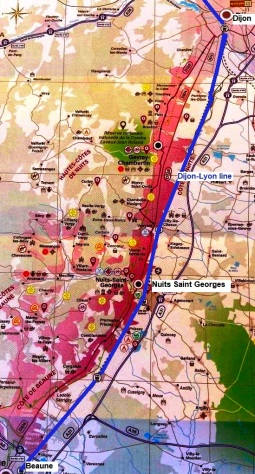
For many, Beaune is the wine capital of Burgundy. It is on the Route des Grand Crus tourist trail and remains a centre for wine industry services.
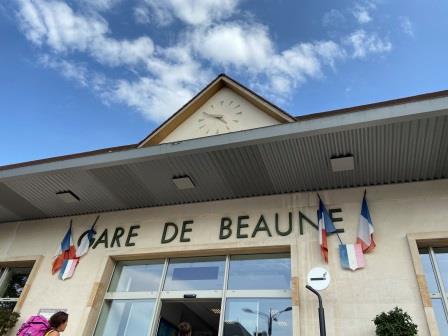
The town itself is walled and a fair proportion of the old centre remains intact. Full of beautifully preserved old buildings, it is easily walkable.
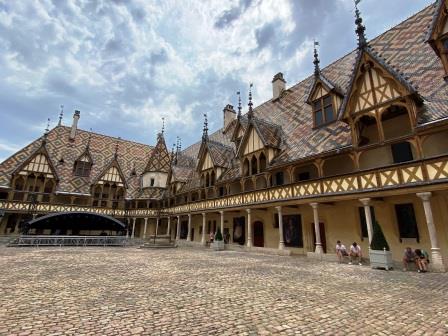
The biggest single attraction in Beaune is the Hotel-Dieu Hospices. Said to be a perfect example of 15th-century Flemish-Burgundy architecture, until relatively recently it housed a charity hospital that was founded way back in 1443.
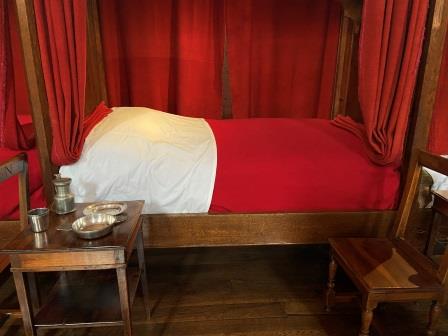
The Hotel-Dieu is now a museum, and we go inside for a closer look. The highlight is the Great Hall with its painted ceilings and the red-curtained booths where the sick once had their beds.
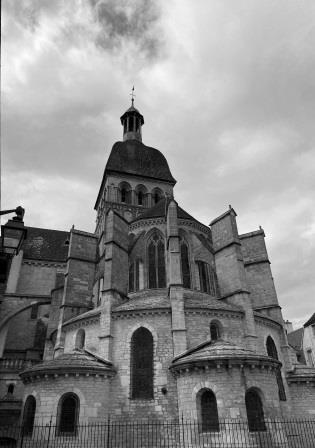
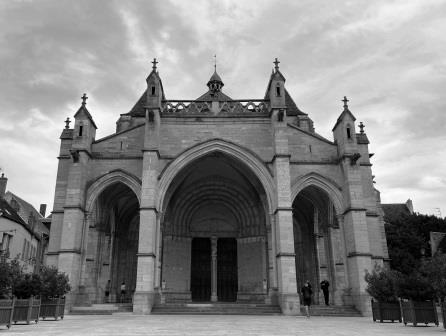
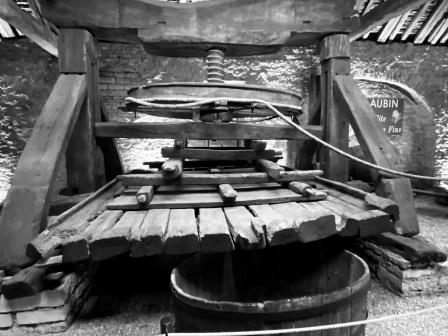
We visit the Church of Notre-Dame, one of the last of the churches built in the Burgundian Romanesque style and we also pop into the Musée du Vin de Bourgogne (Burgundy Wine Museum) which tells the story of winemaking from the Romans to today and has some incredible old wine presses on display.
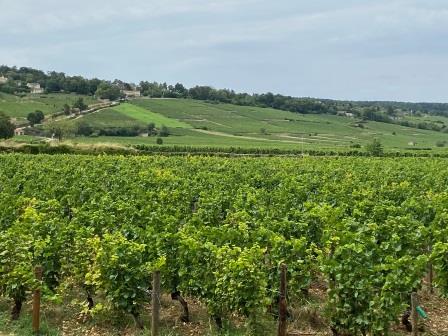
Before we catch the train back to Dijon, we also find time to walk out of the town and spend a few hours wandering around the vineyards nearby.
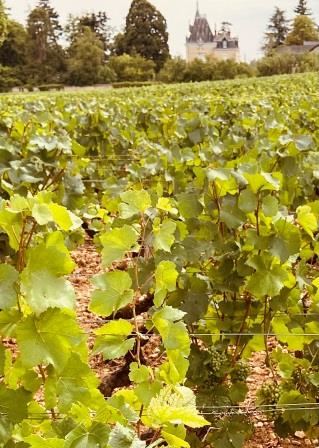
Nuits-Saint-Georges
Not as many trains stop at this little commune situated between Dijon and Beaune, so we elect to go out by bus.
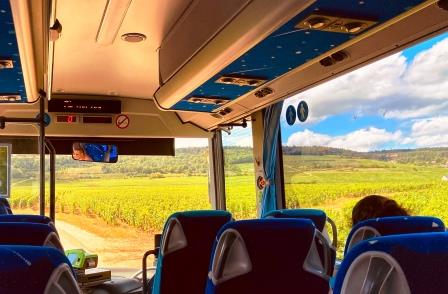
The trip takes around 40 minutes, more than twice as long as the train, but at one point the bus makes a little detour through the vineyards, all very picturesque and tremendous value at 1.50 euro.
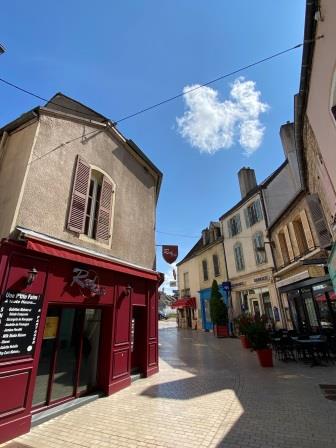
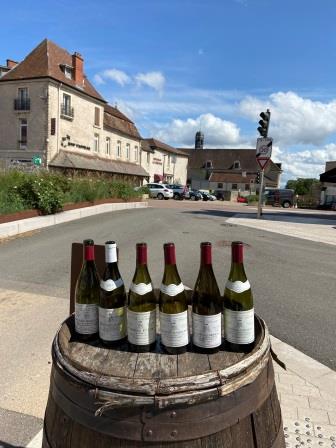
After sampling some of the local wine, we go off for a walk around the village.
Before catching the train back to Dijon, we visit a little museum next to the station that is dedicated to telling the story of the humble blackcurrant and its role in the famous local liquor crème de cassis.
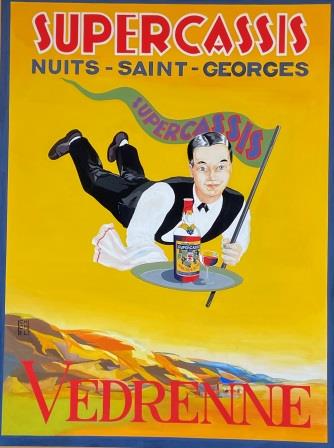
Organised by the liqueur-maker Védrenne, it is all quite fascinating. Through interactive displays and a factory tour we discover exactly how the stuff is made.
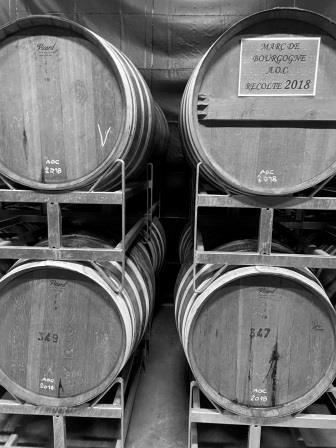
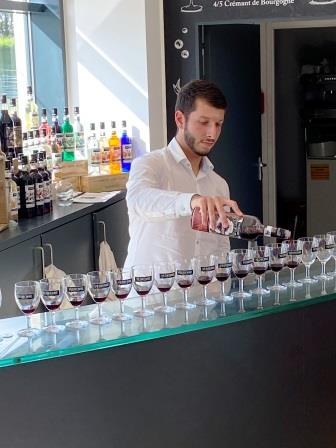
Having become experts on blackcurrants, we get to taste a generous amount of crème de cassis, other liqueurs and various cordials.
SNCF Connect
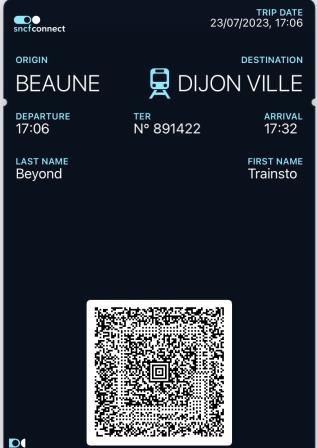
In advance of the trip, I have downloaded the “SNCF Connect” App, and I use it the whole time to search for fares, book tickets and keep abreast of any potential delays.
I find the ticket purchasing function especially easy to use. Using Apple Pay, I become adept at finding fares and getting tickets loaded onto my iPhone in a few minutes.
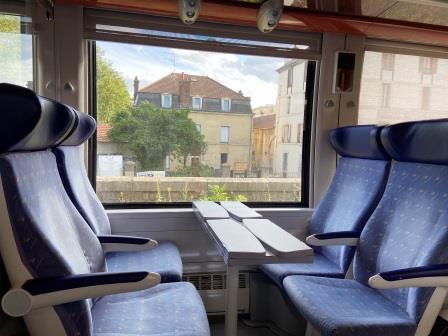
Perhaps we are lucky, but we find travelling around on SNCF excellent. All the TER trains we take are on time, modern, clean and comfortable and have lovely big windows to enjoy the view.
The biggest difference with the UK is the pricing. TER fares are generally fixed, so there is no discount for advance purchase, but the base price is considerably lower than at home.
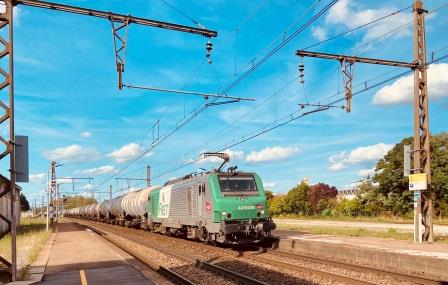
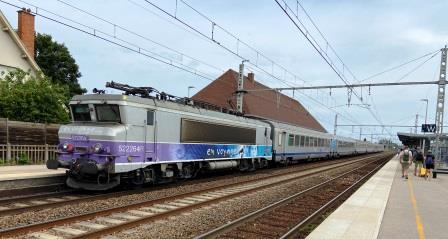
A pleasant surprise is that some of the old Nez Cassé (broken nose) locomotives can still be seen around the Dijon area. The design, by Paul Arzens, first appeared in 1964 and was produced in a variety of diesel and electric models.
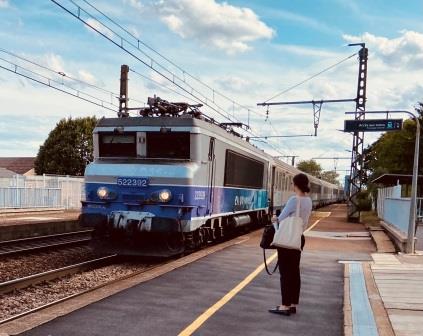
Some of them reached 200km/h and back in the 1970s when they hauled the most famous expresses, they were the symbol of French high speed in the pre-TGV era. Many examples of Class BB 22200 have survived and some are now being used in push-pull mode on secondary services around Dijon.
All in all, SNCF gives a good account of itself, and after a few days we find ourselves humming its little marketing jingle. It is played ahead of all station announcements and on board all the trains. It is dangerously catchy! Listen here = SNCF
Marché De Dijon
On our last morning we are back at a market once again shopping for a picnic. Dijon’s market is one of France’s best known and is held every Tuesday, Thursday, Friday and Saturday. It is concentrated in and around a large market hall right in the centre.
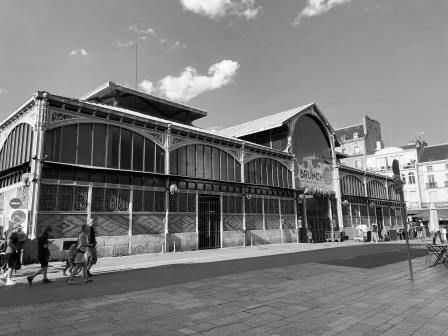
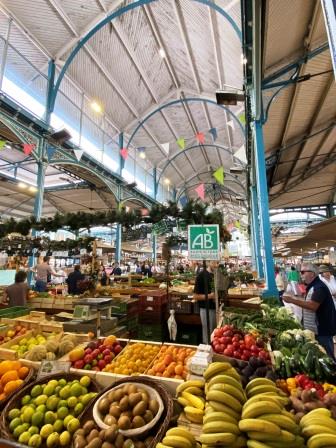
The hall itself dates from 1876 and was built to a design that came from Gustav Eifel, a Dijon local. It is pretty stunning.
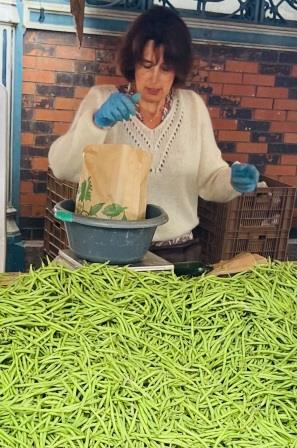
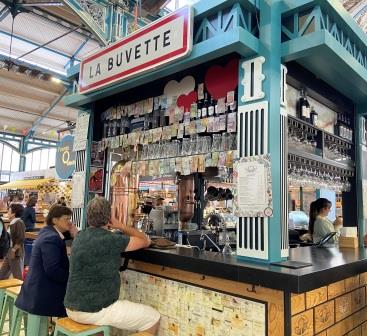
We walk around looking at the incredible selection of meats, fish, cheeses, fruits, vegetables and bread, before stopping at La Buvette du Marche for an expresso.
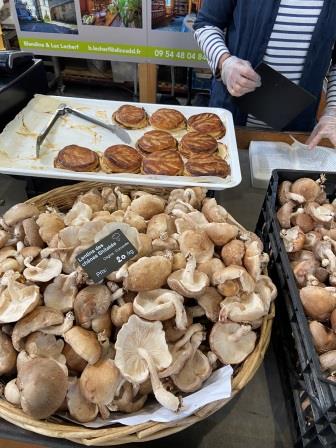
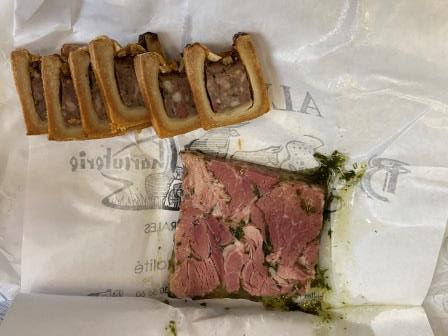
Once again, the picnic builds itself. A visit to a mushroom producer provides a tasty looking pastry, a gourmet traiteur (Le Plaisir du Goût) provides mini chicken pate en croute and Jambon Persille, the local delicacy of ham in jelly.
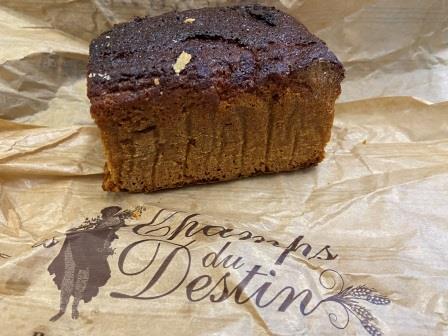
We get bread from a bakery stall (Les Champs du Destin) and pick up some local Dijon gingerbread from there too. Some local cheese, celeriac and carrot salads complete the picture.
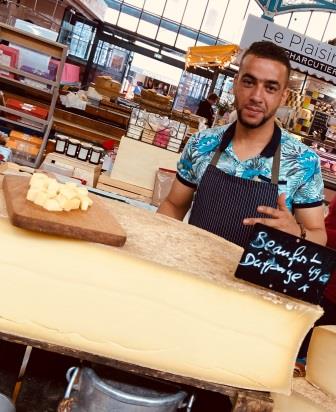
On the way to the station, we pick up another plastic bottle of the cheapest red wine we can find. We are ready for the journey home.
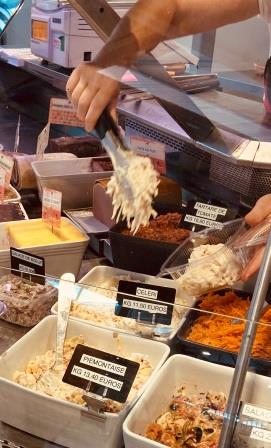
Pique-nique à grande vitesse
Somewhat reluctantly, we are taking the quick route home, but at least we have managed to find a slightly cheaper deal on Eurostar.
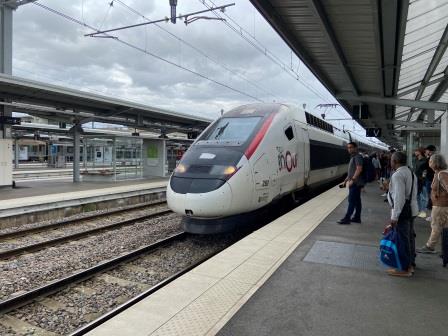
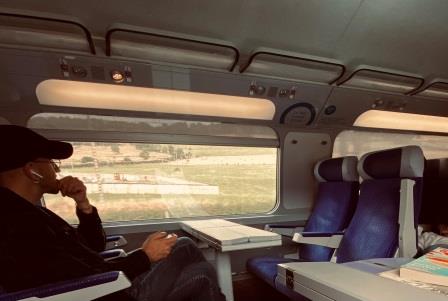
We board the 17:00 TGV service from Dijon, formed of a NeoDuplex unit. After a slow meander back towards Montbard (with great views from the top deck) we zip up the LGV at 300km/h to reach Paris in just over 1 hour and 40 minutes.
We use RER line D, for the quick trip across to Gare du Nord. The RER is probably the only French rail disappointment on the whole trip. The automatic gates seem to have a life of their own (we get trapped twice), the trains are old, and the platforms dark and a bit foreboding.
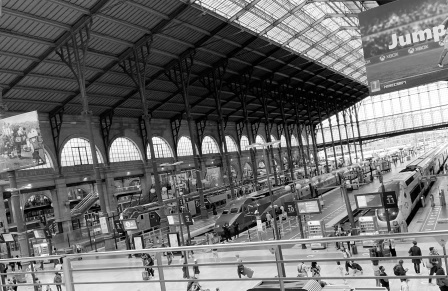
At Gare du Nord it is a struggle to find the Eurostar platforms amid all the construction work, but we eventually make it. After a quick check-in followed by smooth French and UK immigration, we end up with a bit of time on our hands before setting off again on the 20:13 train to St Pancras.
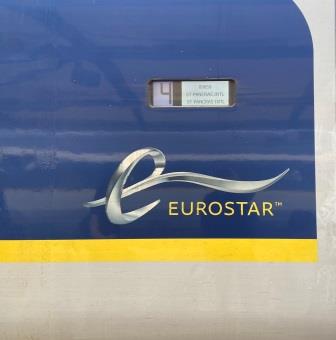
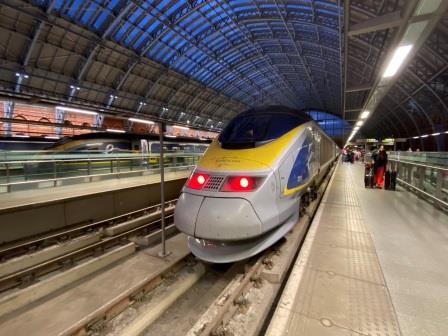
The service is formed of one of the original Class 373 units. Introduced almost 20 years ago, many of these trains have already been scrapped and replaced by newer ones based on the German ICE design. Our train has been refurbished inside but it still feels cramped and with a bulkhead right next to our seat, we can’t really see out easily.
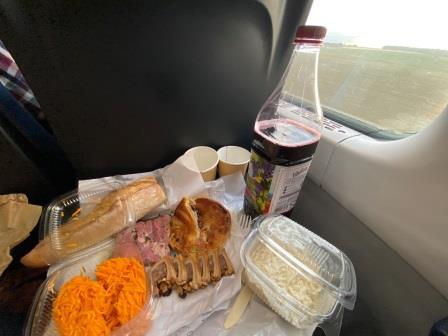
Despite the lack of much of a view, our train picnic is once again delicious and by the time we reach the Channel Tunnel we are already onto the gingerbread and have finished a fair amount of the wine.
This is my first Eurostar trip in more than 10 years, and I have to admit that my disappointment with the lack of comfort and rip-off prices continues. Nevertheless, it is quick: arrival at St Pancras is on time at 21:30, just 5 hours and 30 minutes after leaving Dijon.

 Trains To Beyond