A trip to the railway museum in Brussels, with extra animal attachments.
The Plan
Think of a world-class railway museum that is around a 2-hour train ride from Kings Cross / St Pancras? Yes, of course there is always the National Railway Museum (NRM) at York, but another option is to hop on a Eurostar, head to Brussels Midi in 1 hour 56 minutes and then make the quick connection to Schaerbeek, home to the impressive sounding “Train World.”
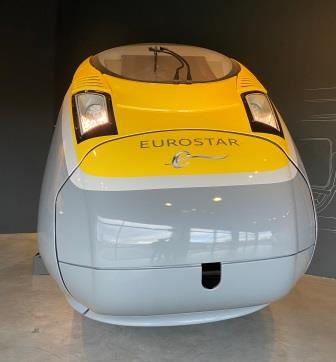
Just before Christmas 2023, curious to see how the Belgian museum compares with its UK counterpart, I decided to give a day trip a go. As a bonus, I arranged to meet a friend who lives in Rotterdam; we planned to tour the museum together before enjoying a long lunch.

The Trip
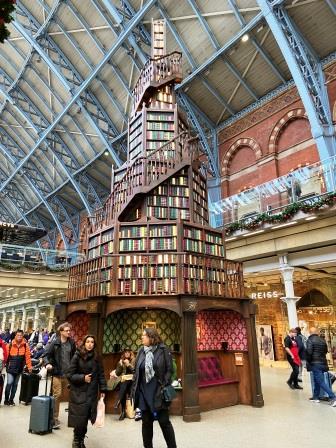
The design of the Christmas Tree at St Pancras International has often come in for criticism in the past for not being very “traditional”. Especially when, a few years ago, it came in the shape of the Eiffel Tower rather than a tree. This year’s design is bound to have its critics too; sponsored by nearby Hatchard’s, it a simple stack of book cases and a spiral staircase. I like it.
I am here at St Pancras to catch the 08:16 to Brussels. I had originally booked on a Wednesday to keep the fare down, but almost as soon as I had made the reservation ASLEF called a strike on Southeastern and my plan to leave home this morning on the 05:59 was thwarted. Not really wishing to postpone, I (somehow!) found a reasonably priced room within a tube ride of St. Pancras and spent last night there.
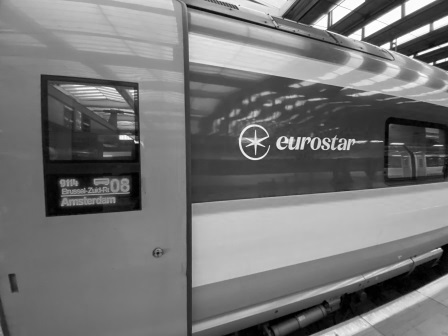
If you have read some of the other posts on here, you might already be aware that Eurostar is really not my favourite train service. It is not necessary always their fault, but I just never seem to enjoy it. Usually, their prices put me off and I end up flying anyway, but whenever I have travelled with them something has always seemed to niggle me. Last time, on the way back from Paris in July, it happened to be a seat without any view out of the window.
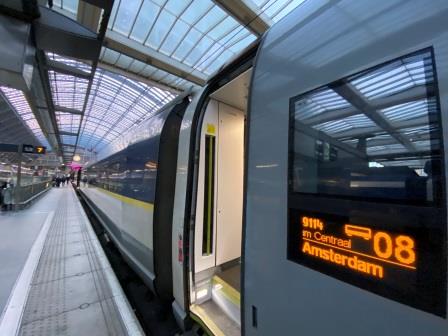
So, I am feeling slightly grumpy as I struggle to find a seat in the waiting area underneath the platforms at St Pancras. There is another train to Paris due to leave just before us, so the place is really crammed. Having turned up, as requested, almost an hour early I have whizzed through security and passport control only to find massive queues at both cafes and only a few seats left. Why they have to send two trains within just a few minutes of each other is beyond me, and why are there only two cafes to deal with all these people? I decide to get breakfast on board, I finally find a seat and fester away for the forty minutes until the train is called.
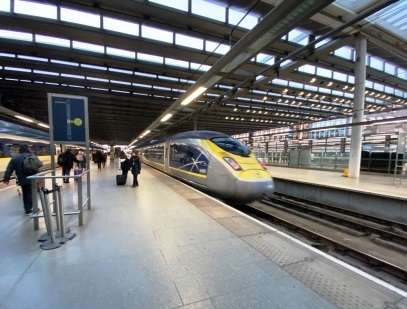
My mood totally changes once we set off. This is my first trip on one of the newer German Siemens-built trains and I am impressed. It is wider and more spacious than its old French counterpart, although to be fair, that is because it doesn’t need to travel on the conventional UK network, and it seems a lot smoother too. It is not very crowded either; I get a seat for two to myself and I have a wide window to look out of. It is a lovely sunny winter’s day and I enjoy the everchanging vistas of Kent, France and Belgium. Best of all, the buffet is just in the next carriage and there is no queue.

The journey passes quickly and before long we are slowing down on the outskirts of Brussels. We pull into Midi for an on-time arrival at 11:12, but only about half the passengers get off with me; the train will continue on to Rotterdam and Amsterdam. It is due into the Dutch capital at 13:15, a total travel time of 4 hours from London; not bad.
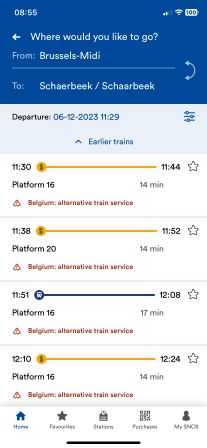
I really appreciate the on-time arrival, not least because Belgian Railways are also on strike at the moment and are running an “alternative train service” with far fewer trains than normal. I have already downloaded the excellent SNCB app; it is telling me my train to Schaearbeek will depart from platform 16 at 11:30. I have already purchased a ticket (Euro 2.50) using the app too.
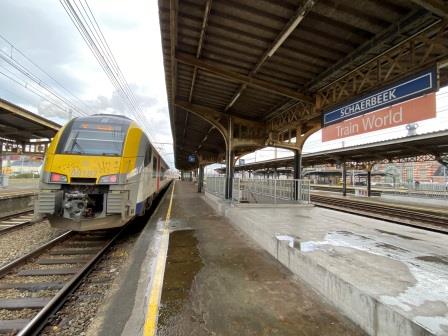
The train turns up on time and fourteen minutes later, after transiting the cross-city tunnel and threading through a maze of tracks to its north, the train comes to a halt at Schaearbeek. The station signs here are helpfully marked “Train World” too. I alight and am happy to see my friend waiting for me next to the entrance of the museum.
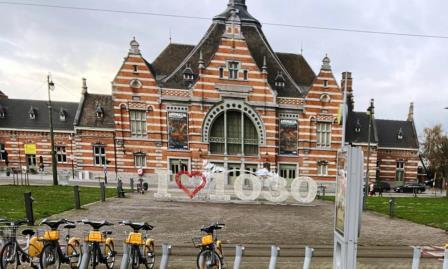
If you are going to house a railway museum in an old station, then you can certainly do worse than Schaearbeek. The station building, a listed monument, looks the part. Built in Flemish neo-Renaissance style between 1890 and 1913, it is vast too, and it is hard to believe that it was never actually a major terminus. The station building closed in 2013 and after extensive refurbishment it reopened in 2015 as Train World.
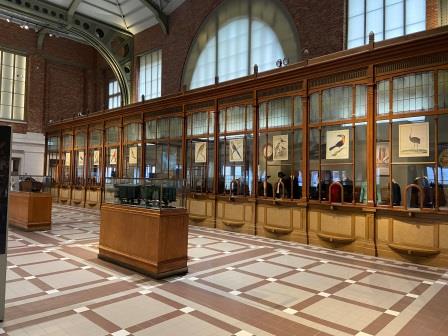
We get our tickets, a reasonable 15 euro, and head on in. The helpful volunteer at the entrance tells us that our visit today coincides with the “Animalia” exhibition, it is an innovative approach that combines themes such as biodiversity and climate with the idea of taking the train to benefit the environment.
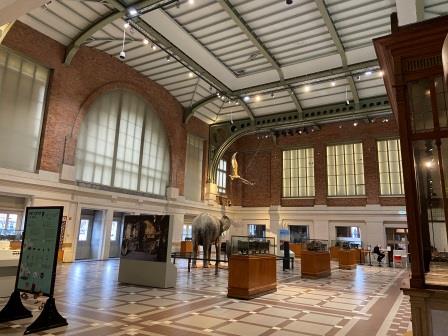
He points to a large elephant in the centre of the hall and explains that we will see more of the animal creations of Belgian sculptor Pierre-Yves Rentkin during our visit. He also tells us that the exhibition had originally been planned to stretch only from February until November but has been extended due to demand.
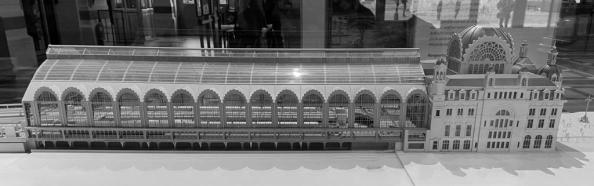
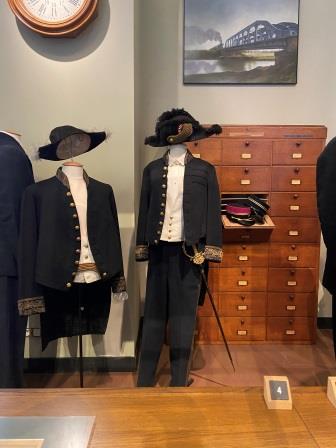
The first part of the exhibition is in the wonderful old booking hall. The number of booking counters is amazing, and behind them are a series of uniforms and ticket machines. There are also impressive models of Belgium’s main stations (above: Antwerp) on display here.
After a brief walk outside, we enter the first of several connected hangers containing the locomotives and other large exhibits. They have had the lighting experts in here and gone for a dark theme. Overall, the effect is pretty stunning with the locomotives themselves lit up brightly. The animals make it look even more dramatic, there are parrots flying overhead and a large giraffe dominates this first room.
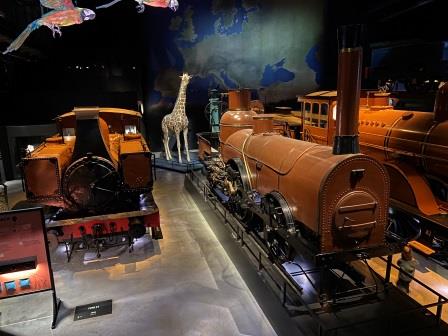
We walk around examining the locomotives. Pride of place here is given over to the Pays de Waes, dating from 1844, (above right) it is the oldest remaining steam engine in Europe.
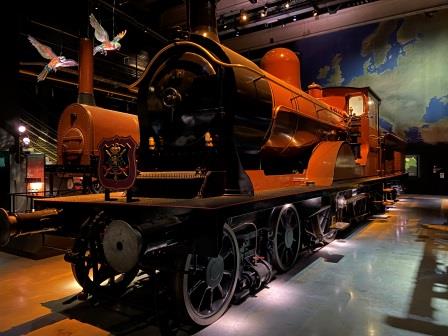
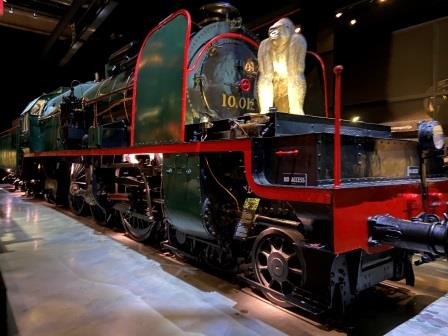
Also on display are a beautiful class 18 in brown livery (above) and a spectacular Class 10 pacific (below) which has a large gorilla perched on its buffer beam.
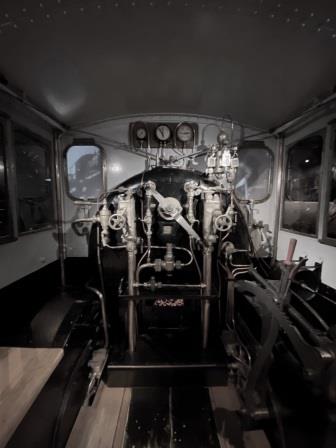
I am happy to see that unlike at York, we can climb over the locomotive footplates, and we spend several minutes doing just that. On the type 10 the cab windows have been replaced by video screens that help tell the story of life as a driver. It is an excellent touch.
Belgium had the first railway network on the continent of Europe. Its origins are connected to the birth of the country itself. Anxious to avoid trade being conducted along Dutch-owned waterways, the Provisional Government of the new country, which gained independence in 1830, pursued the new form of transport as a better option.
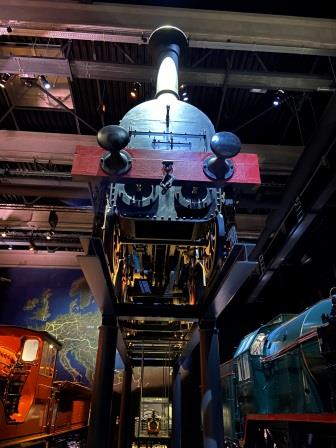
The first railway, designed to run from Antwerp towards Aachen was first authorised in 1834; the initial stretch, a branch from Mechelen to Brussels, was opened in 1835. One of the network’s founding fathers was British industrialist John Cockerill who eventually set up a locomotive works in the country and built some of Belgium’s first steam locomotives.
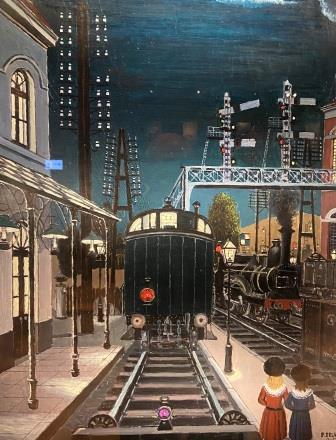
Unlike in the UK, the Belgian Government was involved in planning and operating the network from the beginning. Although private companies built the majority of the country’s network, the system was gradually nationalized from 1870 onwards, with all lines being operated by SNCB, the state operator, from 1926.
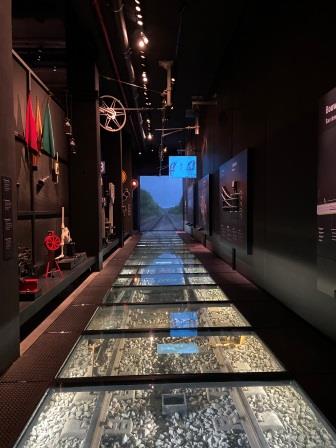
Our tour continues with a walk over a glass covered railway track with a life-size cab view off in the distance. Here the story of the development of rail safety is told using cool exhibits. An interactive video display explains the evolution of the steel rails themselves, and there are also extensive displays on the electrification of Belgium’s network.
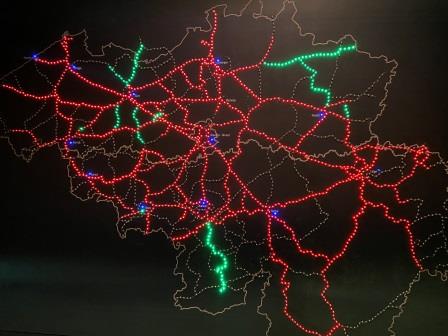
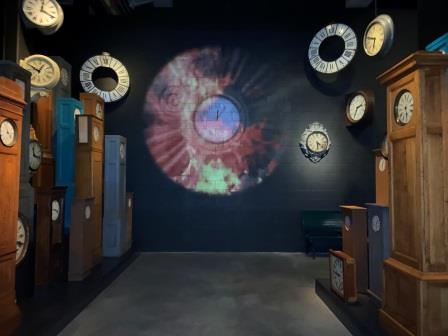
In the next room we walk through an impressive display of old railway clocks, and then into another room which is filled with old signboards, ticket machines and a weighing scale.
In the next hall, we meet one of the best known symbols of Belgium’s railway, the impressive, streamlined class 12 locomotive. Six of these were built by the John Cockerill company in 1939 for the Ostend to Brussels route, but 12-004 here is the only survivor. It certainly looks the part with its impressive head of crafted artificial steam.

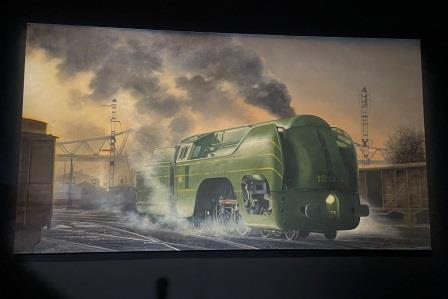
On one side of the Class 12 is a type 551 diesel railcar also introduced in 1939, and on the other side is one of the country’s first electric trains, dating from when the line from Brussels to Antwerp was first energised in 1935.
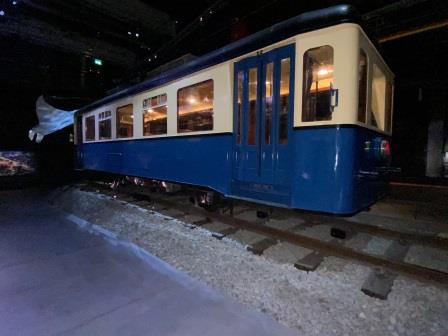
Both are in attractive blue and cream livery, and I am pleased to see that you can clamber aboard and inspect the insides.
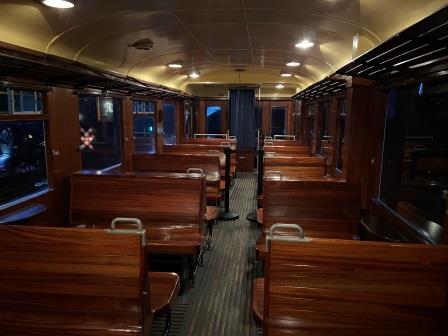
In the next hall are two more passenger coaches dating from 1921 and 1937, the latter partly dressed up as a hospital train. Again, they are ready and waiting for boarding. Apart from the ability to roam more freely and interact with the exhibits, the relatively small number of large vehicles in each hall is a big difference from York. Here fewer exhibits are being used to tell more stories, safety, modernisation, commuting, luxury travel. 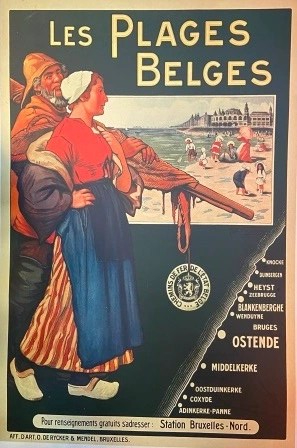
To be fair, the British National Railway Museum is currently undergoing a transformation for the 200th anniversary of railways in 2025. It too intends to reduce the number of vehicles on display and tell “more stories.”
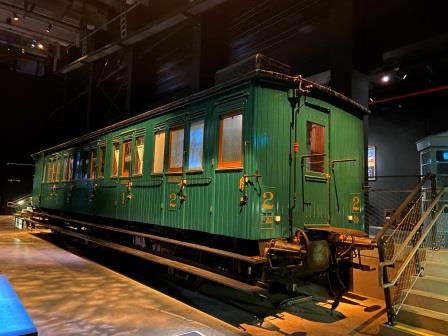
The history of the railways role in the holocaust cannot be forgotten. It is dealt with here, perhaps inevitably, by a freight car which symbolises the transportation of Jewish victims from occupied Belgium to the Nazi death camps.
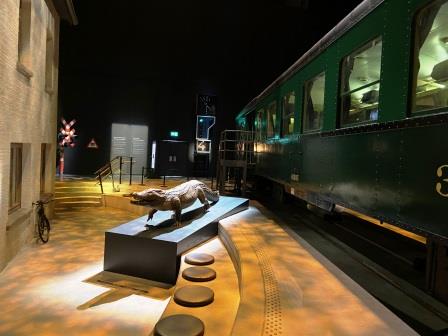
In another corner of the same hall, guarded by a crocodile (or is it an alligator?) is a life-size replica of a railway cottage which is used to tell the story of the ordinary railway men and women who worked on the network.
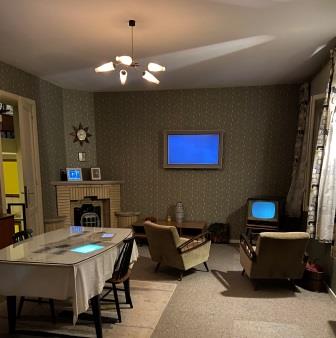
The cottage is set in 1958, the year the famous Brussels Atomium was created as part of the World Expo held in the Belgium Capital. The late 1950s were a period of hope and high growth for Belgium as it rebuilt after the devastation of the Second World War.
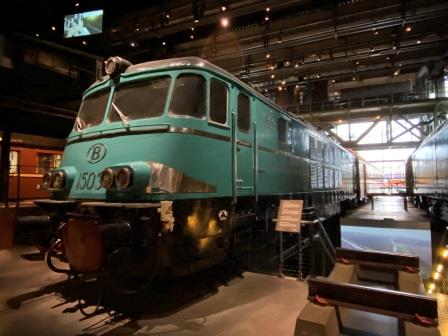
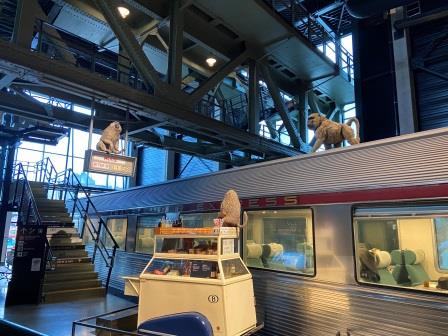
The theme of postwar optimism continues in the next hanger with a carriage from the Trans European Express (TEE) dating from 1974. It is displayed (above) alongside an electric locomotive, No. 1503 dating from 1962, to accurately portray a Paris to Amsterdam express of the mid -1970s.
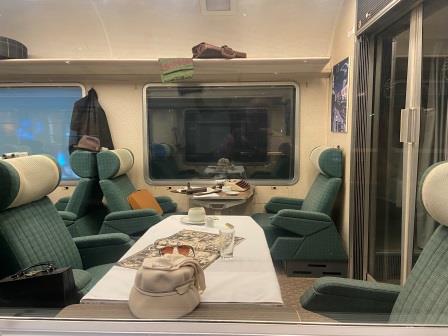
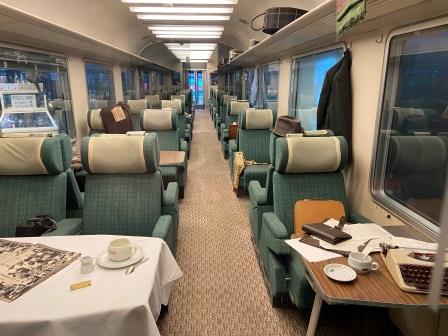
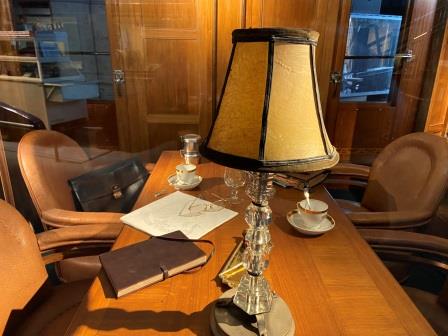
We climb on board and observe through a protective glass panel. The little touches, like the old typewriter on one of the tables, make it easy to imagine our mid-1970s businessman making a trip from Paris to Brussels on this first-class only train.
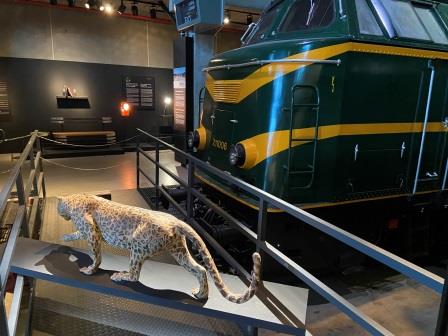
There is a class 211 diesel locomotive (above) close by and we climb up into the cab. I sit in the driver’s seat and, looking through the window, I cautiously observe a leopard down below.
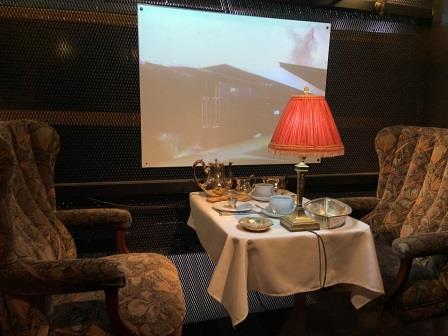
We bump into one of the volunteer stewards and chat about the museum generally and the animal exhibition in particular. He tells us that the animal sculptures are popular with most people, but they have not gone down well with some railway enthusiasts. Personally, I think they are great.
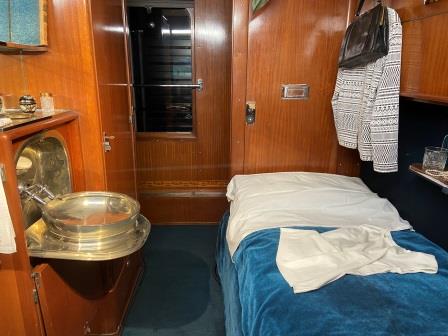
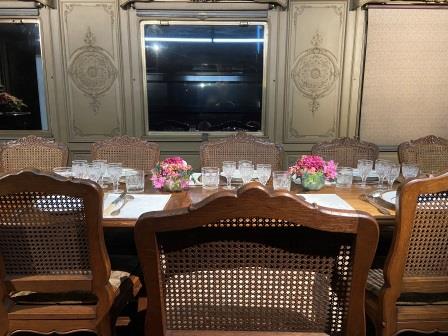
We move on to examine the other carriages in this hanger, symbolising luxurious travel on the Wagon Lits of an earlier era.
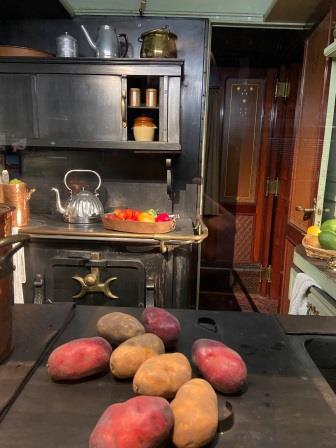
Even more luxurious is a royal carriage from the time of Kings Leopold II and Albert I. There is also another later one from the Leopold III and Baudouin era.
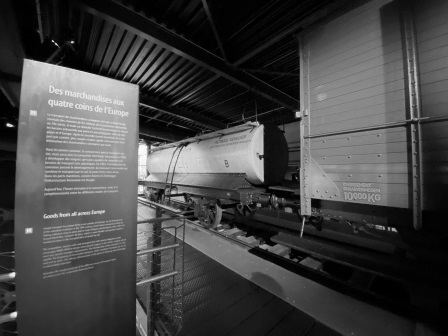
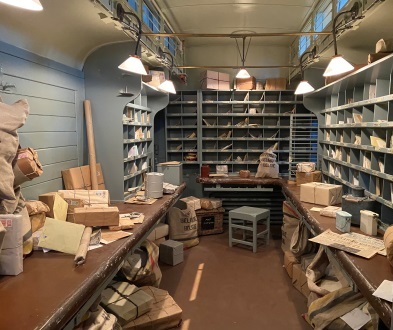
The story of freight is not forgotten either, with a collection of wagons on display and a series of fascinating exhibits. One of them tells how mail and parcels were transported by rail and how between 1840 and 1984 letters were sorted on the train.
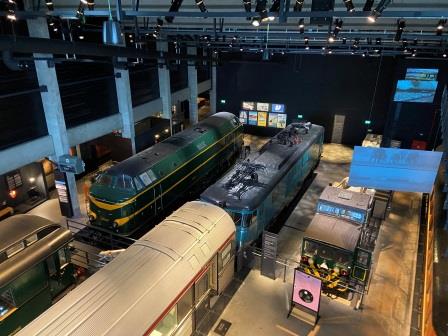
We climb up to the mezzanine, pausing to examine the exhibits on bridge building and heavy engineering on the way. Now we walk back at a higher level towards the entrance.
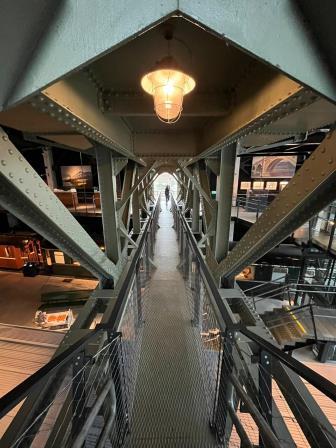
This affords us a look down into each of the hangers we have passed through. Now we are seeing them from a different angle.
We come to a room that is fitted out like a cinema. The seats in the auditorium are from the various high speed trains from around the world, including those from the Chinese and Japanese bullet trains. The film on show is, appropriately enough, on the future of railways.
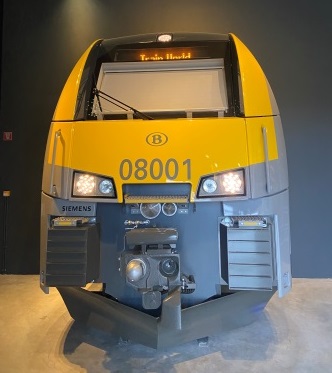
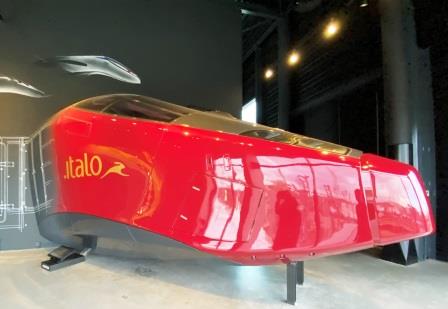
Just before we leave there are life-size mock ups of trains from Siemens, Alsthom and Bombardier to marvel at, and then finally a replica of La Belge, the first locomotive to be made in Belgium, which hangs over the gift shop in spectacular fashion.
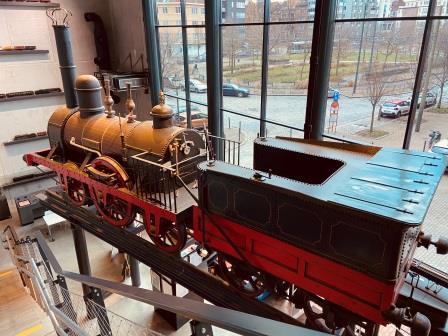
We have both thoroughly enjoyed Train World. It might not have the size of the NRM, and in some ways cannot really be compared, but it tells its stories well and hopefully provides lessons that York will follow next year.
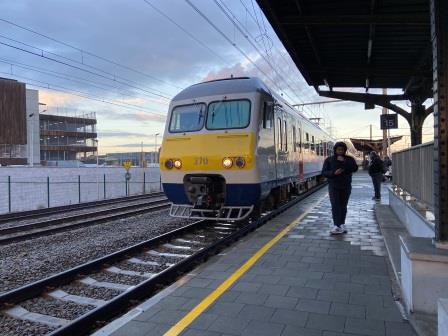
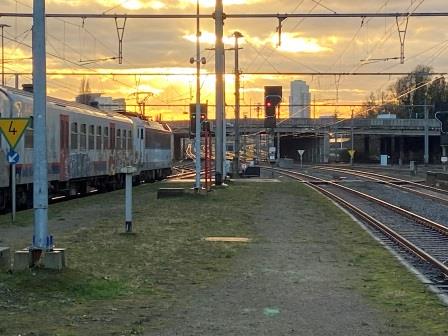
After a long and very pleasant lunch in the former station restaurant, now part of the museum, we say farewell. My friend returns to Rotterdam, and I go off on the train heading literally into a beautiful winter sunset.
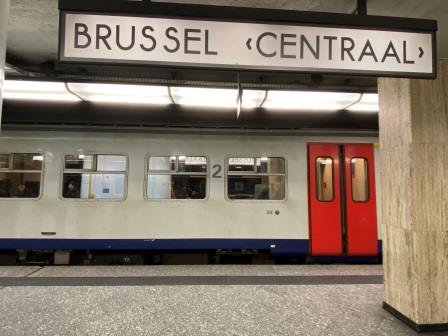
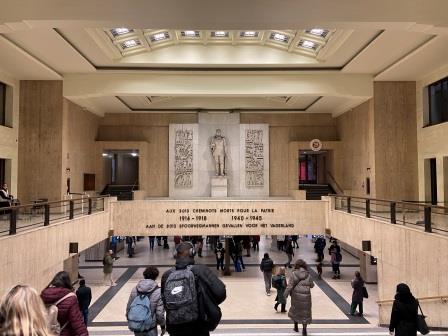
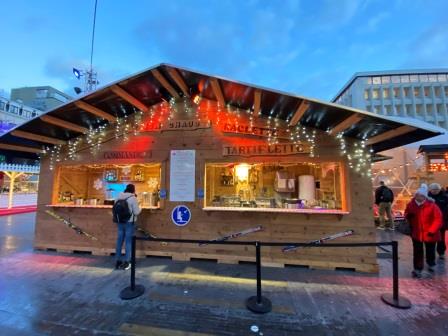
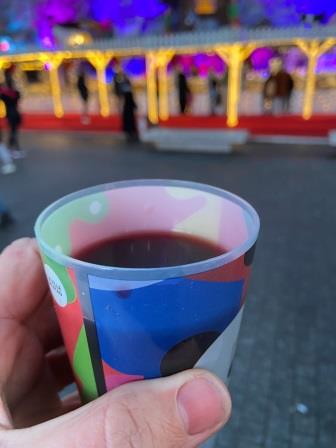
There is just time to alight at Brussels Central Station for a festive walk around the centre. I visit the Grand Place, take a look at the giant Christmas tree and then wander through a few shopping arcades before finding a stall and pausing to enjoy a mulled wine.
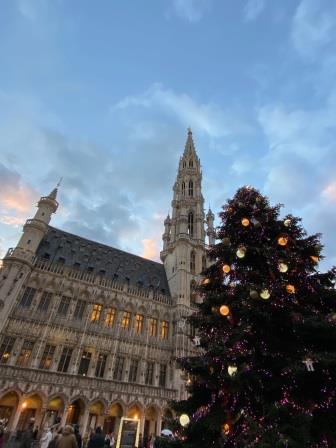
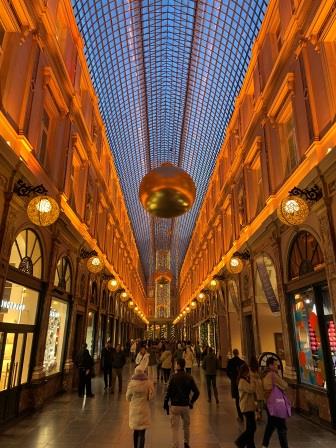
Then it is back to Midi Station. I am heading home on the 17:56, which will get me to London (with the time change) at 19:00. I do my best to try to make it to the terminal for 17:00.
The station facilities at Midi are even worse than St. Pancras. Although at least there is no queue for the café here because there isn’t one. In fact, once you are through passport control and security, there isn’t anything to eat at all. We wait in the subterranean gloom and eventually we are allowed up to the train.
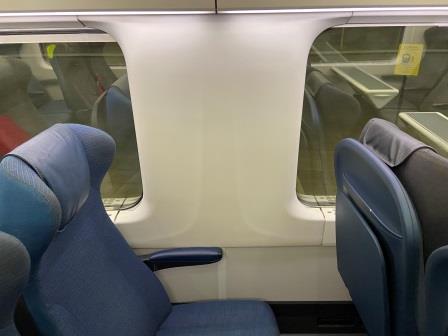
Unfortunately, I see that my Eurostar is one of the older models. Somehow, I am not surprised when I find my allocated seat doesn’t have a proper window to look out of.
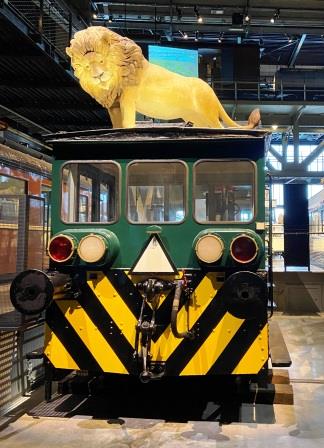
Personally, I think it would be nice to see this particular train pensioned off to Train World soon, hopefully to be guarded there by large lions.

 Trains To Beyond