Travelling from Bulawayo to Victoria Falls
My journey
Having spent a very enjoyable few days in Bulawayo, I now planned to travel to Victoria Falls by bus. After a few more days looking around, I would leave Zimbabwe, walk across the Victoria Falls Bridge into Zambia and continue north from Livingstone.
For the trip I was carrying around 8kg in a new Osprey Farpoint 40 backpack, which was compact enough to work as a carry on item for buses and aircraft.

The Journey North
I had asked the people I met in the Selborne Hotel for advice on which bus company to use for the journey to Victoria Falls. I was told that “Stallion Cruise” was supposed to be faster, but apparently only because its drivers took unnecessary risks. “Extracity” might be a bit slower but it was safer. Both companies had around four or five departures each day, so there was plenty of choice.

In the end, I booked Extracity only because it had a bus with seats at the time I wanted to leave. Its 14:00 departure would have me in Victoria Falls (435 km away) by 20:30. I booked online, paying 15 USD, and made it to the little depot on Lobengula Road just before the large yellow bus itself arrived. It had come all the way from Harare and was bang on time; an encouraging sign, I thought.
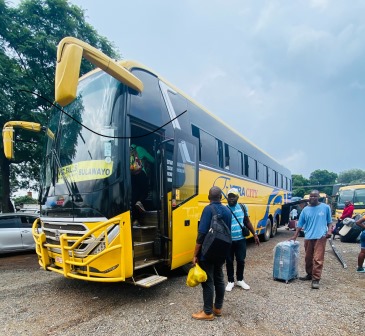
It seemed that more than half the passengers from Harare were finishing their journeys in Bulawayo and even after those who, like me, had been waiting had boarded, the bus was not full. The vehicle, of Chinese origin, was pretty comfortable. It had electrical power outlets at every seat and it was air conditioned, albeit with large windows that opened and sometimes got left open.
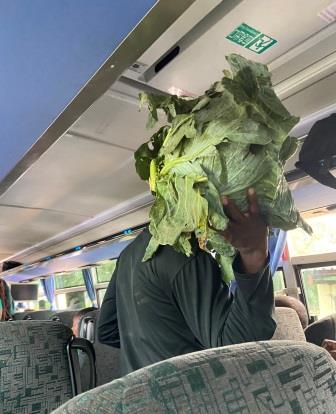
During the twenty minutes or so we waited for departure we were treated to a whole parade of sellers coming on board to push a variety of drinks and snacks; of these by far the strangest was a guy trying to sell us a whole cabbage.

We set off on time. I got chatting to some of the other passengers. One of them was an actress. Originally from Bulawayo, she was working in the theatre at Victoria Falls. She told me that things in the tourist industry up there were a little slow. She also warned me that the condition of the road had deteriorated to such an extent that it would take us at least eight hours to get there.
It was not long before I knew she had a point. For the first twenty minutes we seemed to do okay, but then things fell apart. The bus slowed to a crawl as it negotiated pot hole after pot hole. We bounced along sometimes even leaning into the gaps in the road surface at quite an alarming angle. The conductor came along, scanned the QR code on my iPhone booking but shrugged his shoulders and smiled when I asked about an arrival time.
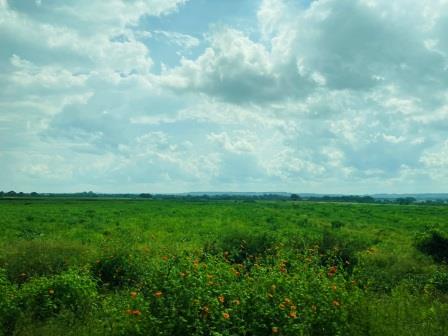
The view out of the window was green bushland and it did not change much the whole way north. Now and then we encountered the “Cape to Cairo” railway tracks running parallel with us or at level crossings. Looking at the track condition, I wondered if the train ride would be better than the bumpy bus experience.

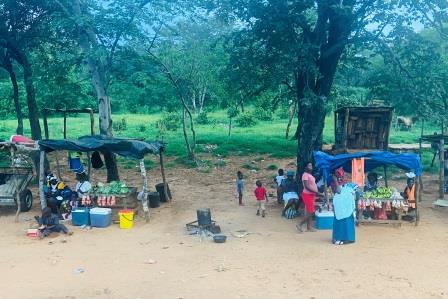
We made frequent stops at little villages where passengers got on or off and local traders attempted to sell things through the open windows. We made a longer pause after four hours at a rudimentary service station. There were also a few halts at police road blocks and incredulously I thought, given the state of the road, at a toll booth.

I was told by one of my fellow passengers that the government had recently partnered with a private company using a kind of repair and operate model, but there had already been issues with payment. The condition of the highway was being held up as a symbol of all the problems with infrastructure in the country as a whole.

Arrival
It was already past our scheduled arrival time at Victoria Falls when we reached Hwange, still a couple of hours short. A lot of people got off at this mining town and when we got going again there were only about fifteen of us left on the bus. When we finally pulled into the Glow petrol station that doubled as Extracity’s terminal on the outskirts of Victoria Falls, it was 22:45. I jumped into a taxi for the last couple of kilometres.
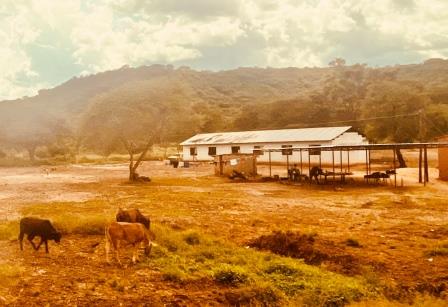
The cheerful taxi driver who took me to the little lodge that I had booked for a few nights regaled me with stories of wild animals roaming the streets of Victoria Falls after dark. I was not sure if he was serious or just trying to justify the fare to me.

The Town
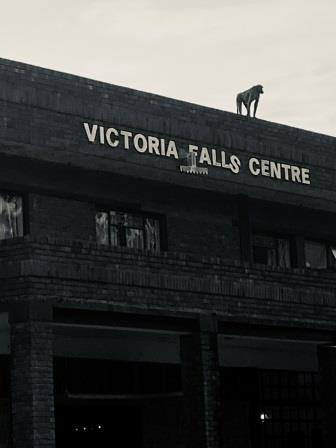
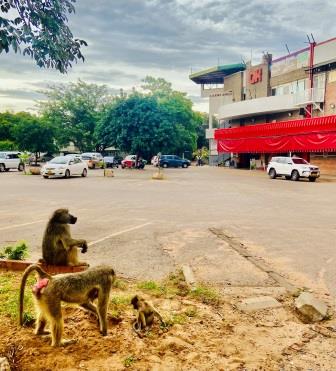
The next morning my affable landlord confirmed the stories. Only last year a guy had died after being trampled by an elephant in the centre of town. “You should be safe until 9pm though”, he assured me. In the end, the only wild animals I encountered were baboons in and around the town centre. There seemed to be far more of them than visitors.
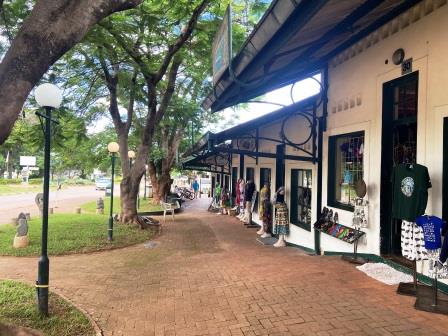
Victoria Falls (population: 35,000) was pretty enough with lots of greenery and verandas, but I found it quite a depressing place. That was not actually much of a surprise to me. I walked around past empty restaurants, souvenir shops and places pushing helicopter rides, day safaris, controlled encounters with lions (presumably before 9pm) and snake displays.
Mixed in with all of this were guys on the streets who seemed to specialise in pushing either old Zimbabwe billion dollar notes or small statues of animals. There were at least twenty of them in the centre, but apart from me with my polite refusals, there were no potential customers to be seen.
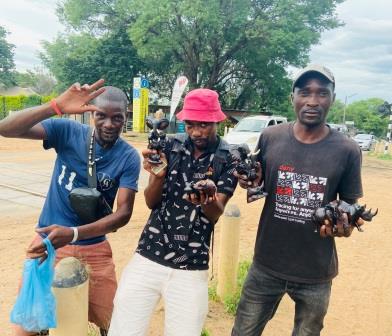
I got chatting to some of them and they turned out to be really nice guys. They knew the tourist industry was rigged against them. Most people visited on safari packages and stayed in the expensive places out of town. The money went somewhere else and nothing much trickled down to the locals. They explained that the town needed more jobs, proper jobs and preferably industrial jobs. It seemed to make sense to me.
The Station
I wandered over to Victoria Falls station. The railway reached here in 1904, having been extended from Wankie (Hwange). Attracting tourists to the falls was obviously the aim from the start, and the famous Victoria Falls Hotel was opened by the railway company the same year. It still stands opposite the station and now charges more than £400 a night for a room.

The station was, as I had expected, deserted. At least there was no one to stop me exploring, and I walked out onto the empty platform. There was a line of container wagons stabled in the centre road, but it did not look as if it was moving anywhere soon. The sign on the platform, “no passenger trains” said it all. I felt sad to think that up until a few years ago I could have been alighting here after an overnight trip from Bulawayo.

Another sign on the platform told me that I was now 451 km from Bulawayo, 2651 km from Cape Town and 1434 km from Beria. Interestingly, there were no distances from the north. Whilst trains from the south have only been suspended relatively recently, regular passenger trains linking Victoria Falls across the bridge into Zambia have not run for decades.

As I was leaving, I noticed a plaque to commemorate the visit of the famous South African Blue Train back in 1998, unveiled by Mugabe himself. I had seen one a few days before at Bulawayo and I wondered how many of them he had actually unveiled.

Around the Station
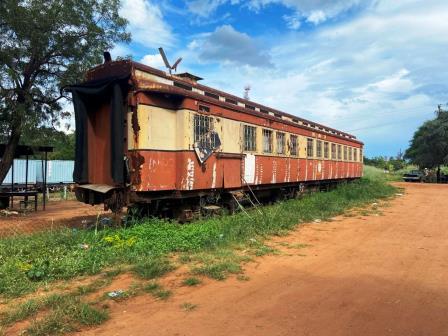
As I walked away from the station, I spotted an old passenger coach standing by itself on the other side of the tracks. I went for a closer look and got chatting with Michael, the friendly guy who was looking after it. He explained that a group of ex-railway employees had converted it into a restaurant to raise funds for themselves. I was sorry I had recently eaten as they had a neat little BBQ and were grilling chicken. I stayed and chatted for a half an hour and was given a little tour of the coach.
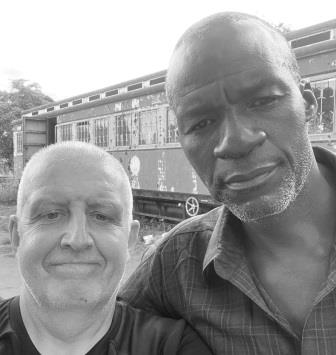
As I was leaving, Michael told me there was an old steam locomotive a little way down the track. As I set off in the direction he had indicated, he shouted with a smile, “it is buggered though”. A little way along the track I found 14A Class, 2-6-2+2-6-2 Garratt, No. 512 sitting in a siding. It was built at the Beyer Peacock Factory in Manchester and delivered to Rhodesia in 1952.

It was “buggered” though: some of the coupling rods had been disconnected and the smoke box door was hanging open. I clambered onto the footplate and found that it was being used as a rubbish bin. There were drink cans, plastic bottles and even training shoes strewn around the floor. It is amazing to think that even as recent as 1980 there were around 100 of these magnificent Garratt locomotives in service in Zimbabwe.

Michael had also confirmed something I already knew, there were regular tourist dining trains from the station to the bridge and sometimes they were steam hauled, the next one was scheduled at 17:30 the following day.
I returned around 24 hours later only to watch the three dining carriages being pushed out of the station by a small diesel locomotive. The train was not full but I felt sorry for anyone who had paid for dinner (around $200 a head) expecting steam. 
Chinotimba.
Although Rhodesia never had the official policy of apartheid that South Africa did, there were residential areas, usually characterised by poverty and lack of services, that were quite distinct from the white-dominated towns and cities. These townships, although sometimes renamed, still exist. The township adjacent to Victoria Falls is known as Chinotimba.
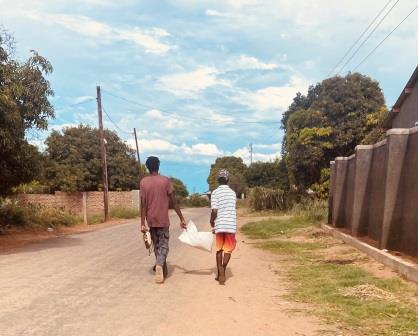
Chinotimba has a population of around 60,000 people. A few of the tourist agencies in Victoria Falls offered guided tours of the township, including visits to the schools and hosted dinners at local homes. To be fair, some of them did have very complimentary reviews on line.
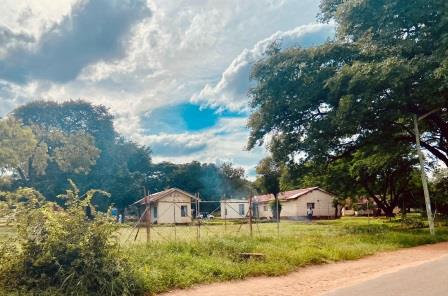
I decided to just have a walk around myself. I found the place easy to navigate and pleasant to walk around. A lot of the houses looked pretty well constructed, some of them were almost brand new. The local market was quite vibrant and relatively well stocked. They were offering grilled corn outside, but my attention was drawn to the Chinotimba Beerhall next door.
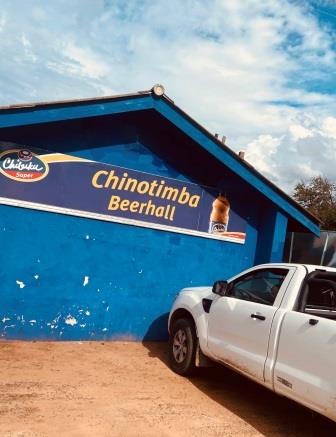
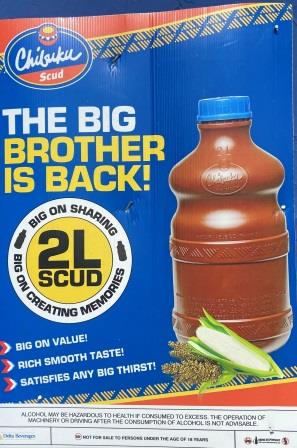
On a weekday afternoon the place was busy with people watching sport on the TV and playing pool. I stayed a while and got chatting with William; he was a Liverpool supporter and told me he was an artist. He introduced me to Chibuku, sorghum beer, which was originally from Zambia. There were adverts everywhere for the 2 litre “Scud” bottled (non-carbonated) variety. Apparently, the alcohol content depended on how long it had been on the shelf. I found it very palatable, to be honest.
Dinner
During my stay in Victoria Falls I tried “sadza” for the first time. Known as nshima in Zambia and ugali in Tanzania, it is a thick maize mash and was a staple in all the three countries on my itinerary. It is eaten with different side dishes and here I had it with another local speciality, peanut sauce with chicken.

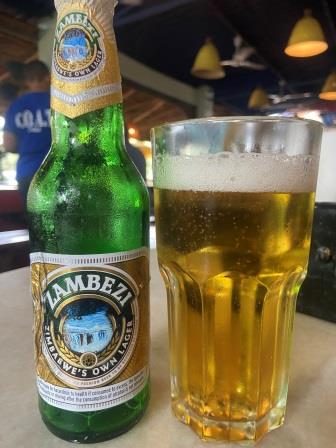
I was not a huge fan of the “white stuff” to be honest and tried to avoid it for the rest of my trip. Whenever I could I tended to substitute it for rice. I thought the local Zambezi lager was excellent though and I enjoyed several ice cold bottles of it during my time in Zimbabwe.
The Falls
I turned up at the entrance to the Victoria Falls National Park on my first afternoon and paid the 50 USD entrance fee that they charge all foreign visitors. I wondered how they set that fee. Could they have even charged more? I doubt many people who, having travelled thousands of miles to get to the entrance, would have just walked away.

In the end, I could not really say that the experience was not worth the entrance fee. I had visited Niagara forty years before, but this was something else, twice as tall and home to the largest curtain of falling water in the world. I spent about three hours inside the National Park, starting out at the statue of David Livingstone and then negotiating my way along the walking trail and pausing at a series of viewpoints.

There were actually several different waterfalls, each one with its own name. The one I came to first was the westernmost, narrowest (100ft) and lowest (220ft), the Devil’s Cataract. Standing close, the noise was almost deafening. It was easy to appreciate why the falls are known as “Mosi-oa-Tunya” in the local Lozi language. It translates as “the smoke that thunders”.

The view of the Main Falls, 305ft tall and 492ft wide, was probably the most spectacular. I was also enjoying the fact that I seemed to have the National Park trail all to myself, for the first hour of my visit I met no one at all.

There were warning signs at the viewing point for Horseshoe Falls. It did not feel dangerous at all, but there was only a very flimsy looking steel rope fence guarding a 330-ft sheer drop.

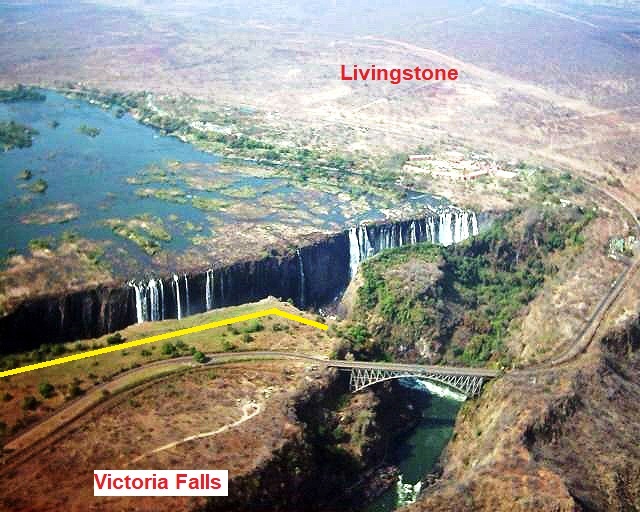
At the viewpoint for Rainbow Falls it was possible to see across into Zambia. There was a debate over whether it was best to see the falls from the Zimbabwean or the Zambian side. There were arguments both ways, basically you saw more of the falls on the Zimbabwean side but you were closer on the Zambian.

Finally, having turned away from the falls, the last viewpoint was looking across to the railway bridge. As I reached it I caught up with a Russian tour group. I waited until they had all gone before spending a bit of time looking at it by myself. Opened back in 1905, it still looks spectacular today.
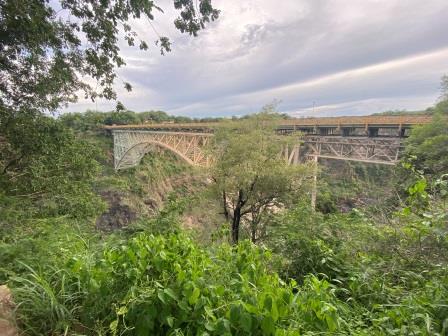
The bridge was designed by George Hobson and built by the Cleveland Bridge & Engineering Company. It was actually prefabricated in Darlington. An episode* of the popular 1970s ITV drama series Upstairs Downstairs suggested it was actually the work of Donald Hudson (close to Hobson, perhaps), brother of the famous butler at Eaton Place. As a child, I believed that theory.
Departure
I was not sorry to leave Victoria Falls but I did feel that I might like to return and see more of Zimbabwe someday. The exit post was just a few yards further on from the entrance to the falls. A short line of trucks was waiting to go through the barrier but otherwise the place was quiet. I went inside the immigration office and got my exit stamp.
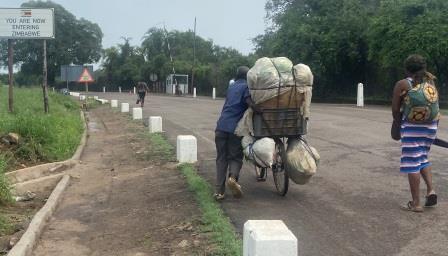
Then I proceeded into the kind of no man’s land that existed between the border post and the Zambian office on the other side of the bridge. As I walked there were still sellers approaching me to offer the last chance to buy a billion dollar note or a carving of a hippo. I walked a bit faster and by the time I got to the bridge they had disappeared.

The bridge was originally built for a single track railway, but the deck was raised and widened in 1930 to accommodate a single carriageway for vehicles. The road went on one side and the railway on the other. Each side also had a small footpath although the southern one was blocked in the middle by the hut used by a bungee jumping company. As I began to cross there was no one around.

When I reached the midpoint of the bridge I looked down at the swirling waters of the Zambezi far below and then all the way across to Rainbow Falls in the distance. On the left I could see the place from where I had viewed the bridge a few days before, on the right was where I was headed next, Zambia.

* Upstairs Downstairs, Series 2, Episode 7, “Your Obedient Servant”, First broadcast December 1, 1972.

 Trains To Beyond