To Pocinho (Linha do Douro)
My next trip involved taking an Inter-regional train from São Bento all the way to the end of the Douro Valley Line at Pocinho. Billed as one of the most scenic railway lines in Europe, the Linha do Douro (Douro Valley Line) follows the river for around 100km of its length between Mosteiro and its terminus. The line officially starts at Ermesinde just north of Porto and most of the trains that use it begin their journeys at Porto.
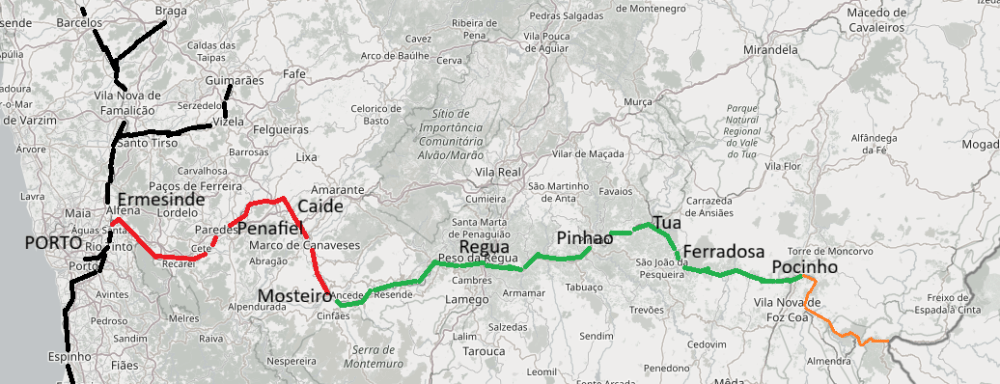
Although many Douro Line trains start at Porto Campanha, a few of the Inter-regional services start back at São Bento, including the one we were intending to catch at 8:20. The train was heading for Pocinho and was scheduled to take about three hours and twenty minutes.
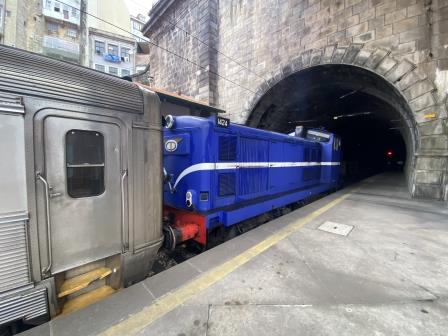
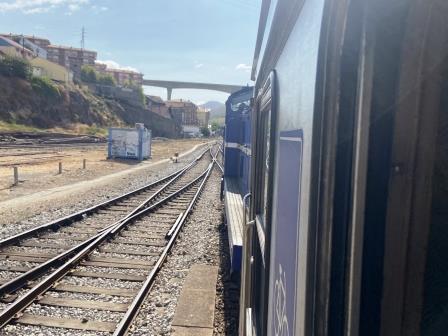
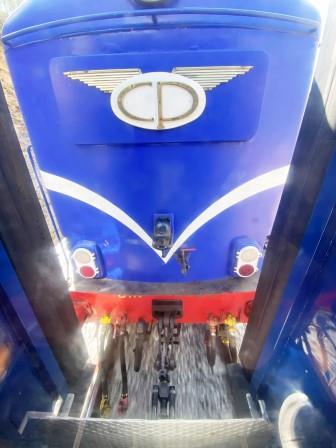
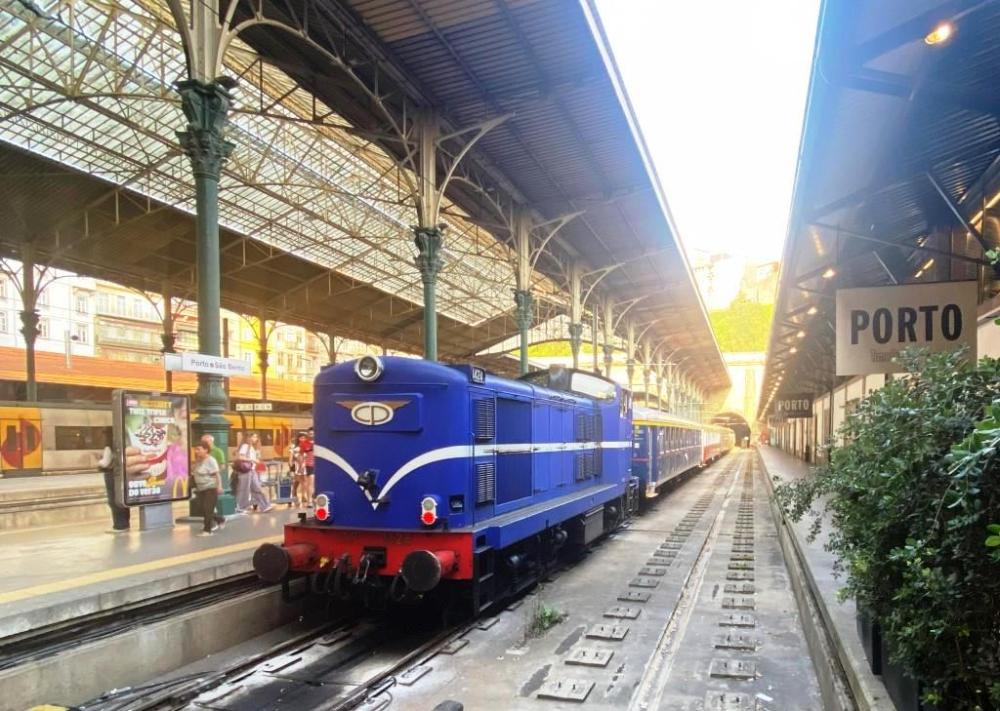
The majority of the line is still not electrified, so this means that diesel traction is in use. The locomotive at the head of our train was a Class 1400 dating from the late 1960s with its origins in the UK. 67 of these machines were supplied to CP, with the first 10 being built at English Electric, England and the rest at Sorefame, Portugal.

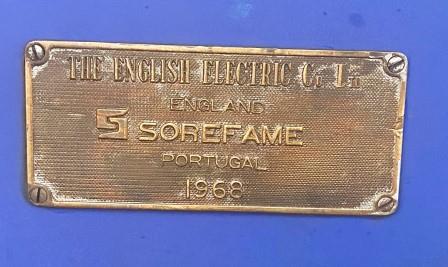
Many of the 1400s have been scrapped, exported to Argentina or are now working for Portugal’s freight company, Medway, but CP retains about ten of them and they are regular performers on the Douro Valley Line with a few being turned out in their original dark blue colour scheme like the one at the head of our train.
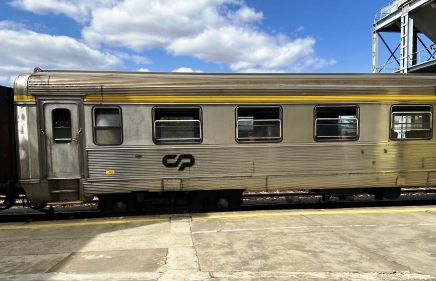
The train itself comprised of two stainless steel coaches of typical Portuguese (Sorefame) origin and two Swiss-built Schindler carriages dating from the late 1940s. None were air conditioned.

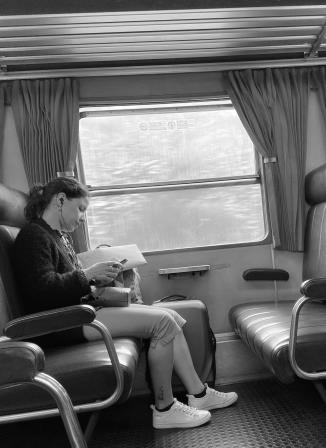
We chose to sit in the carriage at the front, largely because it had yet to fill up with passengers. The rest of the train was relatively busy and expectedly there were many tourists on board. Not everyone seemed to be on holiday though, there were also a few locals travelling.
The River
The train set off on time and after passing through Campanha headed north as far as Ermesinde where we paused briefly before branching off to the east to make a 60km arc initially staying away from the River Douro.

Here the line was double track and electrified. We were sharing the tracks with the yellow Urbano trains of the Porto system and speeding through most of the stations where the electric trains stopped. At 9:04 we paused at Penafiel (37km) the point to which the line first opened back in 1875.

We continued on to pause at Caide (46km) at 09:13. The line to here was opened in September 1878 and this was where the double track gave out. At Marco de Canaveses (09:33) the electric wires ended after 59km. The station is served by an hourly Urbano from São Bento.
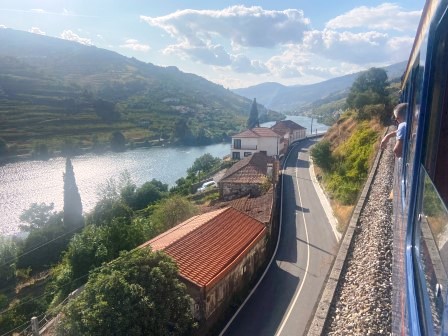
We passed through a long tunnel, and then after a few more minutes finally met the River Douro at Mosteiro (09:48). We started off high above it but gradually descended to its level. For the next 100km, for almost two hours, we would stay close to the river, most of the time on its northern bank.

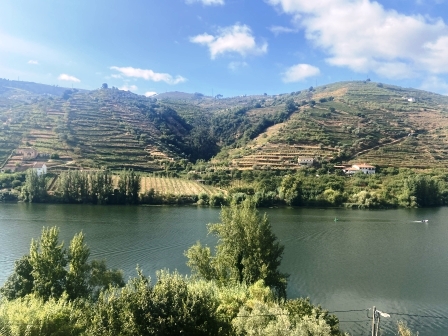
Already the vineyards on the slopes of the opposite banks could be seen. The Douro region was the first in the world to be formally designated as a demarcated wine region in 1756.
Regua and Pinhao
At 10:24, just over two hours into the journey, we pulled up at the large town of Regua (103km). The line reached here in July 1879 and there were a lot of sidings; some of the Inter regional and many of the regional trains terminate here. There are plans to extend electrification to Regua in the future.
We were joined by a lot of passengers; it seemed that some of them were part of large tour groups and as the train set off again one of their guides stood in the aisle and started to explain things.

Listening in to the commentary was interesting. The climate here was Mediterranean, and the long hot, dry summers and mild winters made it perfect for growing grapes. The sun-drenched hillsides we could see out of the windows provided the ideal conditions for creating world-class wines.
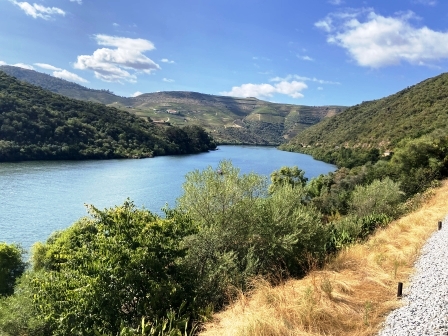
The wine estates were called ‘quintas’ and whilst many of them produced regular wine, many were also involved in creating Port Wine. By definition, ‘Port’ couldn’t be labelled ‘Port’ unless it was produced from Douro Valley grapes.

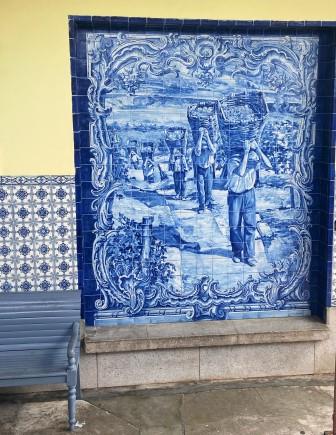
We reached Pinhao at 10:48. This is the centre of the Douro Wine industry and a popular overnight spot for tourists. Pinhao’s station is famous for its Azulejos showing scenes of wine production.

The line to Pinhao (126km) opened in June 1880 and at one time it had been envisaged that this would be the terminus. After construction began, however, the plan was changed and the decision was made to continue construction east and link to the Spanish border.
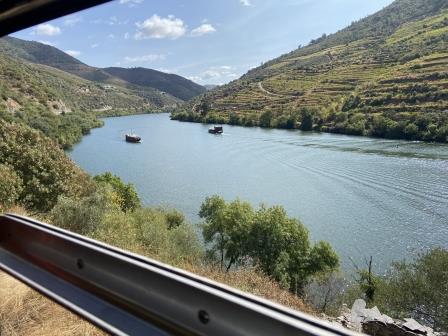
The population of Pinhao is only around 600. Naturally, tourists increase that in the summer months and in the autumn wine picking season when people come to help from all over the country.
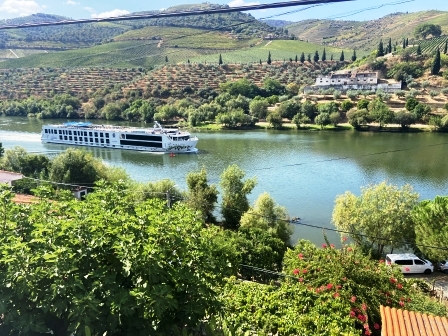
The arrival of the railway meant the end for the traditional ‘Rabelo‘ boats which used to transport wine down the river to Porto. That job has now been passed from the railway to tanker trucks. These days the river is busy with boats transporting tourists.

After Pinhao we continued along the side of the river, by now the number of people on the train had fallen and as the temperature rose, everyone started to pull the windows down. The lack of air conditioning now seemingly a blessing.

Upstream
We arrived at Tua (139km) at 11:04. The line opened to here in 1883 and then took four more years to make any further progress eastwards. As we left, I noticed that there were hardly any passengers left on board, maybe six in our carriage at most.
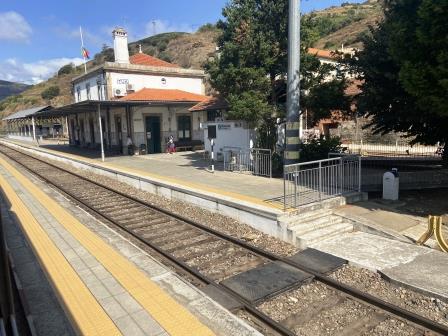
The river scenery changed, the sides of the valley got a bit steeper and more rugged. Beyond Pinhão, the line felt increasingly remote, with fewer signs of civilisation but even more dramatic views.
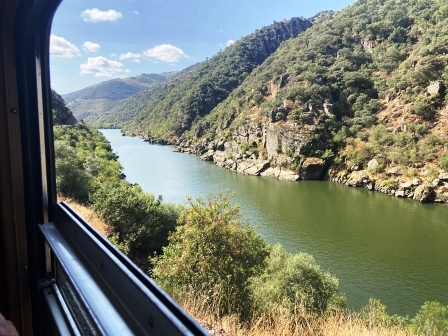
A few kilometres further on there was a dam, we passed to the left of it in a tunnel and then emerging on the other side, the dammed river changed character again.

The river narrowed, and sheer cliffs rose up on either side. This is considered the most beautiful part of the line, so it was odd that so many people had chosen to miss it.
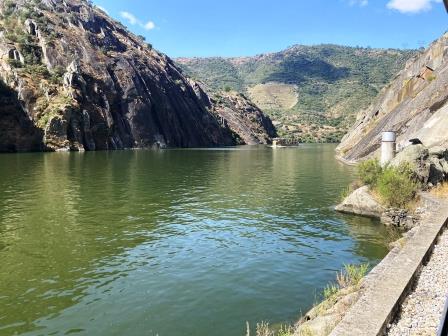
We finally crossed the Douro. Now on the southern bank, we soon paused at Vargelas to wait for a train heading in the opposite direction.
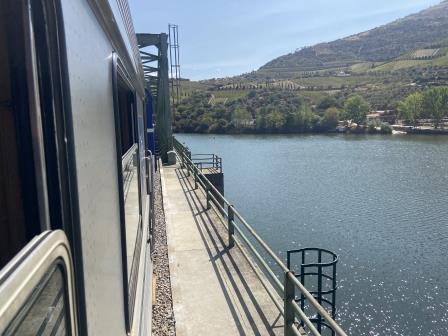
The Pocinho to Campanha service was formed by a Class 592 diesel railcar set, originally operated by the Spanish from 1981, these units were transferred to CP and have worked on the Douro line since 2011.

We continued on for the last few kilometres. There were certainly fewer cruise boats on this part of the river, but just before we headed into the last tunnel on the route, I spotted one in the distance.

Pocinho
We trundled to a halt at Pocinho (171km) right on time at 11:55. The schedule of three hours twenty minutes for just over 100km might not have been taxing, but I was still impressed at the timekeeping given the age of the motive power.

The railway reached here in January 1887 but was soon extended another 28km onwards to Barca d’Alva (199km). The station felt as if time had stood still. Out on the platform were blue tiles which depicted local scenes of the wine harvest and inside the booking hall was an ancient clock and old weighing scales.

Only about twenty people descended from the train. A few, locals perhaps, disappeared quickly into the village but the rest of us started to drift away slowly. The little bar opposite the station was open but did not look too interesting.
We walked down to a level crossing with the abandoned line and looked along the tracks to the east. In 1984, Spanish operator RENFE announced the closure of the line on its side of the border. In 1988 CP then decided to cut the line back to Pocinho.
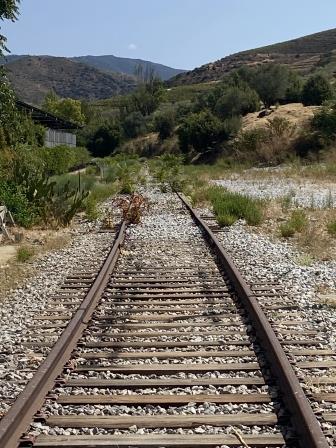
There was a sign to a restaurant close to the level crossing and we followed it to the Taverna da Julinha, a lovely little place where we, and most of the other people from the train, had lunch.

All our fellow tourists were Portuguese and we sat with a couple from Porto who ran a jewellery stall at the market. We enjoyed a wonderful set meal of wild asparagus omelette, homemade sausage and incredibly succulent Mirandesa beef.

The Old Metre Gauge
Pocinho was once a junction for the metre gauge line to Duas Igrejas. There were photographs of the old railway on the walls of the restaurant and after lunch we climbed up to the abandoned viaduct nearby that it used to use to cross the Douro.

The track here was still intact and we walked back along it in the opposite direction towards Pocinho station.
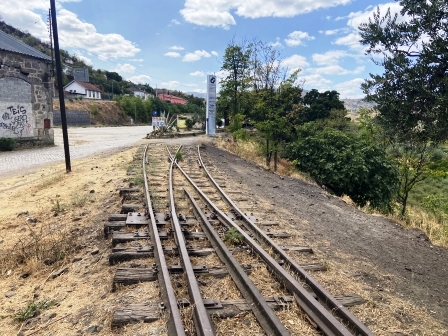
Here, the old locomotive shed, closed in 1988, was still standing, with bits of track running up to the doors. Apparently plans are afoot for turning the old building into a railway museum.

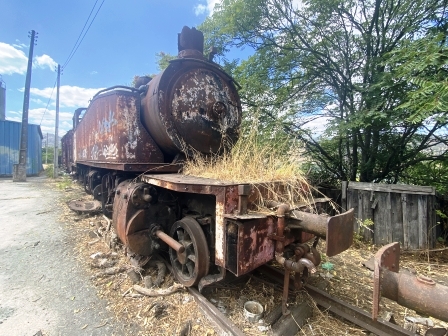
In the middle of the old yard, now being used by a cement company to store its products, we found E213, a Henschel 2-4-6-0T locomotive built back in 1923.

The Duas Igrejas branch was one of four metre gauge lines that used to connect with the Douro Valley Line. Shown in blue on the map below, the four, now defunct, branches each linked to the Iberian gauge line, shown in green, and were separate from one another.
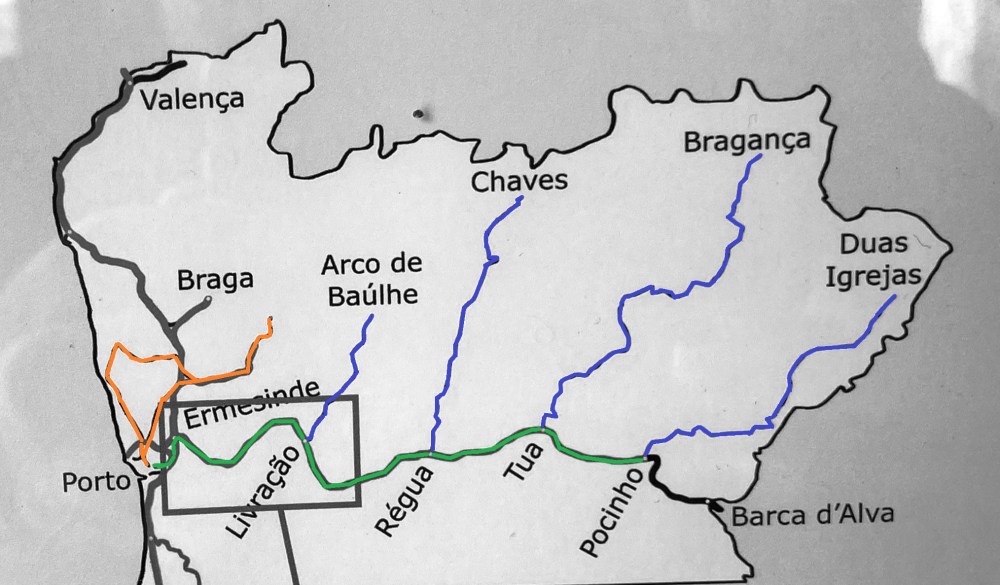
A separate metre gauge network operated in and around Porto and is shown in orange above. It is also defunct although parts of it have now been turned into the Porto Metro and other sections have been converted to Iberian gauge.

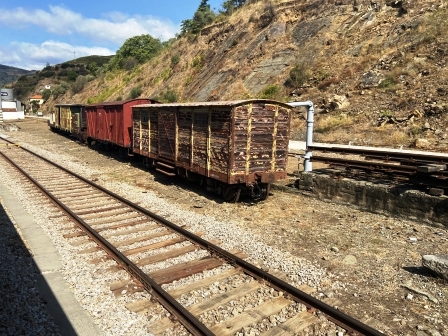
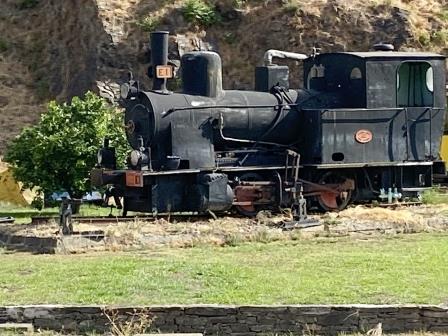
Along the Douro Valley, there was still plenty of evidence of the existence of the former system. There were coaches at Tua (above) for example, and we observed Henschel 2-4-6-0T, E208, at Regua.

Also on display at Regua was E1, a 0-4-0T another Henschel-built engine and dating from 1922 was often used for shunting.
The Journey Back
When we returned to the station, we found a guy minding the tourist information desk. He could not sell me a ticket back, but he told me I could buy one on the train.

Whilst we had been eating lunch, another service had arrived from Campanha, turned around and departed back there. Meanwhile the train we had arrived on was still waiting at the station ready to form the 15:12 service back to São Bento.
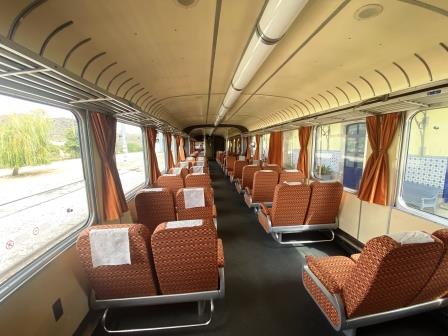
For the return, we chose to sit in the Schindler coaches at the front, enjoying the more comfortable seats and larger panoramic windows.
Initially, the service back from Pocinho was as empty as the trip out had been. There were only around seven of us in the carriage, which meant there were enough windows for everyone to look out of.

We paused again at Tua but only after Pinhao did the train begin to fill up and by the time we were leaving Regua there were no empty seats left.

We were back at São Bento just before 7pm. Whilst it would have been interesting to alight at some of the intermediate stations and explore more of the Douro Valley, this first trip had been a great introduction. Certainly, one of the most scenic rail journeys I have made for a while.
Metre gauge museum at Lousado…. By Urbano
 Trains To Beyond