A lot has been written over the years about the history of the London termini, Euston and St Pancras. This is my own modest account. It focuses on the different ways the stations evolved and how their stories often intertwined with one another.
Introduction
The story of how St Pancras came to be built, why it declined, how it was threatened and why it was ultimately saved is intricately connected with the history of Euston. Here is a brief look at how the London to Birmingham Railway grew into the LNWR and how Euston was once the sole gateway for the north. How, later, the Midland Railway grew from a provincial network and was frustrated in its attempts to involve Euston and other termini in its access to the capital and was forced to create its own station at St Pancras.

North From Euston – The LNWR
The London & Birmingham Railway (L&BR) was the second railway in London (after the London and Greenwich line from London Bridge) but it was the first inter-city line and the first link with the north. It opened its Euston terminus on 20 July 1837 exactly one month after Victoria ascended to the throne.
The first section of the railway up to Boxmoor (near Hemel Hempstead) opened at the same time as Euston, with an extension to Tring following in October. In April 1838, the line reached Denbigh Hall near Bletchley from where a horse-drawn road service linked to Rugby and another section of line completed south from Birmingham. The whole 112 mile route was opened to traffic in September 1838.
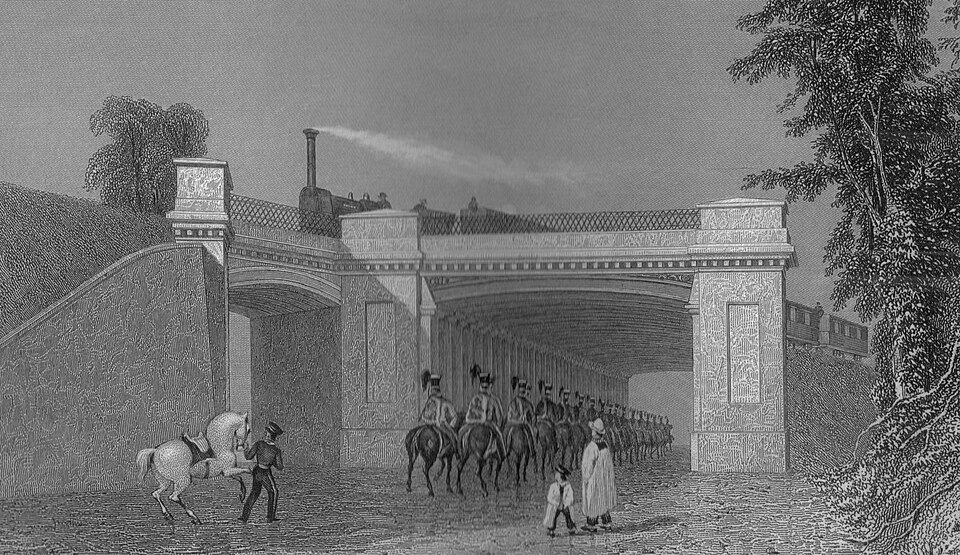
The L&BR originally bypassed Northampton, not because of protests by locals as is often cited, but for topological reasons. Constrained by the performance of the locomotives of the 1830s, the line followed an easier path through the great Kilsby Tunnel to the west of the town.
Over the next few years, several branches were built by various companies linking to the main London and Birmingham Railway including to Aylesbury, Leamington, Derby, Leicester, Dunstable and Bedford. Northampton got its own rail connection on a line heading to Peterborough in 1845.
From the outset, the L&BR connected at Birmingham with the Grand Union Railway which linked northwards via Stafford and Crewe to Earlestown near the midpoint of the Liverpool and Manchester Railway. The North Union Railway ran from this area on to Preston and from there a line was opened to Lancaster in 1840 and eventually Carlisle in 1846. The Trent Valley Railway created a line in 1845 linking Rugby and Stafford via Lichfield and bypassing Birmingham offering a shorter route between London and the north.
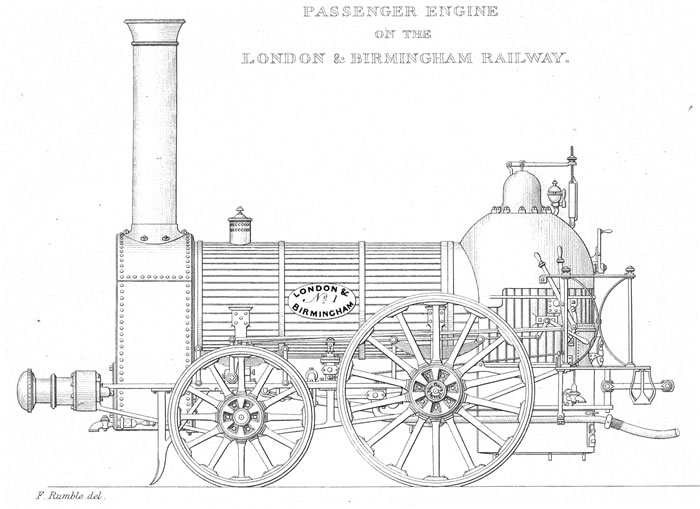
Today’s West Coast Main Line to Carlisle was thus created within ten years of the first train leaving Euston for Birmingham. All of the companies were merged to form the London & North Western Railway (LNWR) in 1846. With its headquarters at Euston, the LNWR became one of the largest and most powerful railway companies in Britain.
When the LNWR quadrupled the line between Euston and Rugby in the early 1880s, it chose to route the second pair of lines via Northampton and created what is now known as the Northampton Loop. The Loop diverges from the main line at Roade, north of Wolverton and rejoins it just south of Rugby. Sadly, the time penalty created by the divergence meant that Northampton never became a stop on many of the express trains heading north.

Euston for everywhere ?
Before the opening of Kings Cross in the early 1850s, Euston was the only terminal for the north. There is an argument that the station could have coped with even more destinations than it eventually ended up with. A more planned approach to the construction of lines could have rendered St Pancras and even Kings Cross unnecessary.
One of the features of the British railway network is that it was never centrally planned. The governments of the 19th century adopted a laissez faire attitude to railway companies and allowed them to build competing lines that often duplicated each other.
If a more planned and logical approach had been taken, as happened in some other European countries, it is likely that the track mileage needed to cover the country would have been less and it is also possible that there may have been fewer closures of redundant lines in the 1960s.

In his excellent book, The World’s First Railway System: Enterprise, Competition, and Regulation on the Railway Network in Victorian Britain, Mark Casson, a professor of economics at the University of Reading, led the academic argument that the railway network was deeply flawed due to a lack of centralised, rational planning.


This is partly borne out by the initial growth of the network itself. Ending up with more than ten termini in London was not inevitable. A planned approach could certainly have meant that Euston served more destinations permanently.
One of the earliest lines constructed from the L&BR was from Rugby to Leicester, eventually operated by the Midland Railway, it offered links on to Nottingham, Derby and ultimately to Sheffield, Leeds, York and Newcastle. By 1845, travellers could leave Euston and, by changing at Rugby, reach many of the towns that were subsequently served from St Pancras and Kings Cross.

Changing between companies at Rugby was never ideal though, and Charles Dickens, a frequent early rail traveller, wrote a series of stories about ‘Mugby’ Junction, critical of the arrangements. The problem was, in the end, the inability of the various railway companies to coordinate together and the lack of any overriding political will to direct them to do so.
This all contrasted sharply with the planned approach taken to the creation of the M1/M6 motorway network in the 1960s and also to the original planning for the high speed HS2 line in the 2010s. The design of both systems featured the same concept of a single main route from London bifurcating into Birmingham/Manchester and Nottingham / Leeds branches as the original railway in the 1840s.

South to St Pancras – The Midland Railway
The lack of a strategic network plan led inevitably to the construction of the Midland Main Line from Leicester all the way down to London and the building of St Pancras station itself.
The Midland Railway was formed in 1844 and was based in Derby. It was a merger of three companies whose lines converged on the town. The Birmingham and Derby Junction Railway whose first line (#1 on the map below) ran to a junction with the L&BR at Hampton-in-Arden, The Midland Counties Railway who created a shorter route to the L&BR from Derby, and also from Nottingham, via Leicester and Rugby (#2 on the map below) and the North Midland, whose line went north to Leeds.
Although the Midland grew through mergers and by the 1850s it stretched south west to Gloucester, it remained a provincial railway with no London station of its own. It was still reliant on feeding the lucrative traffic bound for the capital through its connection with the LNWR at Rugby.

In 1857 it opened a line from Wigston (just south of Leicester on its Rugby line) through Market Harborough and Bedford to Hitchin (light blue – #3 on the map above) and a connection with the Great Northern Railway (GNR) and its new line from York and Peterborough into Kings Cross which had first opened in 1852.
Whilst this reduced reliance on the LNWR at Euston, it was still not a satisfactory solution and following capacity problems particularly around the time of the Great Exhibition of 1862, the Midland decided to create its own line from Bedford into a new station at St Pancras (#4). The line via Luton and St Albans finally opened in 1868.

St Pancras (1868)
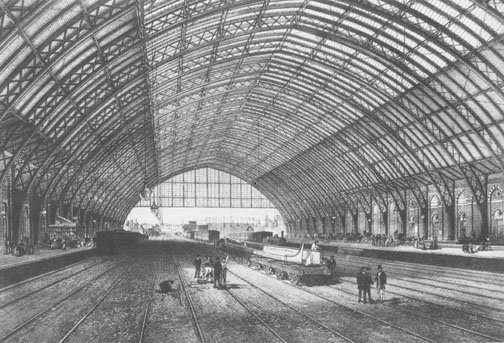
The Midland Railway opened the station, designed by William Barlow, on 1 October 1868. The Midland Grand Hotel in front of the station opened a few years later in 1873. It was designed by Sir Gilbert Scott in Gothic Revival style.
The 1870s and 1880s were the beginning of a time of expansion by the Midland Railway as it opened a new, direct railway from Chesterfield to Rotherham through Sheffield and routes in competition with the LNWR to Manchester and also to Scotland after the building of its Settle and Carlisle line.
Nevertheless, St Pancras was never very busy with Midland Railway services and other railways were invited to use it as well. The Great Eastern Railway (GER) used the station as a ‘West End’ terminus for certain services, including those to Cambridge, between 1870 and 1917, whilst through services were operated to Southend, long before the Midland formally purchased the London, Tilbury and Southend Railway (LT&SR) in 1912.

Decline at St Pancras
When the Midland merged with the LNWR and other railways in 1923 to form the London Midland and Scottish Railway (LMS) Euston was adopted as the new company’s principal London terminus. St Pancras fell into a relative decline with fewer services. Meanwhile, the Midland Grand struggled with high operating costs and lack of modern amenities (en-suite bathrooms) and was closed in 1935; the building was subsequently used as offices for British Railways.

Although the fortunes of the station were briefly revived after nationalisation in 1948, by the 1960s, St Pancras was seen as redundant, and several attempts were made to close it and demolish the hotel (by then known as St Pancras Chambers). Meanwhile, attention shifted to what was happening at Euston.
Demolition at Euston
Euston had grown piecemeal over the 19th Century. The Great Hall opened in 1849 and then more platforms were added a few at a time over the next fifty years. By the turn of the century the terminus had 15 platforms, 14 for passengers and 1 for parcels.

Faced with growing congestion in the 1930s, the LMS drew up plans for the station’s redevelopment and in 1937 it appointed Welsh architect Percy Thomas to a come up with designs. The resulting proposal was for an American-influenced station which would have meant demolishing the Doric Arch and perhaps rebuilding it on the Euston Road. The project was shelved as a result of the Second World War.

The project for redevelopment was revived after plans to electrify the lines to Birmingham, Liverpool and Manchester was launched in the late 1950s. The restrictions of the layout meant that the redevelopment had to make use of the land occupied by the Great Hall and the Doric Arch. These were demolished in 1962. As in the 1930s, the idea of rebuilding the Arch elsewhere was proposed, but in the end was dropped.

Whilst it is true that 1960s architects often viewed Victorian buildings with contempt, regarding them as obstacles to progress, it should also be remembered that the demolition at Euston was seen as very necessary for the future functioning of the station. The entrance to Platforms 8-11 was built close to where the Doric Arch had been, and the platforms themselves where the old Great Hall had once stood.

The proposal for demolition of the Euston Arch and Great Hall sparked a battle led by figures like John Betjeman, Nikolaus Pevsner, and Woodrow Wyatt. Protesters also included the Georgian Group and Victorian Society. Although ultimately unsuccessful the battle at Euston influenced the later one at St Pancras.
Euston for Leicester ?
By the mid-1960s with the need for British Railways to cut its losses, the issue of unnecessary duplication of lines came into sharp focus. As the bulk of the investment was going into the lines from Euston, it was thought that competitive services could be downgraded. Trains from St Pancras to Manchester had been cut in 1966 and the idea of serving Leicester from Euston was a logical next step. The proposal to use the Northampton to Market Harborough line came in the same year.

The basic premise was that all suburban services from Bedford and stations south going into St. Pancras would be transferred to Moorgate using the City Widened Lines (first opened in the 1860s) via Farringdon.* A semi-fast service to Leicester would also operate from Moorgate to serve stations between Bedford and Market Harborough. InterCity services would then be transferred away to the new Euston leaving St Pancras to be closed and demolished.

The rescue of St Pancras station in late 1967 and its Grade One listing put paid to the whole scheme. Although it is likely in the late 1960s capacity restraints at Moorgate, particularly before the closure of the Kings Cross Suburban access to the Widened Lines in 1976, were a big factor in the plan not moving forward.

There was one exception though, a small glimpse of what might have been. The 1969 withdrawal of sleeper services from St Pancras meant that one Scottish overnight service did follow the proposed route. The train left Euston for Northampton at 21:00 and then, after changing traction, followed the line to Market Harborough and then to Leicester, Nottingham, Sheffield and Glasgow. It followed the same route in reverse, arriving at Euston at 09:00. In 1972 the sleeper was recast to run only between Nottingham and Glasgow.
*This actually happened in 1983 with electrification to Bedford with trains to Moorgate and eventual operation onto the Thameslink network and destinations south of the Thames.
St Pancras Saved
The impact of Euston being permanently lost galvanised John Betjeman and Jane Hughes Fawcett of the Victorian Society to push harder for the preservation of St Pancras. In November 1967, the station was granted Grade I listed status, giving it legal protection against demolition.

To be fair, the reasons behind the plans for the demolition of St Pancras were the polar opposite of those at Euston. The station was seen as potentially redundant and in that sense its closure was separate from its destruction.
Unlike Euston, where the old station had to be removed to allow the new one to grow. St Pancras could simply have been closed and retained for a different purpose, as happened at Manchester Central with its successful conversion into an exhibition centre.

In the 1970s, the train shed roof was in danger of collapse, and the newly appointed Director of Environment Bernard Kaukas persuaded the British Railways Board to invest £3 million to save it. Although the station was saved, it did not immediately regain prominence. For several decades. St Pancras remained in use but was relatively neglected compared to other major London stations.
The electrification of the suburban line from Bedford in 1983 to Moorgate and the reopening in 1988 of the Snow Hill tunnel to create the Thameslink route meant even fewer trains were using the terminal.
HS1 at St Pancras
Everything changed when plans to terminate Britain’s first High Speed Line (HS1) at the station in the early 21st century were announced in 1994. Having struggled to find enough traffic to justify its existence for most of its life, St Pancras had finally found a proper role.

In 2004, the Barlow train shed was finally closed to Midland Main Line services after more than 130 years. Trains heading to Leicester, Derby, Nottingham and Sheffield then used the newly completed eastern extended train shed (now used by Southeastern HS1 trains) until their permanent home, the western extended train shed, was opened in 2007.

In 2007, with the completion of HS1 from the Channel Tunnel, St Pancras became the London terminus for Eurostar, connecting the UK with mainland Europe. The St Pancras Renaissance London Hotel was opened in the same year. The total rebuilding cost was in the region of £800 million, against an initial estimate of £310 million.

HS2 at Euston
Encouraged by the success of HS1, the Government announced HS2, linking London to the North, in 2009. The initial plans called for a new station at Euston that would eventually handle ten high speed trains an hour. Ten platforms would have been constructed, six initially on a new site to the west of the 1968 station, and then four more converted later from space taken from the current station itself.
The original plans called for the demolition of the 1968 concourse building (which is not listed) and a grand new station covering all the conventional and new high speed lines built in its place. An often-mentioned idea was for the new station to incorporate the old Euston Arch. Two-thirds of the original stone blocks have been recovered and are now in storage.
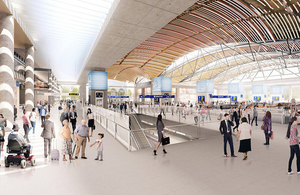
With Phase 2 of HS2, the extensions to Manchester and Leeds, now permanently cancelled, the project for Euston has been scaled back. Despite hundreds of millions of pounds being spent and years of political wrangling there is still no agreed plan in place. In October 2023 the government decided that HS2 Ltd would not be building the station, it would instead be funded through a public / private investment vehicle.

The new buzz word for the area around the station is “Euston campus”. Details for the station itself are sketchy. There will be just six new platforms and a new concourse will be built over them. The 1968 part of the station will be modernised to improve passenger flow and address overcrowding. There is no word yet on whether the Arch is coming back.
Whatever the new design is, we are in for a long wait. HS2 services on the initial section to Old Oak Common may be running sometime between 2036 and 2039. Euston itself might open as early as 2040 but could be delayed until 2043.


