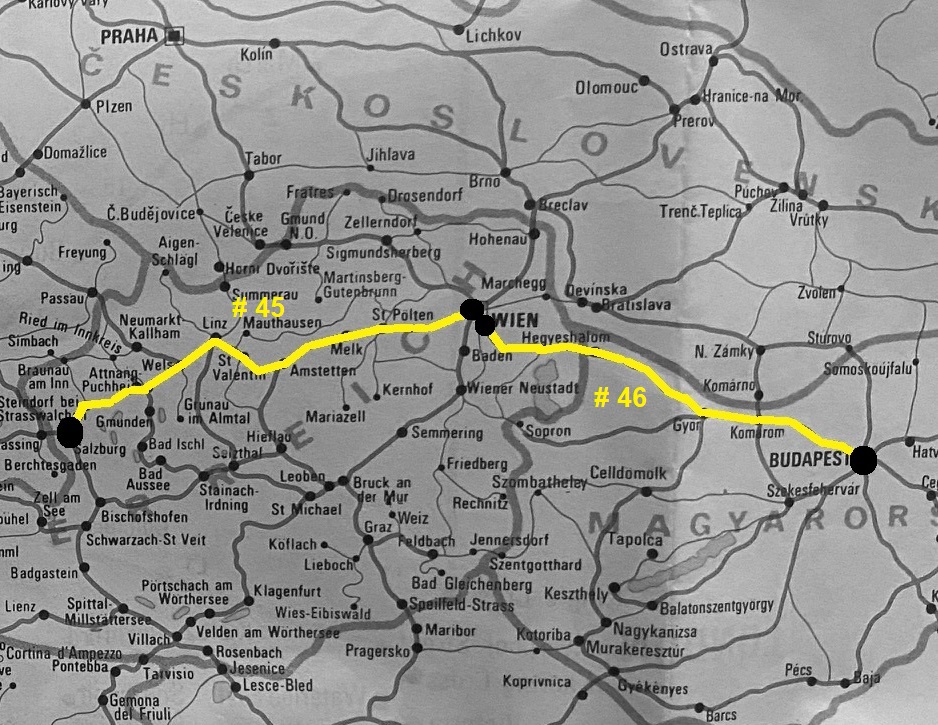
TRAIN #45 – 01:45 Salzburg to Vienna Westbahnhof
The 01:45, a Stuttgart to Vienna express, appeared on time. We were in luck again as we got an empty compartment. The curtain was broken and there was the sound of glass bottles rolling up and down the corridor but otherwise it was fine. I slept intermittently but was woken up at 06:10 by the ticket collector. We had arrived back in Vienna.
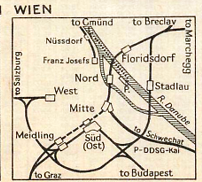
We scrambled out of the station passing lots of guys selling newspapers to the early commuters. At the tram stop we fed our carefully preserved 36 schillings into the machine and were rewarded with two tickets. A tram turned up within a few minutes.
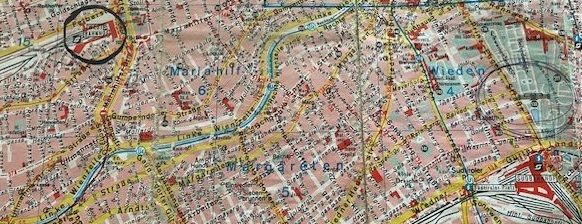
TRAIN # 46 – 07:45 Vienna Südbahnhof: to Budapest
We made it to the SudBahnhof and onto the 07:45 Budapest departure with time to spare. The train, named ‘Lehar’ after the musician, was made up of Austrian OBB and MAV (Hungarian State Railway) stock. It would be hauled, at least to the border, by another OBB Class 1044.
We thought we had found an empty compartment and settled down, only to be thrown out by a pair of French women who insisted they have reserved the window seats. We were doubtful but luckily the next compartment was still free and we took it.
Within forty five minutes of leaving Vienna, we had had the Austrian passport check and were heading towards the Hungarian one. The train stopped for 30 minutes at Hegyeshalom whilst it was carried out.
Although we had passed through East Germany and glanced over the Berlin Wall, Hungary was the only communist country that we planned to visit. In a strange sort of way I was really looking forward to our brief trip behind the Iron Curtain.
The Hungarians were strict, akin to the East Germans. The passports were ruthlessly examined and a rigorous check of the compartment was conducted. They went under the seats and above the roof rack with torches. This was just to get into Hungary; it had to be worse getting out.
Thinking the whole thing was over, I went down the train to the restaurant car to get coffee. The next thing I had a customs official come up to me and order me back to the compartment. He made me leave the drink on the counter and pretty much dragged me back. Another search of my luggage ensued.
When we got going again I went back to the restaurant car and drank the cold coffee whilst watching Hungary out of the window. I was no expert but I thought the agriculture looked a bit primitive. This was haymaking season and there seemed to be little mechanisation in the fields.
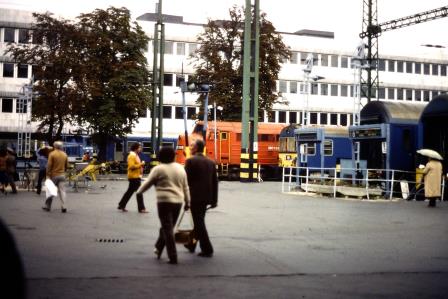
The train seemed to be continuously using its horn, possibly to warn cars at level crossings All or nearly all of the cars I saw waiting seemed to be Ladas or at least they were Lada-shaped. The settlements we were passing certainly seemed to be a lot poorer than the ones back in Austria. At 11:15 we arrived on time at Budapest Deli.
BUDAPEST
Deli station looked pretty bleak. We walked around for quite some time trying to find the left luggage. We went to the tourist information centre and waited whilst an American got himself fixed up with accommodation. We eventually got a map and directions to the end of long queue for the luggage store. The place was run by an elderly couple and they were slow and quite bad tempered.
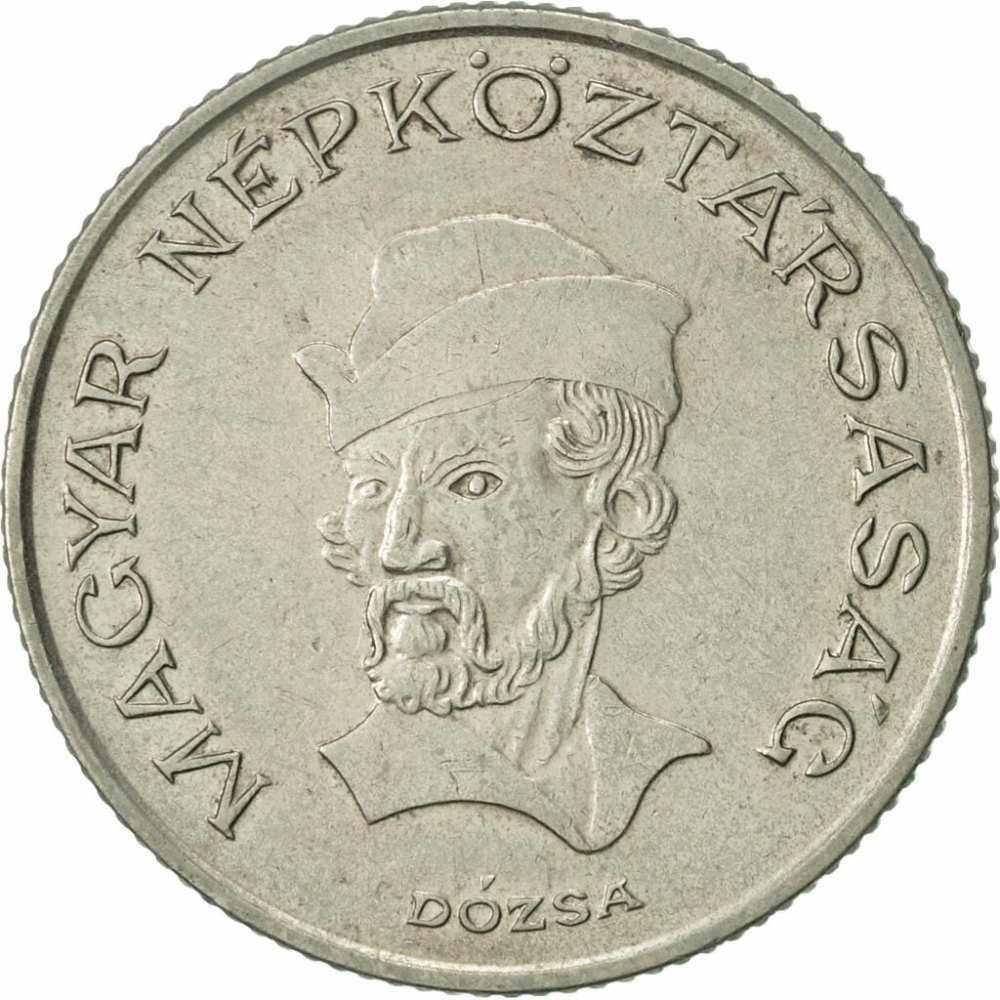
We couldn’t find any way of buying a ticket for the tram outside the station and the people didn’t seem to be able to understand us. In the end we rode for free. We got off the tram at Moscow Square. We had a walk around and bought a hamburger for 25p and a coffee for 7p. We were rich. The £10 we had changed in Vienna would go a long way.
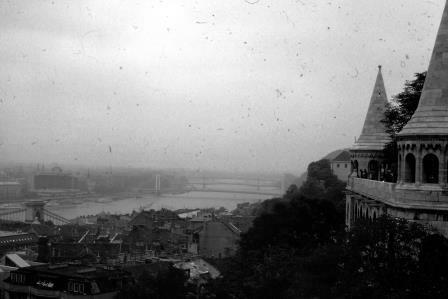
We walked up Castle Hill past the Hilton Hotel to the battlements of the city of Buda from where we looked down across the Danube on Pest. We toured the church and descended to the Art Gallery where we spent some time with the paintings.
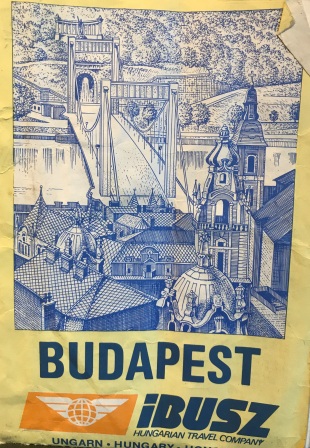
We walked across the 1949 Bridge into the city of Pest. The streets and shops looked very drab especially compared with Vienna. The buildings were actually very attractive but they looked worn. Nevertheless, Budapest had a certain atmospheric charm. It was also very cheap. Next, we bought corn on the cob and grapes for just a few pence. 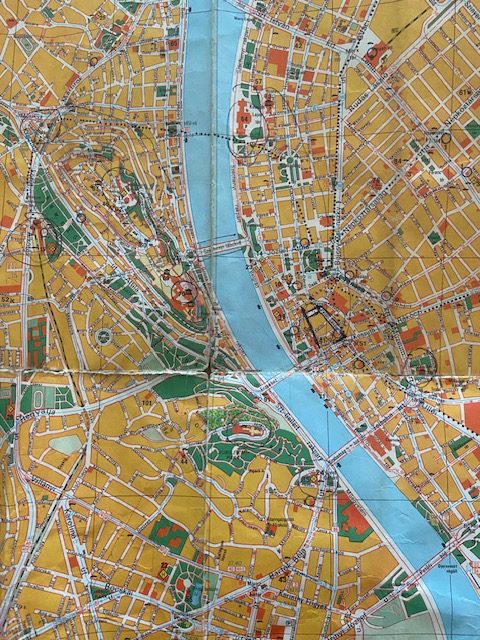
We took the metro to the National Museum. The system worked on tokens and cost just 1p to enter. It was very clean and efficient but it was striking how there were none of the usual adverts in the carriages or on the stations. The museum was 4p to enter and we spent quite a while looking around. The crown jewels were on display.
The highlight of the whole trip was the Hungarian goulash we got in a Bistro opposite the museum. We ordered it with bread and beer and the price came to 40p each. We sat there eating our meal amazed at the differential in pricing between all the countries we were visiting.
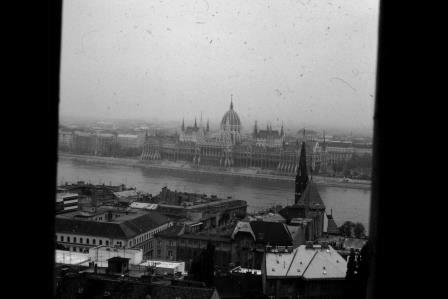
We got a metro to the beautiful gothic-styled Parliament building, took some photographs and then got another back to Deli Station. We picked up the left luggage from the grumpy couple and went back to the centre of the city by metro once more. We were ultimately heading for Keleti station where our train back to Vienna was leaving from.
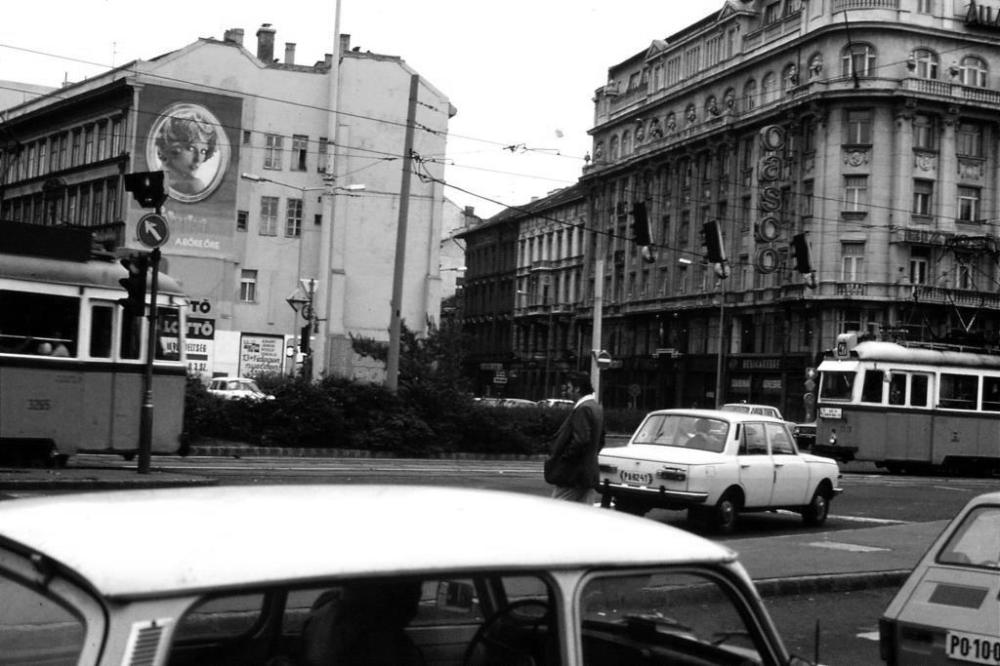
We walked around the centre hoping to spend some of our florins on souvenirs, but it was half day closing and most of the shops were not open. I was surprised to see that several of them took Access cards. Hungary might have been communist but they obviously liked western credit cards. It was said that Hungary was more relaxed than its communist neighbours. It offered rock music and Western fashion and had brands like Adidas on sale.
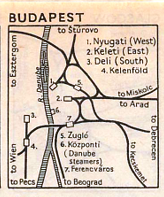
Compared with Deli, Keleti was a palace. We still had 200 florins left and just 15 minutes to spend them in. We saw a little grocery shop open and we went in. When we came out we had several plastic bags containing a huge quantity of salami, ten cheese rolls, six small cakes and three large bottles of lemonade. With no florins left we struggled on to the platform where our train had just arrived in from Bucharest.
TRAIN # 47 – 16:10 Budapest to Zurich
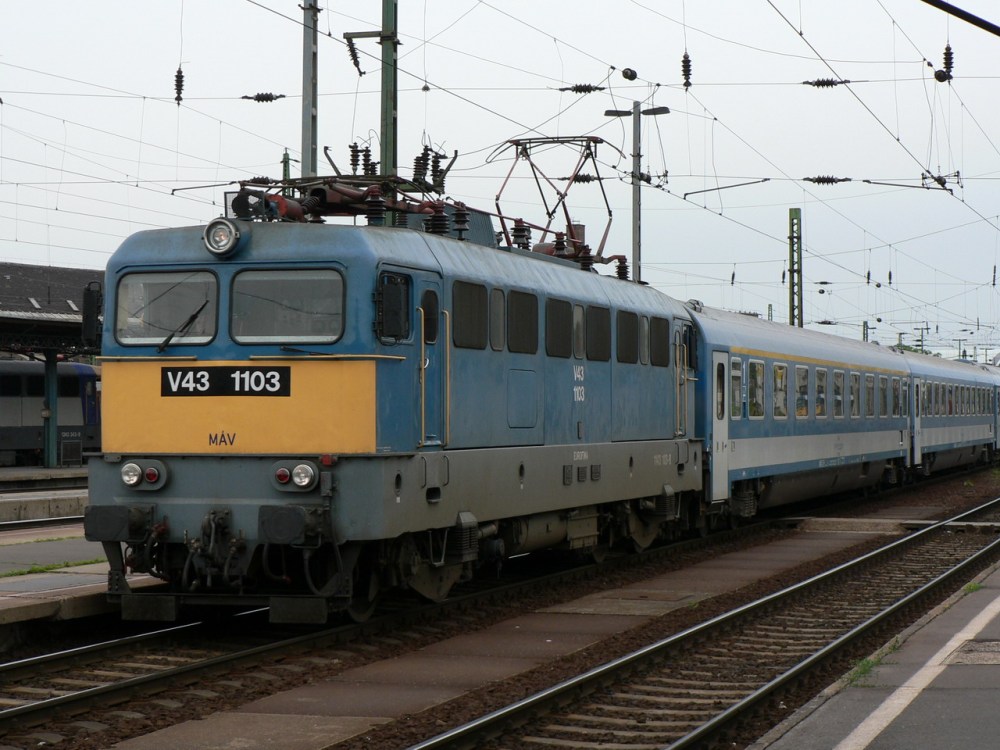
We were boarding the overnight ‘Wiener Walzer’ once again. This time we would take the westbound train all the way back to Zurich, where we were scheduled to arrive at 08:31. The train would be hauled back to the border by a Hungarian State Railway (MAV) V43 Electric Locomotive. Based on the French BB9400 design, the V43s had been introduced in 1963 and continued in production until 1982 with 379 entering service.
Now with multiple small bags as well as rucksacks it was quite difficult to negotiate the narrow corridors and internal doors as we tried to find a suitable compartment. It took us a while but eventually we found a compartment in a MAV carriage with just one other person in it.
There were still only three of us as the train departed. We got chatting and found that our compartment mate was Swiss. He was on the way back from a visit to Poland and he told us all about it. As the train raced back towards the Iron Curtain, we tried some of the bread and meat we had purchased. It all tasted horrible and it took a lot of lemonade to coax it down.
As expected, the Hungarian immigration checks, conducted during another 30 minute halt at Hegyeshalom, were pretty brutal. They obviously didn’t want anyone leaving the country without permission. We were all made to stand outside the compartment whilst the guy with the torch examined the space under the seats. All this must be routine I thought, but it still seemed to cause a delay.
At Vienna we switched to another OBB carriage and to our amazement and delight we found it mostly empty. They shunted the train out to the sidings and back into the station and then we were on our way. By nine thirty Vienna was behind us, we had finished some cheese and paprika rolls and were already in the sleeping bags. We hoped for better luck than our last trip on the ‘Wiener Walzer’.
Forty Years Later….
- In 1989, the ruling Hungarian Communist Party agreed on a peaceful transition to a multi-party system.
- In May 1989, Hungary began physically dismantling its electrified border fence with Austria.
- Hungary joined NATO in 1999 and the EU in 2004.
- Physical border controls between Austria and Hungary were removed in 2007 under the Schengen Agreement.
- There are now 425 florins to the £1.
- Vienna Sudbahnhof was closed and demolished in 2009 to make way for the new Hauptbahnhof.
- The trip from Vienna to Budapest now takes around 2.5 hours.
- The V43 locomotives are still in scheduled daily service.
- The ‘Wiener Walzer’ is still running as an overnight service.
- I have visited Budapest several times since on business and for pleasure.


