TRAIN # 9 – 17:50 Irun to Lisbon (Continued)
I slept really well right up until the Portuguese border at 05:00. Then with passport stamped, ticket checked and watch adjusted by one hour, I continued sleeping off and on as we continued on. The noise coming from the front of the train told me that the Spanish electric locomotive that had been pulling us before had now been replaced by a Portuguese diesel.
When we arrived at Pampilhosa at about 10:00 Portuguese time, I realised we were running about two hours and fifty minutes late. In fact, we should have already been in Lisbon by that time. The diesel was quickly replaced by an electric but we were still 200 kilometres north of the Portuguese capital.
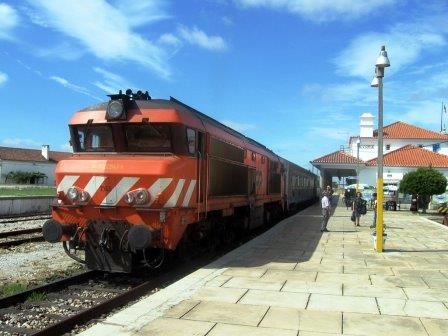
We made reasonable progress along the main line heading into Lisbon. The compartment was still empty, although many people had tried to get in. We had developed a way of looking at them in disarray and suggesting the seats were taken. We just looked blank. We were now 26 hours out of Paris and in anticipation of arriving I changed into my shorts and got out the suntan lotion.
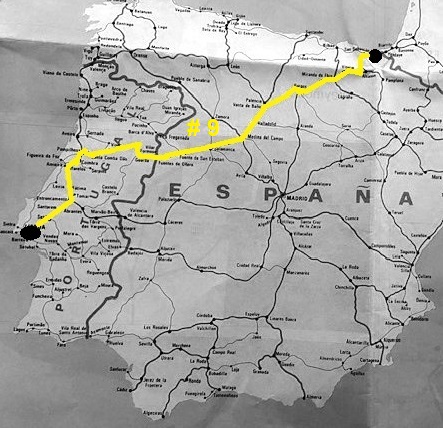
LISBON
We arrived at Lisbon Santa Apolónia around 13:00. The late train had eaten into our plans for the day so we decided to share tasks, my friend went off to get escudos and information on the city, whilst I joined the very long queue for left luggage. He returned just as I was handing over the rucksacks to a very unfriendly guy behind the counter.
We took a bus to Rossio and then walked around the centre of the town. We were amazed at how cheap everything was. We sat at a pavement café watching the crowds pass by whilst feasting on ham and cheese sandwiches and drinking the local beer.
We got on the metro to Marquis of Pombal Square and then caught a bus towards Belem. We passed through quite a deprived neighbourhood. There was quite a lot of political graffiti. It was probably my first experience with a kind of culture shock.
We walked around Belem past posh houses with bars on the windows and guards outside. It was sweltering hot and a lot of water was being sprayed onto the gardens to keep the grass from parching. We had a couple of Cokes in a restaurant and then walked along the river to the Torre de Belem.
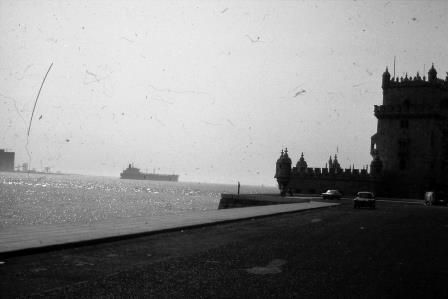
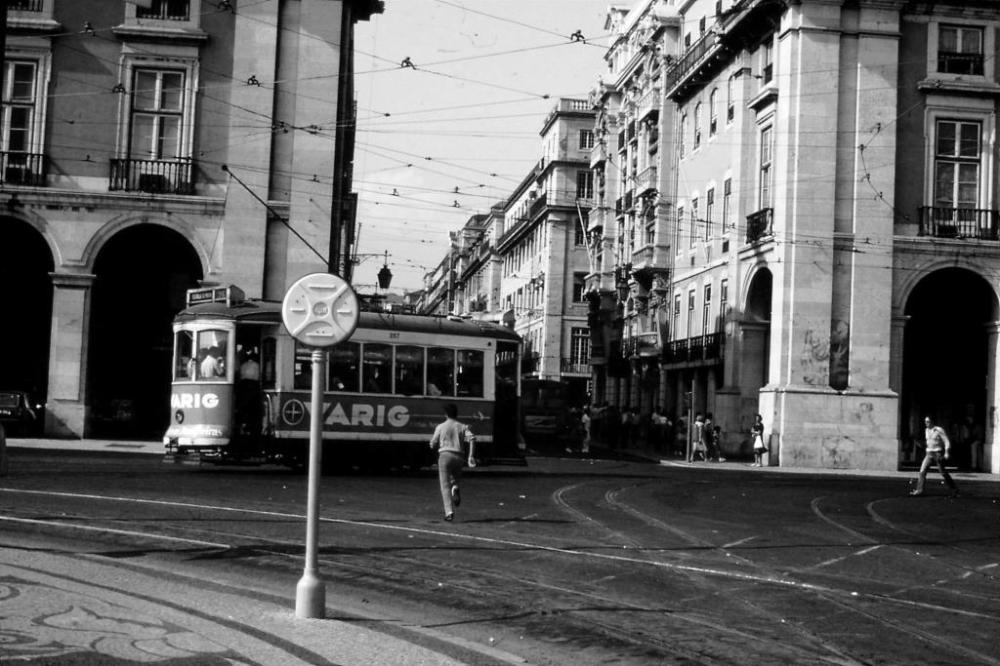
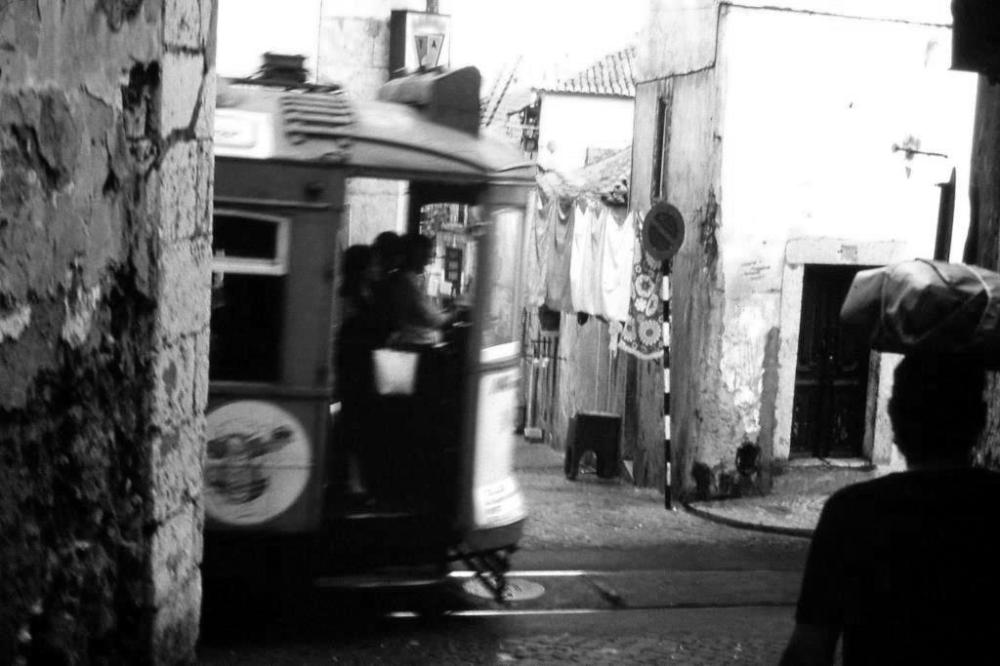
We slowly made our way back to the Praco do Comercio and watched the boats leaving for the other side of the river. We tried to resist the beggars, drug pushers and the gold ring dealers who continually bothered us. Then we went off for a longer walk around the centre watching the ancient trams, smelling strongly of carbon, passing by.
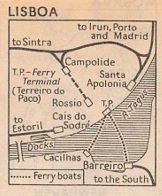
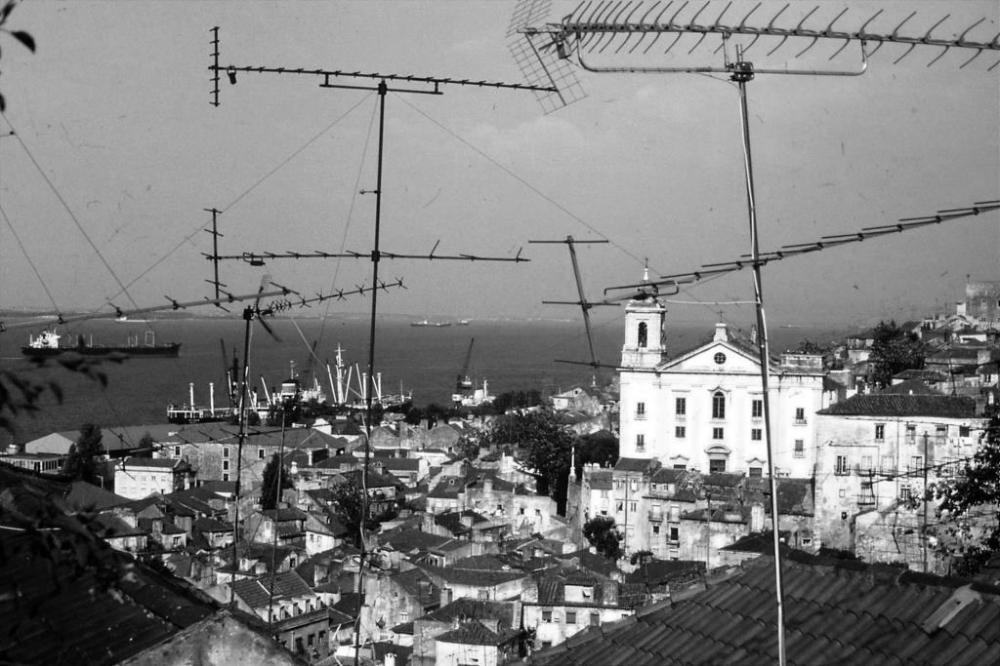
We went up to the cathedral and then around the Alfama district, the narrow streets of old Lisbon. We had pork sandwiches and 7Up in a small café and then followed the tram tracks up to the castle for superb views of the city sprawling below us and of the 25th of April suspension bridge across the river.
On the way back to the station, we tried to use up all the escudos we had left. It was quite difficult; a bread roll was the equivalent of just 1.5 UK pence. In the end, we stocked up on bread, tins of sausages and melons.
Then, back at Santa Apolónia we realised that we hadn’t got enough to pay for the supplements on our next train. We used some of the pesetas we had changed at Irun but then got escudos in change. We would have to find a way of getting rid of them before we left Portugal.
TRAIN # 10 – 21:00 Lisbon to Madrid
Lisbon had been the western extremity of our trip, now we planned to head east towards Rome. First though, we would spend a day in the Spanish capital. After collecting the luggage, we waited on the station concourse for the 21:00 ‘Lusitania Express’. The train would be taking us directly to Madrid and the journey was scheduled for exactly eleven hours.
After a while, we noticed the 21:00 departure had suddenly become the 21:30. We were finally allowed on the train at 21:20 with about ten minutes to go. We found an empty compartment and got chatting with the only other occupant, a man from Richmond, UK. We then realised that our supplement receipt actually had a coach and compartment number on it. We went off to find Coach 122 and compartment number 9. We found we were in the carriage right at the rear.
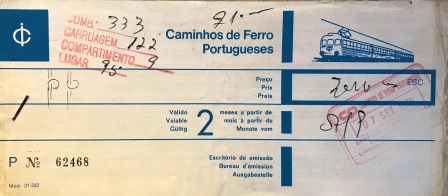
The coach in which we were sitting was owned by the Spanish national operator RENFE. Apart from the fact the seats were blue rather than brown, it was pretty much the same as the Portuguese one we had been on the previous night. The toilet was certainly as bad.
There was a man reading a Commando comic book sitting by the window. We quickly established he was Portuguese. As the train set off we settled down to a little feast of sausages, bread and apple juice. The guy had several bottles of beer at his feet and as he finished one he tossed the empty out of the open window.
At Entroncamento, the first stop out of Lisbon, a young couple and an older woman came into the compartment. They all greeted the first guy in Portuguese and we assumed they were locals too. We were now six: a full house. They were changing the electric locomotive for a diesel, but the time they were taking to do it made me think they were actually building a new engine. We sat in the station for a full hour.
We walked to the back of the carriage and were surprised to see that the gangway had just been left wide open. The train was stopped but it still seemed dangerous. Any drunk could come staggering down the corridor and thinking there was another carriage just fall out of the back of the train. We got a few cans of beer from the buffet trolley to use up our escudos and possibly test the theory.
The train still didn’t move out of Entroncamento. Eventually we went back to the compartment. The sound of crickets in the adjacent field and the number of people coming down the corridor trying to sell drugs was driving us mad.
The train finally started to move now two hours and ten minutes behind schedule. Back in the compartment the guy had put down his Commando book and taken his socks off and placed them next my place. The smell was horrendous and after twenty minutes I couldn’t stand it any longer. I went back to the end of the carriage. My friend joined me. It was fast approaching midnight.
Forty Years Later….
- Portugal joined the EC (now the EU) along with Spain in 1986.
- Physical border controls between Spain and Portugal were removed in 1995 under the Schengen Agreement.
- Euro banknotes and coins replaced the Escudo on January 1, 2002.
- Portuguese got richer. GDP per Capita in 2026 is roughly 12.5 times that of 1984, almost twice the rate of increase of the UK.
- All 18 Class 1930 diesel locomotives had been withdrawn by 2018.
- I have been back to Portugal including Lisbon several times since for business and pleasure. I like it a lot.


