Kyoto (476.3km / 297.6 miles)
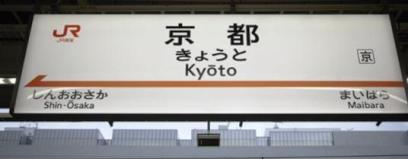
The track layout at Kyoto follows the basic pattern of Shin-Yokohama and Nagoya: two island platforms serving four tracks. The normal pattern in each direction is for services to alternate between the two sides of the island platforms as they follow each other.

Most trains have a scheduled pause of up to two minutes in Kyoto, but given the city is one of the major tourist destinations in Japan and there are plenty of foreign tourists not used to boarding trains quickly, it is common for dwell times to be slightly extended. It is not unusual for the following service to draw up in the opposite platform before a train is ready to leave.

The one exception to the dwell time rule in the current timetable is the hourly Hikari service to Okayama which is scheduled to sit in the station for six minutes, presumably to regulate the service further west. By coincidence, this is going to be the next train I take. Less than a minute after the Kodama I have just alighted from leaves at 15:36, Hikari 513 (which left Tokyo at 10:03) arrives on the opposite side of the platform at 15:37.
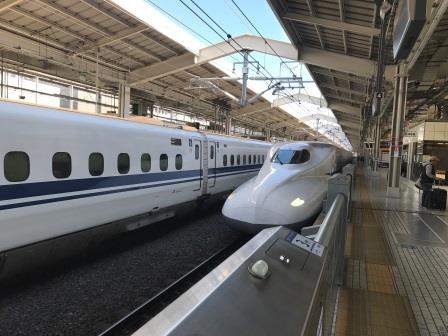
Having been to Kyoto many times before, I don’t really need to explore. I use the short time I have to walk to the front of the train and look across at the track maintenance vehicles which are positioned just beyond the platforms.

On a previous trip to Kyoto, we stayed in the hotel overlooking the Shinkansen platforms. One evening I watched out of the window as the system closed down at midnight and all the maintenance vehicles were manoeuvred onto the track.
In and around Kyoto Station
Kyoto originally opened in 1877 as a terminus of the line from Kobe, one of Japan’s earliest railways. The main station building which lies on the opposite side from the Shinkansen has been rebuilt three times since then. The latest iteration was opened in 1997 and is constructed in a futuristic style using plate glass over steel frames. Now one of Japan’s largest buildings, it also houses a hotel and department store.

The main JR West platforms are located in a “valley” between the main station building and the Shinkansen tracks. Here the Tokaido Line is joined by the San’in Line which terminates from the west, and the Nara, Kosei and Kusatsu Lines which run into the station from the east. The private Kintetsu and Kyoto subway lines are located underneath the whole complex.

Looking at all this now, it is almost impossible to imagine that the original plan was for the Shinkansen to bypass Kyoto Station and stop 2km to the south. It is also difficult to contemplate that even after the current location had been confirmed, the decision to stop the faster Hikari trains here was only made a few weeks before the line opened.

Train #10 – Kyoto to Shin-Osaka
I now board my tenth and last train of the trip. With its longish pause at Kyoto now over, Hikari 513 is ready to leave. Just as the doors are closing at 15:43, the next train, Nozomi 37, can be seen arriving on the opposite track.

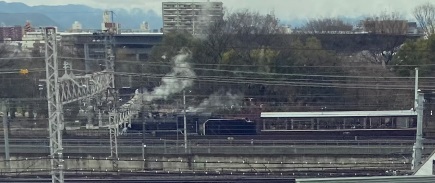
As we leave, we pass the Kyoto Railway Museum on the right. There is a steam locomotive doing trips back and forth in the yard outside the museum.
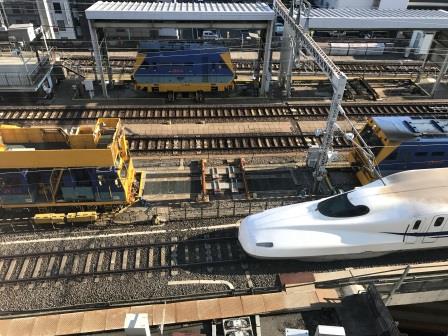
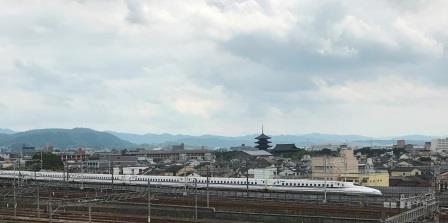
I recall visiting the museum myself a few years ago, looking across and taking a picture of a Shinkansen train (below) passing the point where we are now. The view is looking south and Toji Temple is clearly visible in the background.
We cross the Katsura River with the Tokaido Line on our right and then curve gently to the left. The route now takes us between this river, which eventually flows into the Yodo, and the old railway line all the way to Shin-Osaka.
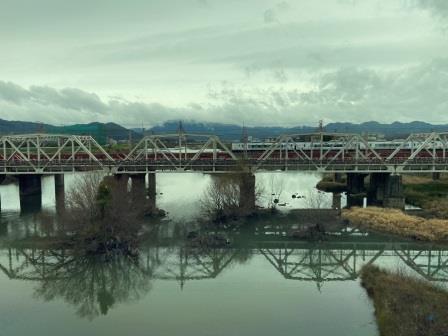
This section always seems a bit of an anti-climax after Kyoto and the scenery, which is getting ever more urban and greyer, doesn’t help much either.

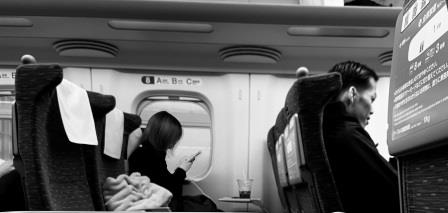
For a while the Hankyu Electric Railway with its distinctive maroon trains runs parallel. The Hankyu is relatively unusual in that it has the same wider track gauge as the Shinkansen.
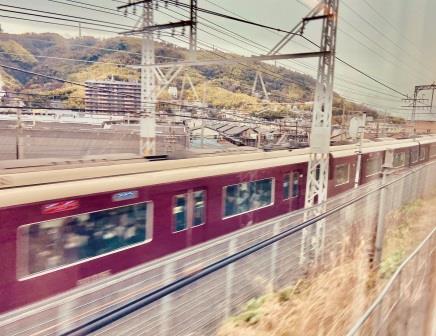
Back in 1963 when both lines were being built next to each other on elevated structures, the trains of the Hankyu were diverted temporarily onto the course of the Shinkansen which had been finished first. Thus, it is often claimed that Hankyu passengers were the first to travel on Japan’s new super railway.

The relative monotony of the scenery is suddenly broken by the sight of the extensive Torikai (Osaka) depot on the right hand side. At Tokyo and Nagoya, the depots are hidden away on short branch lines, but here the extensive car sheds are on full view.
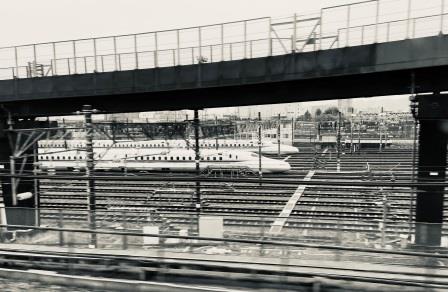
The number of Shinkansen sets that are sometimes here parked up, waiting in reserve, is quite amazing. Although as today is a relatively busy service day, there are fewer trains in the sidings than normal.
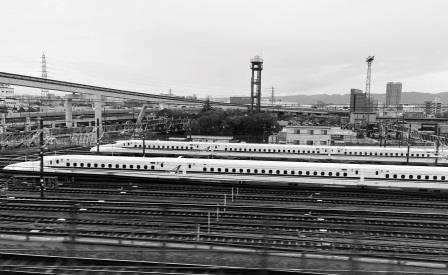
And now as our journey is almost done, the scenery gets ever more urban, we slow down, the announcements are made and after a few bends, we pull into Shin Osaka at 15:57. Our journey time of 14 minutes for the 39km compares with 19 back in 1965.
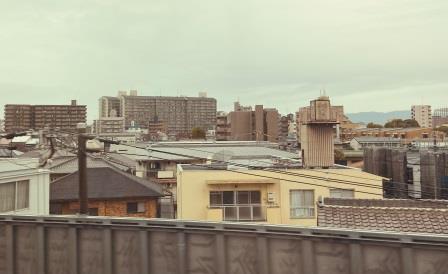
I have made it !
I left Tokyo at 8:33 and it is now almost 16:00. It has taken me 7 hours and 24 minutes to get here. Strange as it may seem though, that journey time would have not been out of the ordinary in the late 1950s. Right up until 30th September 1964, even the very fastest train was taking more than 6 hours. It really does emphasise how revolutionary that change to 3 hours 10 minutes back in 1965 really was.

 Trains To Beyond