Shin-Osaka (515.4km / 322.1 miles)
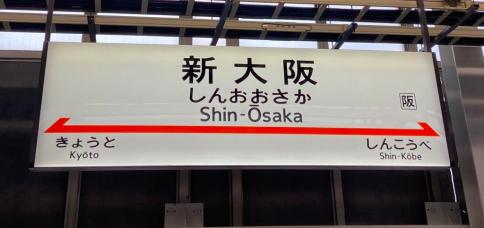
The layout at Shin-Osaka is the most complicated on the Tokaido Shinkansen. Here eight tracks pass through the station and there are three island and two side platforms. They are designed to cope with a large number of through trains passing from the Tokaido to the Sanyo Shinkansen as well as a sizeable quantity of services from either line that terminate and turnaround here.

As if to prove the point, just three minutes after my own arrival, Nozomi 37, which has followed us from Kyoto, pulls into the adjacent platform on time at 16:00. It has taken just 2 hours and 30 minutes to reach here from Tokyo. Over the next hour almost forty trains will arrive at and/or depart from the station.

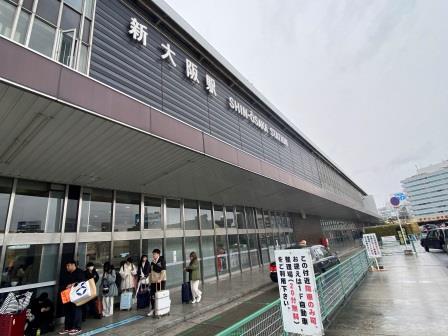
Shin-Osaka opened with the line in October 1964 and was built in a brand new location just to the north of the main city centre of Osaka. Although it was originally a terminus, its position on an east-west axis was intended to facilitate further extension of the line west, as happened in 1972.

The station (shown in 1964 in a film still above) was located at the point where the new railway passed over the Tokaido Line. The old line ran north-south here so the intersection was at right angles. Platforms were then added to the existing railway and linked to the new station above by escalators. A line of the Osaka subway was also extended to serve Shin-Osaka and connect it to the city centre.

Originally there were two island Shinkansen platforms serving three tracks, later increased to four (the current 21-24). Capacity was increased in 1974 by the building of a third island and two more tracks (25-26) to create a six track station. In 1985 an extra platform was added at the south side (20) and in 2013 another at the north side (27).
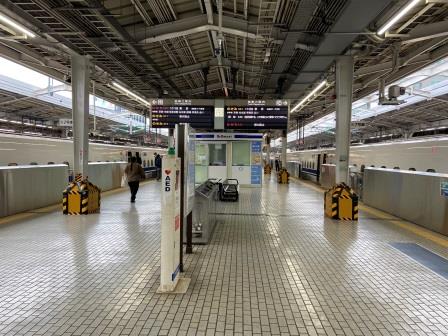
Generally speaking, platforms 20-22 are used for Westbound services heading on to the Sanyo Shinkansen, with 20 being used for trains which arrive from the west and turnaround here. 23 and 24 are used for Tokaido Shinkansen services which terminate or originate here, whilst trains coming from the Sanyo Shinkansen heading east towards Tokyo typically use 25-27.

Escalators lead down from the platforms to the third floor Shinkansen Concourse located inside the ticket barriers. There are restaurants and shops in this area and at the eastern side there are transfer gates leading through to the Tokaido Line “conventional” concourse.
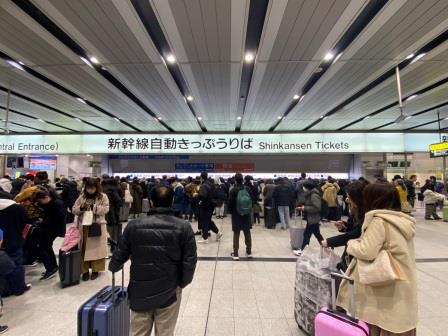
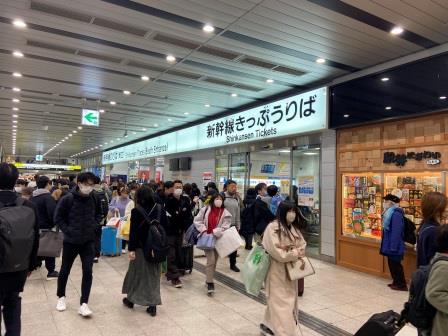
Two other ticket gates lead out from the Shinkansen Concourse directly to the outside world. At the western side the Central Exit leads out to a wide north-south passage filled with souvenir shops and ticket machines. At the southern side another exit leads out to a narrower east-west passage running along the south side of the station.

The two passages intersect in the shape of an “L” with exits to the Hankyu Building to the north and to the street on the east side. Escalators lead down to more souvenir shops, restaurants and bus stops on the second and first (ground) floors.
The exit at the south side on the third floor leads out to an elevated taxi ramp in front of the main building. There is a large car park for waiting taxis beyond it.
Beyond Shin-Osaka
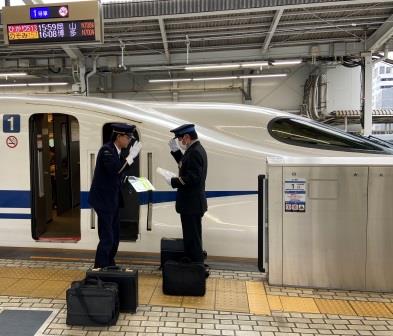
Back on the platform, Nozomi 37 is not hanging around, the JR Central crew have handed over the train and all its passengers to their JR West counterparts and after a halt of only 2 minutes it is ready to leave. It will now cover the 550km to Hakata (Fukuoka) in just 2 hours and 28 minutes, a total time from Tokyo of 5 hours.
The line that Nozomi 37 will follow was the next chapter in the Shinkansen story. Authorised in 1967, completed to Okayama in 1972 and throughout to Hakata in 1975, the Sanyo Shinkansen vastly improved on the standards of the Tokaido and employed a much straighter alignment with far more tunnels. Its line speed has now been pushed to 300km/h.
Since 2011 another line, the Kyushu Shinkansen, has stretched south from Hakata to Kagoshima at the tip of Kyushu, and although no through trains operate from Tokyo, it is possible to catch a train from here in Shin-Osaka to the end of that line. One day it might be possible to reach Nagasaki too, when the, currently marooned, Nagasaki Shinkansen (opened in 2022) is linked to the rest of the system.
Chuo Shinkansen
As we learned back at Shizuoka, the most ambitious plan is the Chuo Shinkansen, which will employ Maglev technology on a straight route, 90% in tunnel, through the mountains between Tokyo and Nagoya. The line is under construction and a test track has already been built. The aim is to run at a speed of up to 505km/h, fast enough for a 40 minute journey time to Nagoya and, if the planned extension is built, to Shin-Osaka in 67 minutes.
The new Maglev will eventually replace the Tokaido Shinkansen as the main route between the Tokyo and Shin-Osaka, but as of 2024, no opening date has yet been announced and construction work is yet to begin on some sections.
In traditional Japanese culture, Kanreki, the 60th birthday, was a time where retirement could finally be contemplated; the family “rice spoon” would be symbolically passed on to someone younger. Yet, at the moment it does not seem likely that the Tokaido Shinkansen will be replaced to Nagoya any time before its 65th anniversary, nor to Shin-Osaka before its 75th.
Happy Birthday !

More on the history of the line
 Trains To Beyond