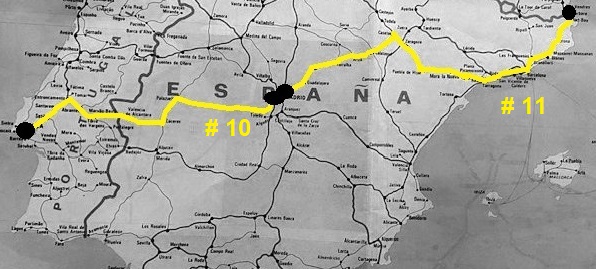
TRAIN # 11 – 22:20 Madrid Chamartin to Cerbere (Continued)
I woke at 08:30 having slept soundly. We were now travelling along the Mediterranean coast. We were passing through a small town. We were still in Spain. I knew this not only because the architecture looked distinctly Spanish but also because the local children were stoning the train as we went past.
We passed through Barcelona and then I fell back to sleep. I woke again about 10:00 and went to the toilet. As I closed the door, the roof panels caved in on me. I couldn’t get out of the door at all. I spent a frantic five minutes trying to reassemble the roof so the door could be opened. I had had enough of RENFE, and more than enough of Spain.
We were now close to France. I calculated we were about twenty minutes late and as we had only a twelve minute connection at the border. I started to worry if they would hold the French connecting train for us. At 12:06, almost fourteen hours after leaving Madrid, we arrived at Cerbere.
TRAIN # 12 – 12:12 Cerbere to Narbonne
We went through customs and boarded the waiting SNCF train to Narbonne. They had held the connection for us. The compartment we were now sat in was older than the other SNCF carriages than we had experienced earlier in the trip, but it still seemed like a massive step up from the Spanish and Portuguese trains we had been riding on.
It felt good to be back in France. As we passed through the Occitanie wine region with views of the Mediterranean and little coves, we dined on the last of the bread from Madrid spreading some with Philadelphia cheese and then some with jam.
TRAIN # 13 – 13:40 Narbonne to Marseille
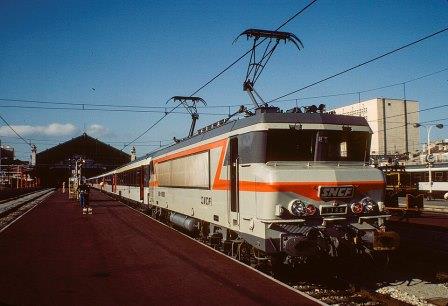
We easily made the connection at Narbonne. The 13:40 had originated in Bordeaux and was formed of more comfortable Corail stock. It was hauled by a classic SNCF ‘broken nose’ BB 7200 locomotive. After Narbonne the track continued to run close to sea passing lagoons and stopping in little towns along the coast. We were into Marseille for 16:24.
In the short time we had at Marseille, we located the bureau de change but found it closed on a Sunday afternoon. We had more success posting letters. I also caught my first ever glance of a TGV. I already knew that we planned on taking France’s new flagship train from this very station back to Paris towards the end of the trip.
TRAIN # 14 – 16:48 Marseille to Nice
Our next train, the 16:48 from Marseille, which we caught as far as Nice, was packed. The coach where we managed to find a single spare seat in a crowded compartment was of Italian State Railway (FS) origin, bound for Milan.
I didn’t mind too much that it was crowded. I spent most of the journey standing near the doorway along with three Italian guys, admiring the French Riviera. I decided that this was the best scenery of the trip so far. Two hours of blue sea, sunshine, coves and yachts. We made it into Nice for 19:00.
NICE
We crammed the rucksacks into luggage lockers, feeling the joy of being able to do so after the debacle in Madrid. We asked some British people who happened to be at the station if there was anywhere open on a Sunday to buy provisions. They told us they lived in Nice and assured us there was nowhere.
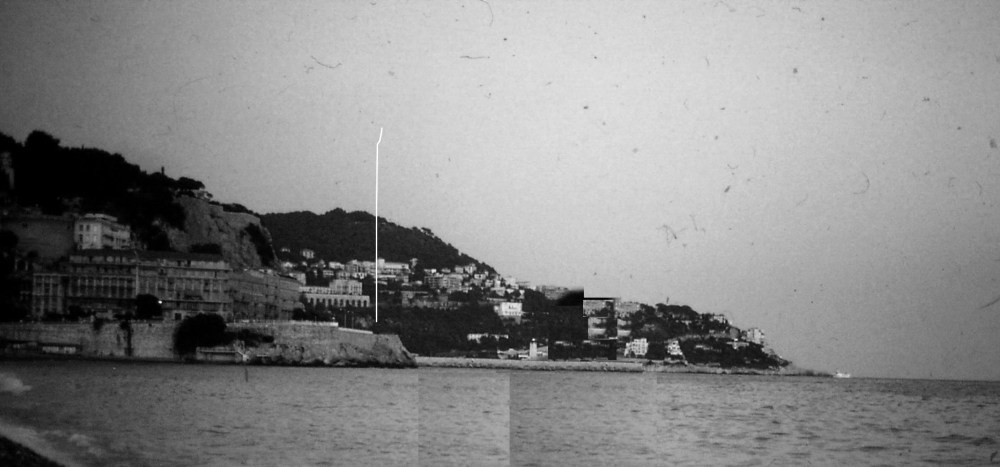
We walked off in the direction of the beach and found a little supermarket open around the corner. We stocked up on cheese, bread and Fanta and then headed down to the promenade. We dipped our feet in the Mediterranean Sea and then sat on the beach in deck chairs watching the sunset. With its beautiful gardens next to the sea front I thought Nice looked a bit like Brighton. There was certainly some British influence.
TRAIN # 15 – 23:07 Nice to Venice
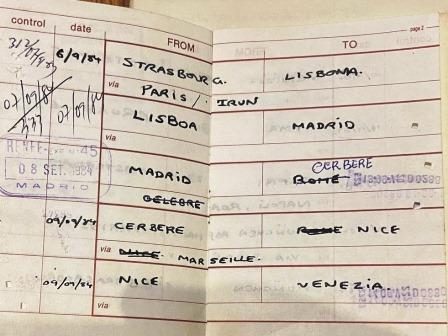
When we got back to the station at Nice, I realised that my meticulously planned schedule contained a glaring error. The only through coaches on the Rome connection I had planned were first class sleepers. Out came the ‘Thomas Cook’ and I quickly decided that we should swap the Italian capital for Venice, a place we had planned to go to later in the trip.
We climbed aboard the 23:07 overnight express, which had through coaches for Venice, and it departed on time. We walked through the train only to find that every through coach for Venice was actually full. There were some French Corail coaches at the rear and we found an empty compartment in one. We ate a supper of rubbery cheese and bread that tasted stale as we wound our way through Monte Carlo and towards the French / Italian border.
Just before midnight we were approaching the border station, Ventimiglia. I knew that the empty French compartment we were travelling in would terminate at the border. We would need to find a new place to sleep.
Forty Years Later….
- Trains from Madrid to Cerbere now take about 6 hours, including the change in Barcelona.
- Spain’s railway network with its AVE high speed trains is now amongst the best in the world.
- RENFE permanently abolished all of its traditional overnight trains during COVID.
- Physical border controls between Spain and France were removed in 1995 under the Schengen Agreement.
- Around 70 of the 240 SNCF BB 7200 locomotives built 1976-1985 remain in service.
- There are no longer any overnight trains from Nice to Venice.
- I have returned to Nice a few times and spent several days there for a conference in the early 2000s.


