Timetable
The intensity of the timetable is one of the most impressive and fascinating aspects of the Tokaido Shinkansen. The extract below is from the March 16th 2024 combined Tokaido and Sanyo Shinkansen timetable. It shows only the Tokaido Shinkansen section, with the stations which opened in October 1964 all marked in English. All 16 departures between 7:57 and 8:57 are shown.

Train Types
There are three types of train services operating on the Tokaido Shinkansen. Whilst all three are operated by the homogenous fleet of 16-car N700A/N700S trains, they differ by their stopping patterns and by the number of standard class cars which are designated for reserved seating.
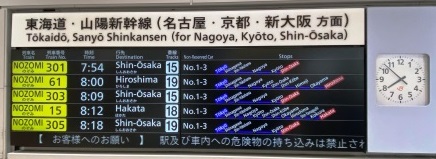
The fastest services on the line are known as Nozomi (Hope) and serve only Shinagawa, Shin-Yokohama, Nagoya and Kyoto on their way to Shin-Osaka. These trains are denoted by the colour yellow on the schedule and train indicators. In addition to the 3 Green (first class) cars common to all train types, they feature 10 reserved cars and only 3 unreserved cars. Up to 12 Nozomi trains can depart Tokyo each hour, up to 6 of these may extend onto the Sanyo Shinkansen, normally terminating at Hiroshima (approx. 4 hours – at least 1 train an hour) or Hakata (just under 5 hours – at least 2 trains an hour).

The next fastest services are the Hikari (Light) trains. Denominated by red, they normally run half hourly and make three or four more stops than the Nozomi on their way to Shin-Osaka. The exact stops vary on a pattern: generally, the XX:03 departure stops additionally at Atami or Mishima, plus Shizuoka and Hamamatsu and extends onto the Sanyo Shinkansen making all stops as far as Okayama. The XX:33 departure, usually heading to Shin Osaka, stops at either Odawara or Toyohashi as well as Gifu-Hashima and Maibara. The Hikari has 5 regular cars that are unreserved.

The slowest services, Kodama (Echo), serve all intermediate stations and for most of the day operate a half hourly service to Nagoya with one train extending each hour to Shin-Osaka. 10 of the 13 regular cars are for passengers without seat reservations, reflecting the fact that the Kodama is mainly used for short distance hops. These trains are normally designated on schedules and signage by the colour blue.

The schedule extract at the top shows 12 Nozomi, 2 Hikari and 2 Kodama trains, the hourly 16 trains an hour maximum. This schedule is known as “12-2-2”, and it is a long way from the original 1-1 pattern (1 Hikari, 1 Kodama an hour) at the start of operations in 1964.
Reading the Timetable
The blue, black and white boxes at the top show the train type in Japanese followed by the number. Thus, the 08:24 is Nozomi 309, the 08:27 is Kodama 709 and the 08:30 is Nozomi 15 etc.. The times of Nozomi trains are in blue type, Hikari trains in bold and Kodama trains in lighter type. The platform numbers at Tokyo, Nagoya and Shin-Osaka are also shown. Trains that operate beyond Shin-Osaka along the Sanyo Shinkansen to Okayama, Hiroshima and Hakata can easily be discerned as they have a departure time from Shin-Osaka (bottom line).
The schedule operates 7-days a week, but certain services (mainly Nozomi) may only run on specific dates. These are indicated by the black diamonds and italics. The actual dates of operation are at the bottom of the full schedule (not shown). Depending on the time of day, the full complement of 12 Nozomi hourly departures might only operate at busy holiday periods. A normal weekday might have 11 Nozomi departures and a “quiet” Sunday morning just 9, for example.

The duplicated departure times have different calling patterns after Shin-Osaka depending on the day. For example, the 08:21 (shown first in regular type) runs every day to Shin-Osaka as the Nozomi 209 but on certain days it will extend to Hiroshima and on others to Hakata (both shown in italics) as the Nozomi 115.
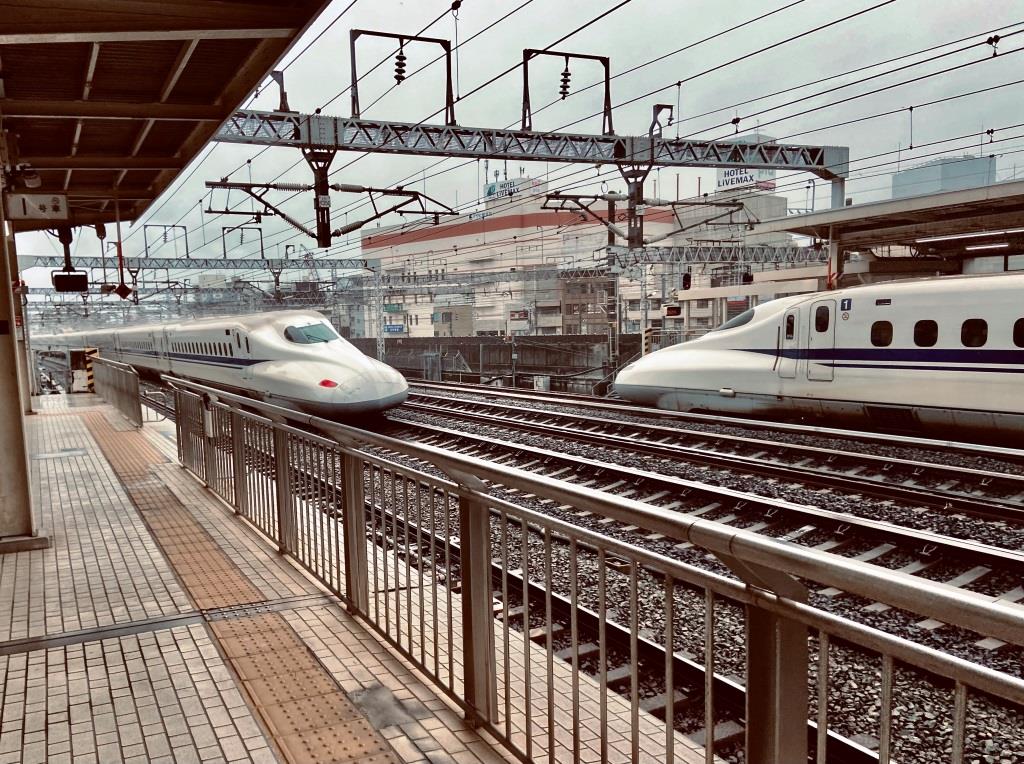
The timetable also shows that the 8:12 departure, Nozomi 15, is scheduled to be operated by the newer N700S stock.
Timetable History (1964-1992)
When the line first opened in 1964 there were hourly Hikari trains to Shin-Osaka stopping only at Nagoya and Kyoto. For most of the day, hourly Kodama trains also heading to Shin-Osaka stopped at all stations. The original “1-1” schedule (one Hikari and one Kodama each hour) lasted until November 1965. Then, in tandem with the speed-up of services, it became “2-2”. In 1967 this was increased to “3-3”, sometimes with extra Kodama services to Atami and Mishima (from 1969) in the peak hours.
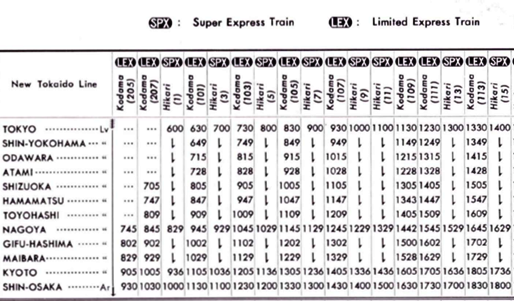
The opening of the Sanyo Shinkansen westwards from Shin-Osaka, to Okayama in 1972 and to Hakata in 1975, increased the frequency of the trains on the Tokaido Shinkansen itself. “4-4” was inaugurated in 1972 with up to two hourly Hikari trains extending to Okayama. From 1976 the pattern became “5-5” with Hikari trains leaving Tokyo on an even 12 minute pattern followed after 4 minutes by Kodama trains, also on an even 12 minute pattern. Up to 4 Hikari trains extended west towards Hakata with various stopping patterns.
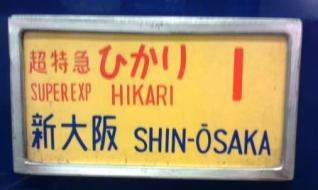
Over the next 10 years extra Hikari stops at other stations gradually increased but the 1976 pattern generally remained intact. Slightly more radical change came in March 1985 with the introduction of a “6-4” schedule. One Kodama an hour terminated at Mishima, leaving three to continue to Shin-Osaka. The number of Hikari trains stopping at Shin Yokohama increased to two per hour, whilst a new type of Hikari (known as HK) was also introduced, running hourly and generally making two extra stops between Odawara and Toyohashi.

These changes coincided with the introduction of the 100 Series trains and the privatisation of Japanese National Railways into the JR group of companies. The line also got its first speed up in 20 years and end-to-end journey times decreased. Simultaneously the balance between the two types of train gradually changed. 1989 saw “7-4” and by 1992 it was “8-3.”

Timetable History (1993-2024)
March 1992 had seen the first appearance of the Nozomi with the introduction of a single (270km/h-capable) 300 series train making one daily return journey between Tokyo and Shin-Osaka. It stopped only at Shin-Yokohama and skipped Nagoya and Kyoto for the first time in the line’s history. In 1993 “1-7-3”, the first serious “three man act” timetable was launched with a single hourly Nozomi, with Nagoya and Kyoto stops restored, extending to Hakata.

As more 300 Series were delivered they were also used on some Hikari services, with the first 270km/h Hikari trains operating from 1996. “2-7-3” featuring two Nozomi, seven Hikari and three Kodama trains each hour was inaugurated in 1997.
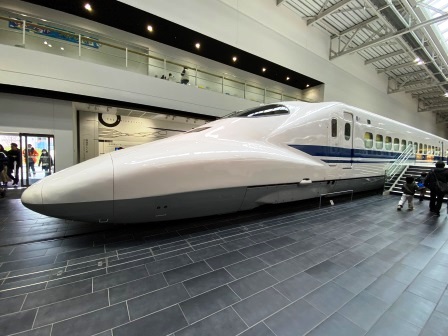
As increasing numbers of 700 Series joined the fleet “3-6-3” became possible in 2001. Then the most radical change since 1965 came in 2003 with a “7-2-3” pattern being established.

In 2009 with the introduction of the first N700s “9-2-2/3” was inaugurated. By 2020, with a homogenous fleet of N700s, and the last of the 700 Series trains gone, a full 16 trains per hour “12-2-2” was possible.
Trains per hour – 1964-2020
A rough overview…..
| 1964 | 2 per hour | 1-1 pattern | 210km/h |
| 1965 | 4 per hour | 2-2 pattern | 210km/h |
| 1967 | 6 per hour | 3-3 pattern | 210km/h |
| 1972 | 8 per hour | 4-4 pattern | 210km/h |
| 1976 | 10 per hour | 5-5 pattern | 210km/h |
| 1985 | 10 per hour | 6-4 pattern | 210km/h |
| 1989 | 11 per hour | 7-4 pattern | 220km/h |
| 1992 | 11 per hour | 8-3 pattern | 220km/h |
| 1993 | 11 per hour | 1-7-3 pattern | 270km/h |
| 1996 | 12 per hour | 2-7-3 pattern | 270km/h |
| 2001 | 12 per hour | 3-6-3 pattern | 270km/h |
| 2003 | 12 per hour | 7-2-3 pattern | 270km/h |
| 2009 | 13/4 per hour | 9-2-2/3 pattern | 270km/h |
| 2020 | 16 per hour | 12-2-2 pattern | 285km/h |
End to End timings
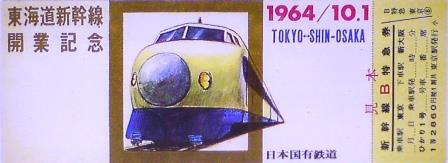
Back in 1964 the fastest Hikari time to Osaka was 4 hours, but once the road bed had bedded down this fell to 3 hours 10 minutes in November 1965. In 1987, after a long period of no real improvements, the speed of the original “0” trains was pushed from 210km/h to 220km/h to match the newer 100 Series and 3 hours was finally achieved.
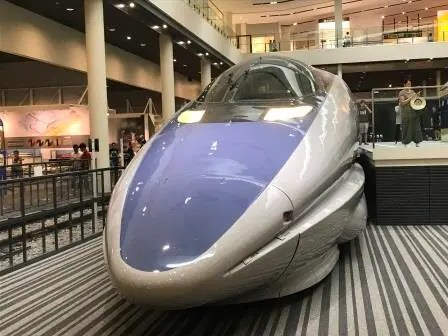
The new 300 Series introduced in 1992, were capable of 270km/h and the time then fell to 2 hours 30 minutes. This dramatic fall was accompanied by the adoption of the new Nozomi name. The 500 and 700 Series trains, introduced in the late 1990s, speeded things up on the Sanyo Shinkansen, but offered no real improvements on the Tokaido.
It was the introduction of tilt on the N700 that enabled the headline time to fall slightly to 2 hours 25 minutes in 2007. Further improvements and the arrival of the N700A allowed the line speed to be raised to 285km/h in 2015; the current fastest timing of 2 hours 22 minutes dates from then.*
| October 1964 | 4 hours | 2 stops | 210km/h |
| November 1965 | 3 hours 10 minutes | 2 stops | 210km/h |
| March 1985 | 3 hours 8 minutes | 2 stops | 210km/h |
| November 1986 | 2 hours 52 minutes | 2 stops | 220km/h |
| March 1988 | 2 hours 49 minutes | 2 stops | 220km/h |
| March 1992 | 2 hours 30 minutes | 1 stop | 270km/h |
| March 1993 | 2 hours 30 minutes | 2 stops | 270km/h |
| January 2007 | 2 hours 25 minutes | 4 stops* | 270km/h |
| March 2015 | 2 hours 22 minutes | 4 stops | 285km/h |
*All trains begin stopping at Shinagawa and Shin-Yokohama in March 2008
 Trains To Beyond