Tokyo Station
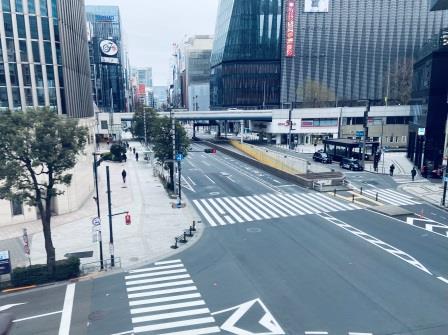
My journey begins just after 8am at the Yaesu Central Entrance to Tokyo Station. Here I am close to the centre of the city’s largest business district and surrounded by tall office buildings. There are many entrances to this vast terminal, but I have chosen to enter on the east (or Yaesu) side of the station constructed for the start of the Tokaido Shinkansen in 1964.

In common with most of the places I will be visiting today, the Shinkansen here was constructed as an “add on” at one side of the original station. This means that the stations usually have a “conventional side” and a “Shinkansen side”. In Tokyo’s case, the historic Marunouchi entrance is on the opposite west side. Opened in 1914 and completed from red brick, it is stunning and normally well worth a visit.
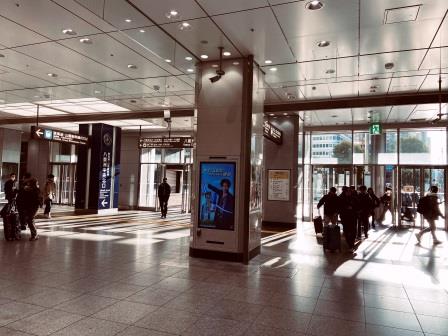
My intention today is to travel to Shin-Osaka getting off at all ten intermediate stations that opened on the first day of operation in October 1964. I plan on spending around 30 minutes exploring each one. As time will be tight, I will mostly be confining myself to the parts constructed in the 1960s and exiting to the street only on the “Shinkansen sides”.
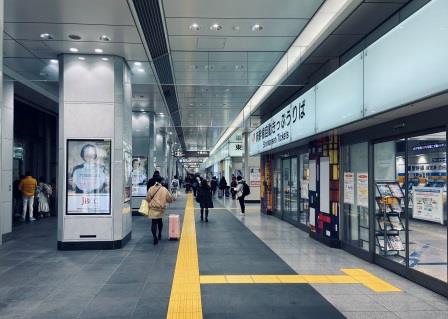
As I enter the station, I can just about discern that it dates from the 1960s. Although heavily modernised in the intervening years, the north-south passageway is recognisable from the 1964 film made to celebrate the opening of the line. The design philosophy of the Tokaido Shinkansen was “Standard, Simple and Smart”, and in line with this, most of the stations are based around simple rectangular ground level concourses with platforms and tracks elevated above.

The concourses themselves are divided into an outer “free” area and an inner area enclosed by ticket barriers and accessed only by passengers who have paid the supplementary Shinkansen fare. As you would expect, the ticket machines, reservation centres, shops and restaurants are on the outside, whilst more shops, and the steps, escalators and elevators to the platforms are on the inside.
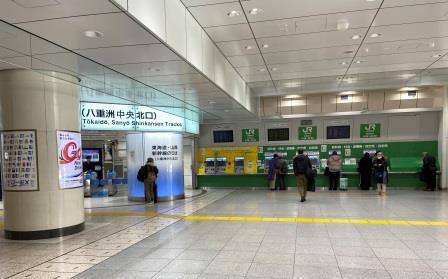
Normally, as here in Tokyo, there is a ticket barrier offering direct access to the inner area and also a “transfer” ticket barrier, used by passengers changing from conventional trains. I put my tickets into the automatic barrier and walk through. In my case, as I am coming from the street, I pass directly into the Shinkansen section.

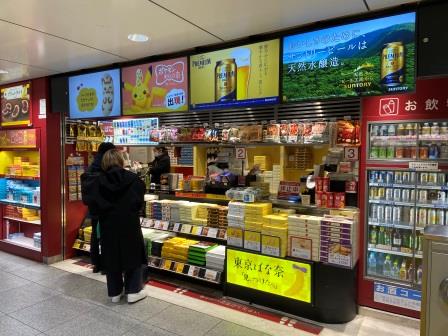
Inside, the inner concourse is very busy with passengers. People are lining up to buy boxed lunches (bento) and other food for their journeys. The souvenir shops, with their attractively wrapped boxes of sweet and savoury gifts are also doing good business.
A fair amount of people, changing from other trains onto the Shinkansen, are coming through the transfer gates too. Tokyo has more platforms than any other station in Japan and is served by two different operators. JR Central operate the Tokaido Shinkansen, but JR East operate the rest of the trains here including the Tokaido Line, the Sobu Line, Keiyo Line, Chuo Line, Yamanote Line, Keihin Tohoku Line and the Tohoku Shinkansen which heads north from here. The station is also served by the Tokyo Metro Marunouchi Line.

I look at the departure board and see that my first train, Hikari 635, bound for Shin Osaka, will depart from Platform 14 at 8:33. I still have plenty of time in hand, so I head up to the platforms for a look around.

The Platforms
In contrast to the green used in the rest of the station by JR East, the signs up on the Shinkansen platforms include a lot of JR Central’s signature orange colour.

The territories of the three JR companies that operate on the main island of Honshu are strictly defined geographically. On the conventional Tokaido Line, which runs broadly parallel to the Shinkansen to Osaka, JR East (based in Tokyo) operates as far as Atami, JR Central (based in Nagoya) takes care of the middle section as far as Maibara and then JR West (based in Osaka) takes over from there. The desire to have a single company operate the Tokaido Shinkansen means that JR Central gets to run the whole of the country’s most lucrative railway all by itself.

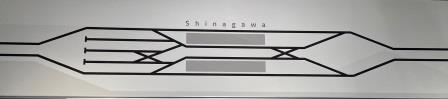
The track layout at Tokyo has changed over the years. In 1964 there were just 2 island platforms here, originally serving 3 tracks, soon increased to 4. When the Sanyo Shinkansen extension was added in the early 1970s a third island platform was added and the number of tracks was increased to 6.
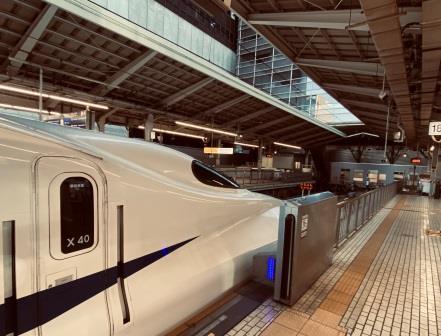
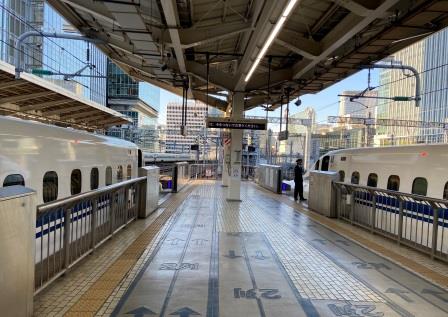
The platforms are numbered 14-19 with the oldest four, 16-19, nearest the Yaesu exit. The layout here, dependent on a single crossover just outside the station, is one of the biggest constraining factors on the timetable.
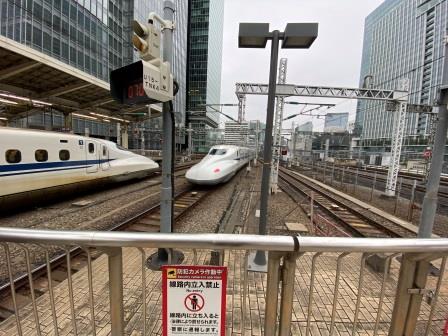
Most inbound trains turnaround in the platforms and form outbound services, but some head out to Oi Depot (shown top right in the diagram above) for servicing.
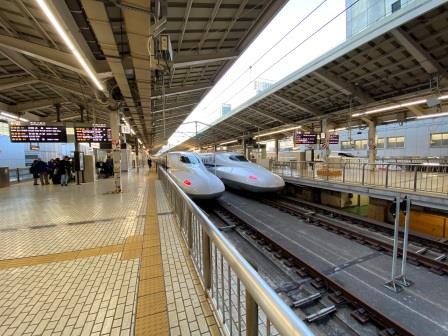
Back in 1964 there was little in the way of furniture, but now the platforms are adorned with a variety of kiosks selling food and souvenirs and Shinkansen branded coffee machines. The platforms are also now fitted with guard rails and platform gates too.
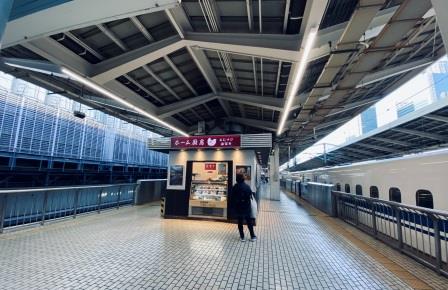
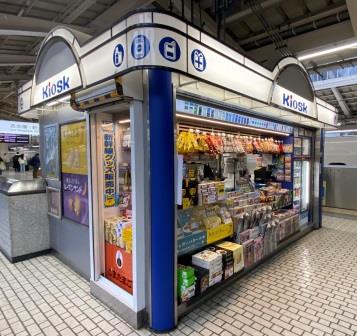
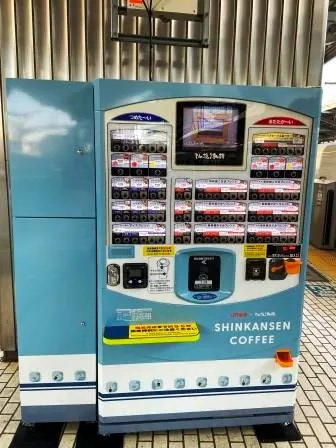
On Platform 14 I can see that the train that will form my Hikari has already arrived as an inbound Kodama service. I get a coffee from the vending machine, sit down and watch it being prepared.

It is being turned around by the dedicated team of people who clean and service these trains. With a departure every 3 or 4 minutes and only 6 platforms, the speed at which the train can be turned is crucial.
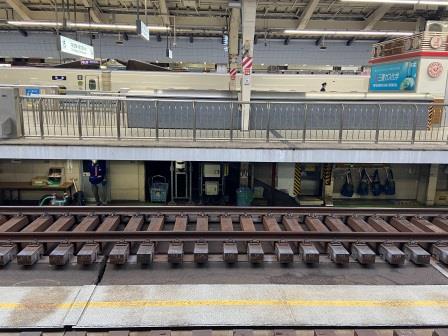
I look across to the platform opposite to see the dedicated village that exists underneath it. Here, a small army of people are moving supplies back and forth to support the cleaning activity.
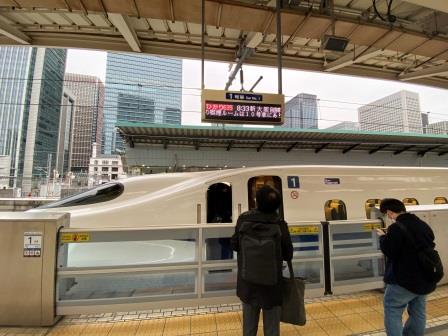
I walk to the front of the train. I will travel on a total of ten trains today and as I have not made a reservation on any of them, I will be travelling in the unreserved carriages. On the Hikari, these are to be found at the front of the train starting with Car 1.

A small queue has formed next to the platform gates. With just a few minutes to go before departure time, the gates and the train doors open simultaneously, and I climb on board.
Train #1 – Tokyo to Shin Yokohama
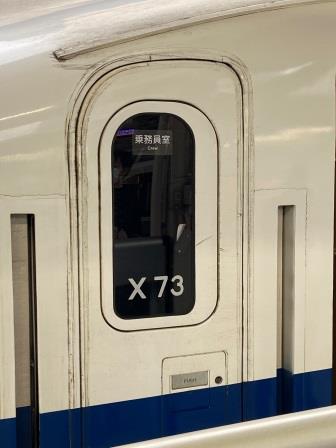
My train today is an N700, a type first introduced back in 2007. These impressive units are now slowly giving way to the newer N700S series, which are almost identical externally but have numerous features including lower energy use and battery back-up systems.

At precisely 8:33 we glide out of the station accompanied by automated welcome announcements in Japanese and English. This is all pleasantly familiar to me. I first used this line back in 1988 and have travelled on it many times since for both business and pleasure.
On elevated track squeezed in next to the conventional lines, including the Tokaido Line itself, we thread a path between tall hotels and office blocks, at one point passing next to the famous Ginza district.

We soon pass the turn off that leads to Oi depot. This vast train storage facility was added in 1975 and is built on reclaimed land in the harbour just north of Haneda Airport.

After a journey of just 7 minutes, we pull into Shinagawa (6.8km from Tokyo). This station where all trains now stop, is one of five on the line that did not exist in 1964. It was added in 2003 to serve this part of Tokyo and relieve congestion. More people get on and within a minute or so, we are off again.
We thread through the outskirts of Tokyo and pass through the first of 66 tunnels on the line. It is a very short one, but it is evidence of one of the many engineering challenges the engineers faced back in the 1960s. Fitting the line into Tokyo was not easy.
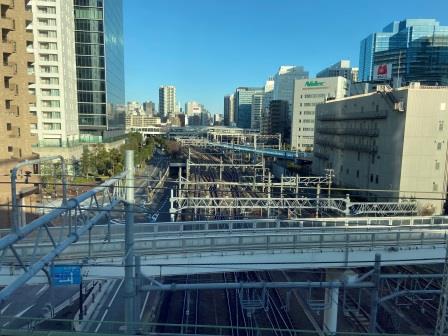
As we leave the central area, we make a relatively sharp right turn to head across most of the conventional lines and then soon after curve to the left. The curve is so sharp that oncoming trains can be seen approaching out of the window.
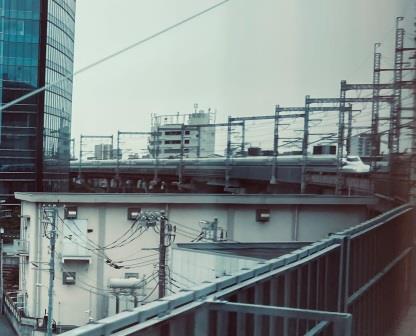
After leaving Shinagawa we pick up a bit of speed, but progress is still relatively slow as the train winds its way out of the capital.
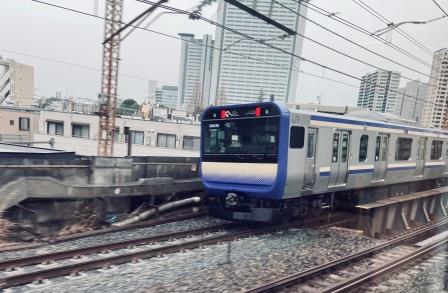
We head alongside the Yokosuka line (A on the map below), over the Tama River Bridge (B) out of Tokyo proper and into Kanagawa Prefecture.

There is little difference in the views from the window, all the time we are heading through a very densely populated landscape.

We pass through two short tunnels and then a slightly longer tunnel and then shortly after arrive at Shin Yokohama bang on time at 08:51. This is the first original 1964 stop, so I prepare to get off for a quick look around.
The journey time today of 18 minutes including the extra stop at Shinagawa compares with 19 back in November 1965, when, a year after opening, services were speeded up once the road bed had settled.
The Route Map
The Tokaido Shinkansen is shown in dark blue and lines to depots are in lighter blue. The approximate position and length of tunnels are in orange. Stations indicated by a yellow dot did not exist back in 1964.

 Trains To Beyond