To Passeio Alegre
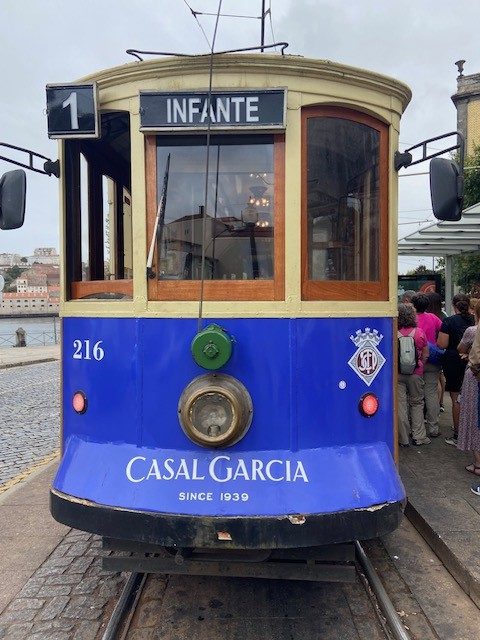
We took a trip on one of Porto’s last tramway lines, number one, along the river bank from Infante, close to the historic city centre, to the mouth of the estuary at Passeio Alegre. About a third of the way along this route was the tram museum and depot at Massarelos.
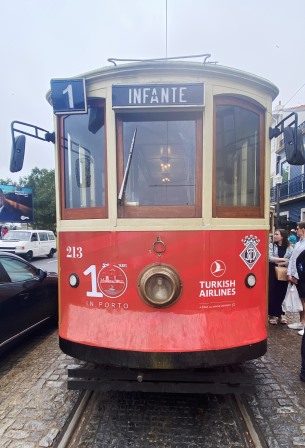
Three Routes
Porto has given up on traditional trams as a serious mode of transport. However, three lines which are marketed as “Porto Tram City Tour” remain, primarily aimed at tourists, The Andante Card does not cover the trams, and a separate ticket is required to board them.
A single ticket is a relatively expensive 6 euros, whilst two trips cost 8 euros but the two day unlimited ticket for 12 euros represents a reasonable deal even for three trips. Tickets are available from a variety of places but can be bought easily when boarding the tram.
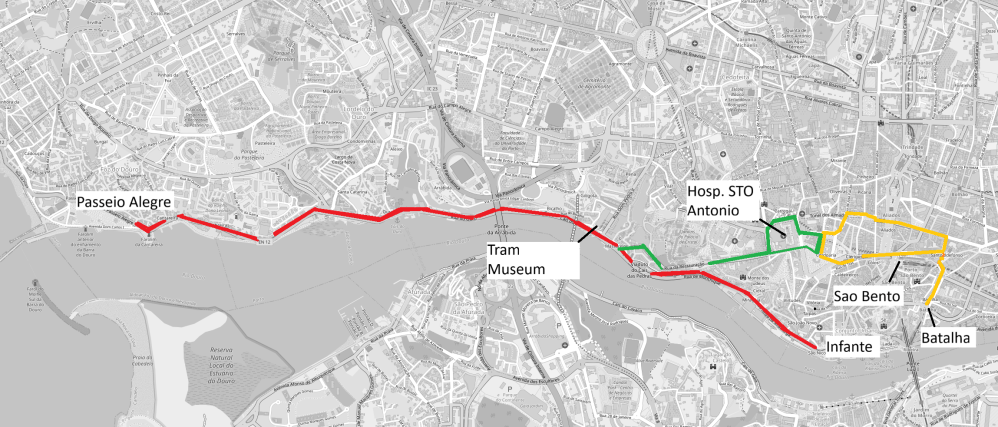
Whilst route number one is all on the flat, the second route, number eighteen shown in green on the map above, climbs sharply away from Massarelos and terminates in a loop around the STO Antonio Hospital.

Here it normally intersects with the third route, number twenty two, shown in yellow, which then loops through the city centre, passing Sao Bento itself, to finish at the upper station of the Batalha funicular.
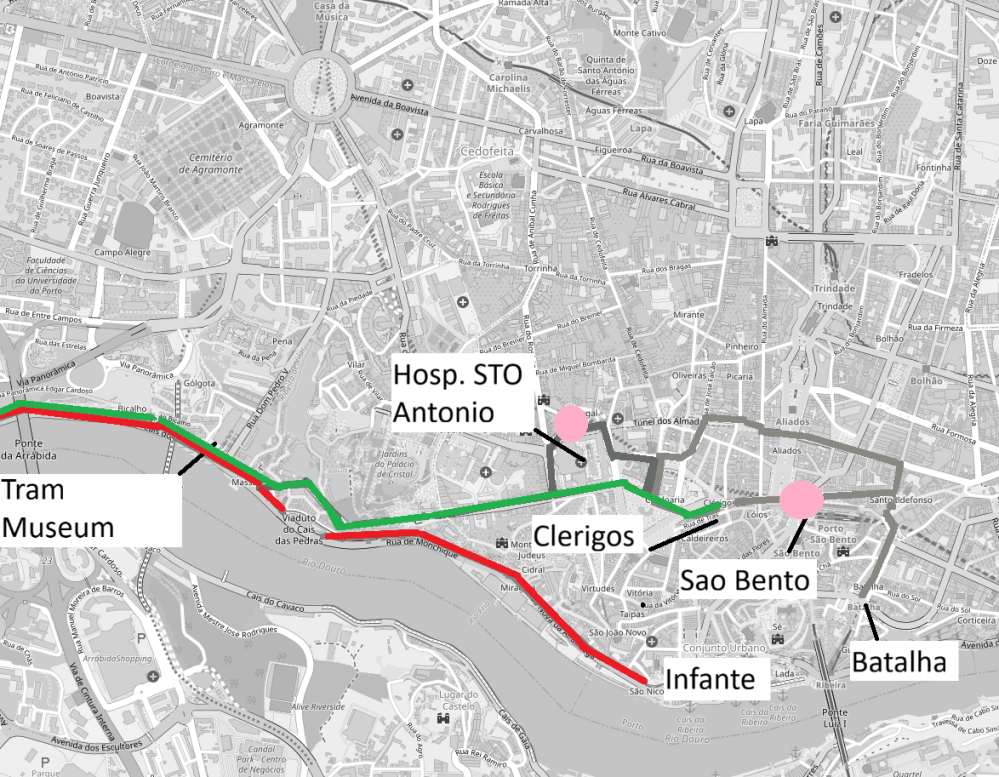
The construction works for the new Pink Metro line (Line G) mean that tram provision is seriously curtailed at the moment with lines eighteen and twenty two being cut in a couple of places, marked by pink dots above. This has led to the suspension and alteration of services.

As of the end of 2025 line twenty two is totally suspended whilst the loop at the end of line eighty has been closed and trams have been extended to Clerigos. Route eighteen now also serves Passeio Allegre meaning there are five trams an hour between Massarelos and the end of the line.
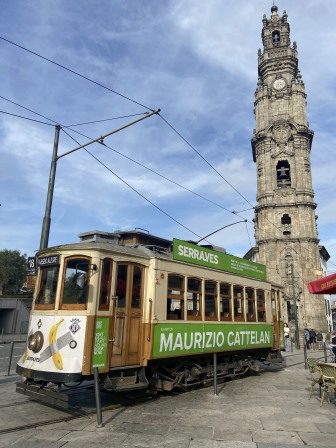
It is not certain if the full system will return after the construction works are completed. On some of the streets that used to serve route twenty two, (as below) the overhead wires are gone the tracks are covered with parked cars.

The current schedule has trams departing on route eighteen every thirty minutes and on route one every twenty. The journey times for each route are around twenty five minutes in each direction, meaning that the system can be served by just five trams.
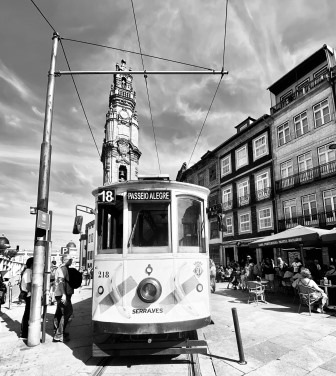
The system is mainly single track with passing places at some of the stops and at the two termini of line one. In contrast to the 900mm gauge used in Lisbon, Porto’s trams run on 1435mm (standard gauge) track. The overhead wire supply is 600 Volts DC.

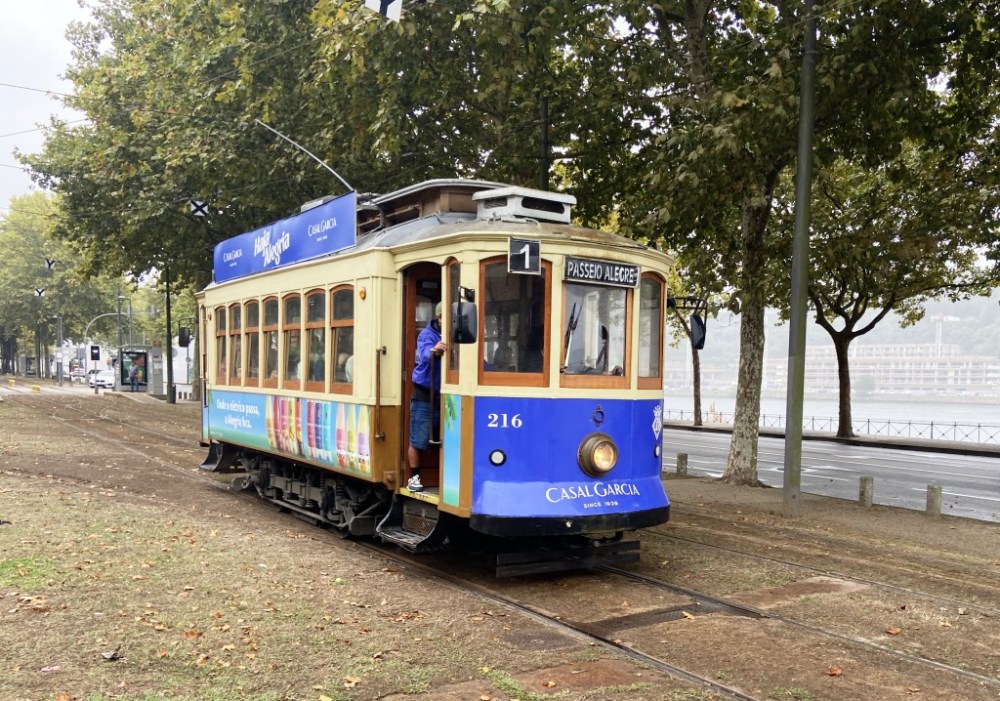
Most of the trams being used date from the 1930s and 1940s and are of the so-called Brill-28 PS (Plataforma Salão) model. Nevertheless, none of the cars were new and were often reconstructions of earlier models with extended platforms to increase standing capacity.
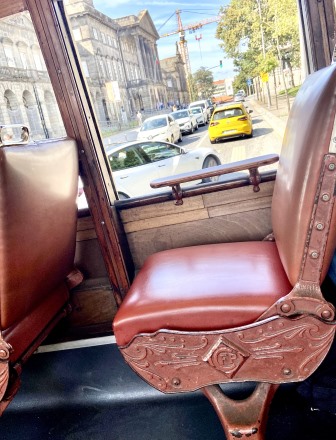
Mounted on four-wheeled chassis, the beautiful wooden interiors feature seating reversible according to direction. Seating and standing capacity amounts to around thirty or so passengers. 
The cars are operated by one person. At the terminus, the driver reverses the trolley pole and switches from one cab to another and then proceeds to take the fares of passengers on a pay as you enter basis.

As the service is mainly aimed at tourists, many passengers board at the termini and ride end-to-end. At busy times waits of forty minutes or more are common especially from the Infante stop on Route one. Trams thus often leave the termini full and standing and then stop along the rest of the route only to allow passengers to alight.
Passeio Alegre
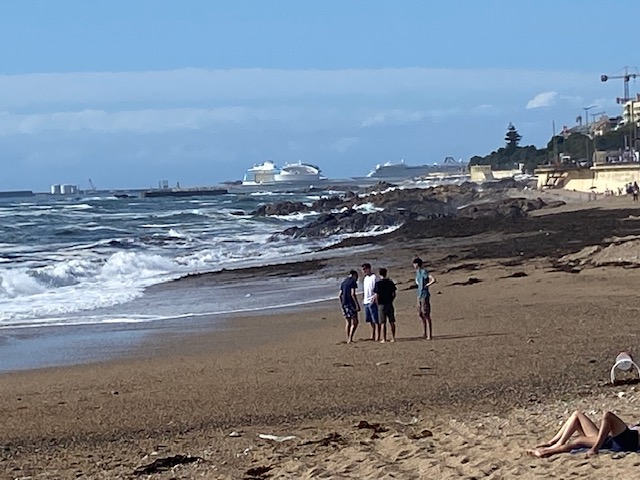
Both of the current tram routes terminate opposite Passeio Alegre, a park in the Foz district of the city.

Close by is the point where the River Douro pours into the Atlantic Ocean. Looking north a line of beaches stretches from here all the way up to Matosinhos.

A ticket on the tram system, whilst expensive, does allow a reduced rate of entry into the tram museum at the centre of the network.

Museum
Opened in 1992 by the STCP (Sociedade de Transportes Colectivos do Porto) the tramway museum is housed in old car sheds next to the former power station that once supplied electricity to the trams and also to the trolley buses that replaced them.

The building itself dates from 1915 and was once supplied by specially adapted coal-carrying trams. The fabulous collection of old trams is well presented in near chronological order in the old car shed.

Electric trams first took over from their horse-drawn predecessors in 1895 and the system grew rapidly. For the first half of the twentieth century, it was the most important means of public transportation in the city.
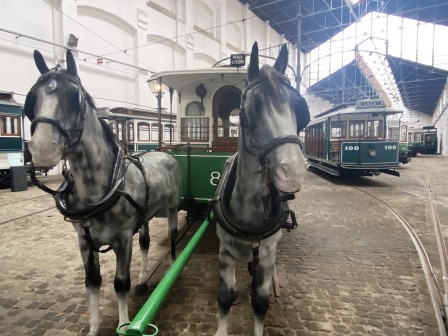
Information panels on the walls tell the history of the tramway system from its beginnings with horse power, through the growth of the number of lines and the decline and replacement mostly by diesel buses. There are also two trolley buses in the collection.
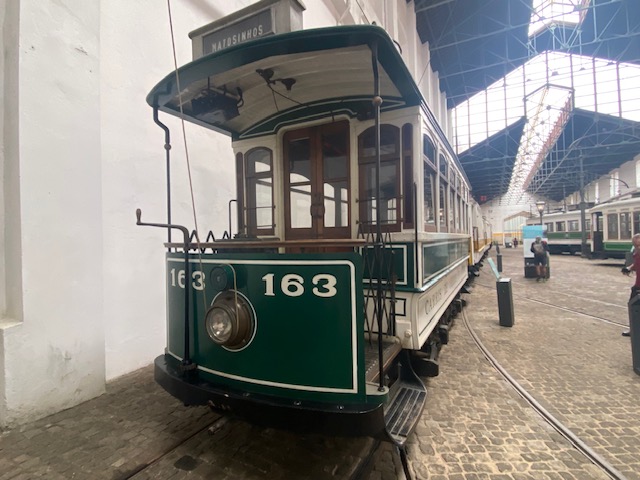
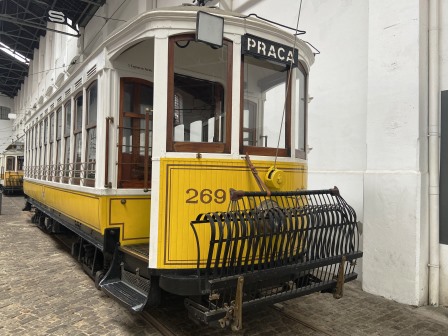
Some of the cars on display came from foreign manufacturers with one from United Electric of Preston, England and several from the USA’s Brill company. Yet many of the later vehicles were built locally including No. 163 (above) from 1904-6 and 269 (below) from 1931.
Until the 1940s the power station here produced enough energy to power the whole network, thereafter the system also relied on the city’s power supply. Energy production ended in the 1960s but it continues to operate as a substation for the last remaining trams. The old power plant is also part of the museum.

Exploring the city…. on Foot
 Trains To Beyond