To Entroncamento (Linha del Norte)
My first trip was a 200km journey south along the Linha del Norte to Entroncamento to visit the Portuguese National Railway museum there. The trains I took, like most in Portugal, were operated by the state-owned Comboios de Portugal (CP). I purchased my return ticket, for less than 50 euros, using the CP App.

The Linha del Norte
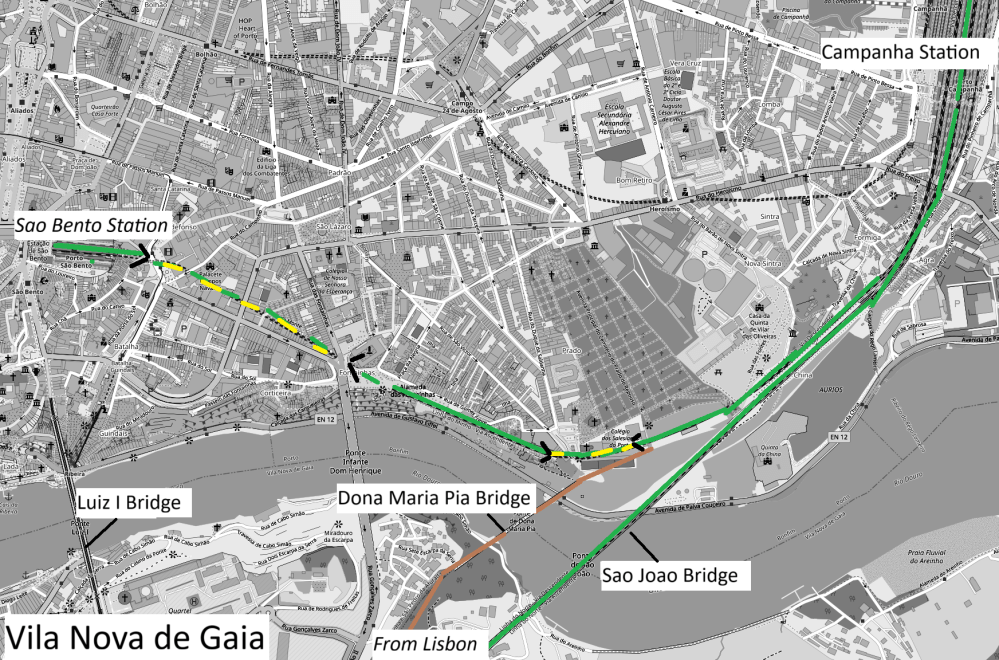
Three main railway lines converge on the city of Porto; the Linha del Norte (the Northern Line) links Porto Campanha station with Lisbon, the Linha do Minho (The Minho Line) goes north from São Bento through Porto Campanha to Valenca on the Spanish border, whilst the Linha do Douro (The Douro Line) branches off just north of Campanha and heads east eventually following the Douro Valley to Pocinho.

The Linha del Norte was Portugal’s first railway and its construction began back in Lisbon in 1856. It was built using the 1,668mm Iberian gauge that the country eventually adopted for its railway network in order to facilitate interoperability with neighbouring Spain. The line was extended gradually until it reached Vila Nova de Gaia, the settlement across the Douro from Porto, in 1864.
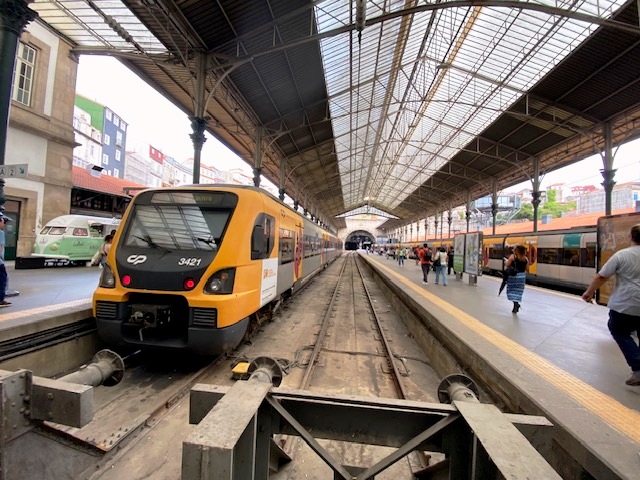
At São Bento I boarded an Urbano train to take me the short distance to Campanha to change for my journey south. As soon as we emerged from the long tunnel that began at the end of São Bento’s platform, a bit of the city’s early railway history came into view.

Crossing the river off to our right was the Dona Maria Pia bridge which used to take the railway into Porto. The bridge was finished in 1877, and it enabled the railway from Lisbon to cross the Douro and enter Porto Campanha, finally completing the Linha del Norte. Although still standing, it is no longer in use.

The Dona Maria Pia often gets mistaken for the city’s signature Dom Luiz I Bridge further downstream. Gustav Eifel was consulting engineer on the railway bridge alongside the designer Théophile Seyrig and he often also gets the credit for the Dom Luiz bridge. In fact, Seyrig beat Eifel in the design competition for Porto’s most famous bridge which was completed a few years later in 1886.
Campanha
The line from São Bento curves around to the north to join the main line just before it arrives at Campanha. This north facing junction means that any trains originating at São Bento must reverse here if they are heading south. Whilst there are Urbano services that switch direction here, no long distance services do and it is necessary to change.
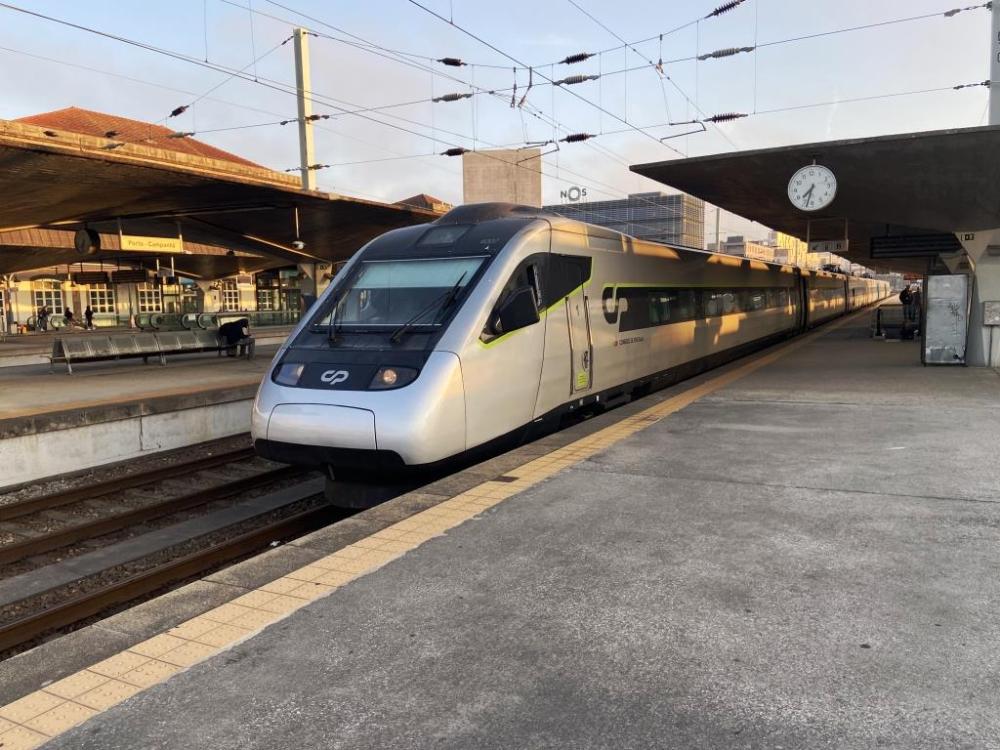
The concrete platforms and canopies at Campanha belie its historic origins. The original main building is still standing, but the station is otherwise heavily modernised and now includes an interchange with the Metro. My southbound Alfa Pendular originated here and was waiting in the platform. We departed on time.
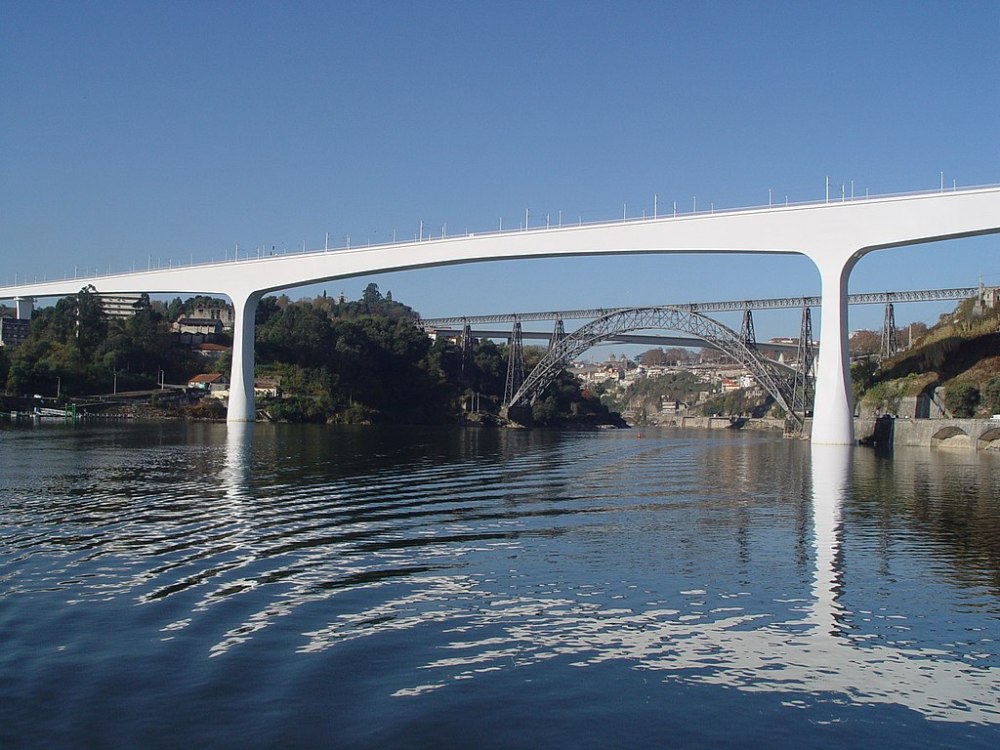
The train crossed the Douro on the new Sao Joao Bridge, opened in 1991 to replace the Dona Maria Pia which had become a bottleneck, being handicapped by its single track and speed restrictions. We picked up passengers at Vila Nova de Gaia and then accelerated south, skirting the coast for a while before heading inland.
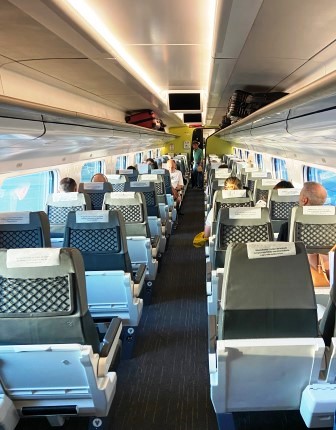
CP currently have nine six car tilting Alfa Pendular sets. They were introduced back in 1999 and refurbished in 2017. The flagships of the CP passenger fleet, they not only shuttle between Lisbon and Porto but also extend northwards to Braga and head south all the way down to Faro in the Algarve.

I found the bright interior pleasant and welcoming and the ride was comfortable. There was an on board speedometer and it occasionally reported speeds of 220km/h. This was quite impressive given that no conventional UK train, including the similar Pendolinos on the West Coast Main Line, ever manage anything above 200km/h.
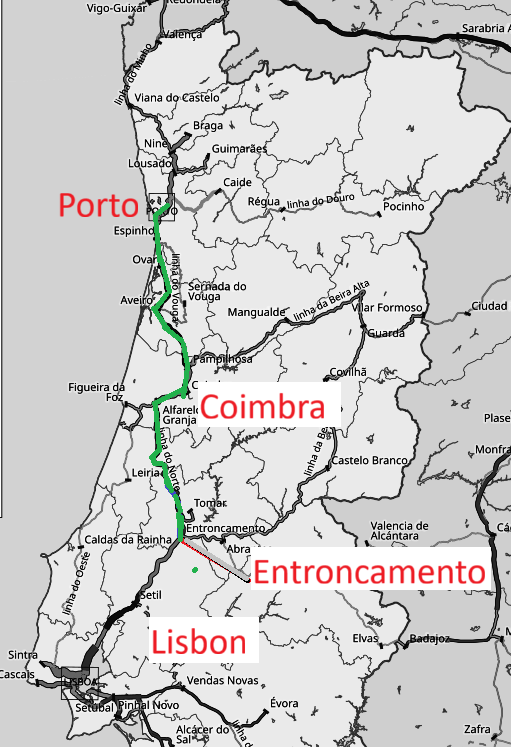
The Alfa Pendulars normally only stop at the largest cities along the route, and unfortunately my destination, Entroncamento, despite being a major junction (the word actually means junction) was not one of them. I was forced to change at Coimba B and catch an Intercidades (Inter City) train onwards.

The Intercidade (IC), the next level down in the CP hierarchy, was pretty comfortable too. On this part of the Linha del Norte these trains are normally hauled by 220km/h-capable Class 5600 electric locomotives and are formed of refurbished stainless steel coaches produced by erstwhile local manufacturer Sorefome in the mid-eighties.

My service had started at Coimba and was heading down to Lisbon picking up the stops that the Pendular had skipped. Other IC services cover the whole Porto to Lisbon ride in timings that are not too different from the tilting trains. I was in to Entroncamento bang on time.
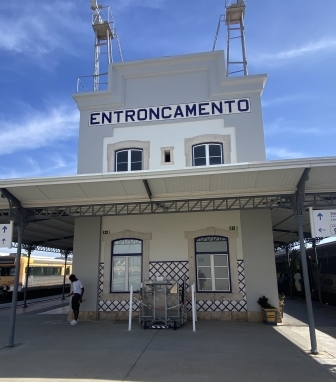
National Railway Museum
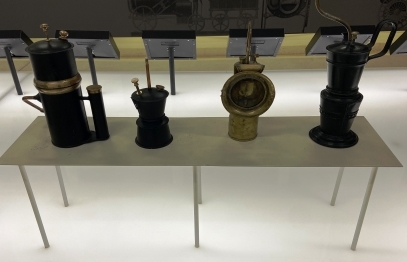
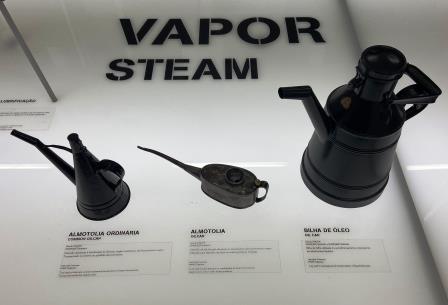
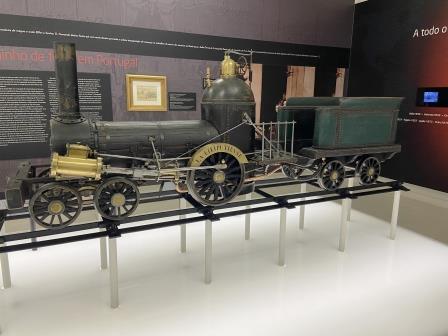
The museum, accessed by the footbridge at the north end of the platform, was just a short walk from the station itself. Entry with a rail ticket was just three euros: excellent value. The museum is home to over 30,000 objects and included a round house with around fifteen steam locomotives arranged in chronological order and a couple of larger sheds holding more modern rolling stock.
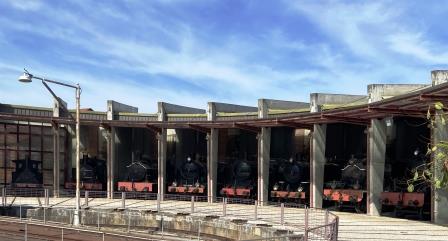
From its beginnings in 1856, the Portuguese network grew slowly. Initially a majority of the system was managed by private companies, with the state-owned portion making up about a third by the early 20th century. Eventually regional lines connecting to more remote and less developed areas were opened. The network reached its greatest extent around 1950 (with 3750km / 2330 miles) but then, in common with other European systems, experienced a significant decline in the following decades.

CP (then standing for Companhia dos Caminhos de Ferro Portugueses / Portuguese Railways ) was formed in the early 1950s and full nationalisation arrived in 1975. State intervention led to some modernisation in the form of dieselisation and electrification but progress was limited. A major batch of closures began in the 1980s and continued well into the 21st century. Particularly affected were narrow-gauge lines and lines in rural areas.
More significant investments in the railways were forthcoming once Portugal joined the European Economic Community (EEC) in 1986. In 1997, Portuguese railways underwent restructuring, resulting in the dissolution of the original CP, the splitting of the track to be managed by ‘Infraestruturas de Portugal’ and the creation of another organisation (also known as CP but now meaning Comboios de Portugal / Trains of Portugal) to run the services.
Total ridership on the Portuguese network in 2024 was 188 million on a network of 2786km. This compares with Great Britain where 1.6 billion journeys were made on a network of 16,179km. In proportion, the two figures are not too dissimilar.
A new high speed line from Lisbon to Porto is now in the planning and aims to eventually reduce the travel time between the two cities to 1 hour and 15 minutes. Another potential project is a high-speed link to Madrid.

Along the scenic River Douro…. by Inter Regional
 Trains To Beyond