Queens Park
The Bakerloo Line began serving Queen’s Park (10.8 km) in February 1915.

Station
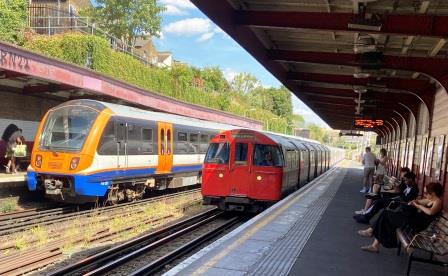
The line climbs out the tunnel here to reach the Queens Park on the surface. This is the transition point from Transport for London (TfL) to Network Rail (NR) ownership. From here northwards, Bakerloo Line trains share their tracks with the London Overground Lioness Line running between Euston and Watford Junction. This shared track, constructed from 1912 onwards, was originally known as the ‘New Line’.
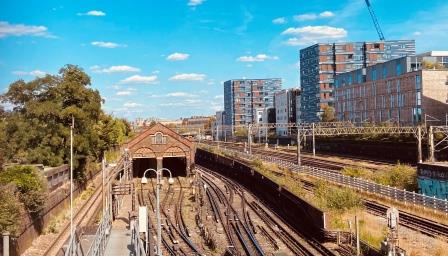
The ‘New Line’ runs parallel to the West Coast Main Line (WCML) almost all the way to Watford. The WCML first opened as the London (Euston) to Birmingham Railway in 1838. A station was opened at Queens Park in 1879 when the WCML was quadrupled. Its platforms, only on the slow lines, still exist today although they are only used during emergencies and engineering work.
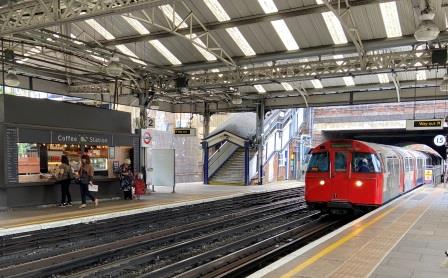
The ‘New Line’ station used by the Bakerloo and Lioness trains belongs to NR but is managed by TfL. It has two island platforms housed in an attractive train shed. Four ‘Lioness’ line trains an hour use the outer faces of the two island platforms 1 (southbound) and 4 (northbound) and provide cross platform interchange with the Bakerloo line trains which use the inner faces, platform 2 (southbound) and platform 3 (northbound).

Roughly, sixteen Bakerloo trains an hour arrive from Elephant and Castle. Eight terminate here and combined with the four continuing to Stonebridge Park and four to Harrow & Wealdstone. With the Lioness Line included, there is thus a total of twelve trains an hour going north from here.

There are two small Bakerloo train sheds at either end of station. The one in the Harrow direction comprises of four roads. Trains terminating at Queens Park go forward from platform 3, reverse in the depot and return to platform 2. In normal service, trains heading to and from Stonebridge Park or Harrow pass through the empty depot roads on their way into and out of the station.

Nearby
We come out of the station onto Salisbury Road. The area around the station with its barbers, pharmacies, convenience stores and fried chicken shops point to its roots as a working class or lower middle class suburb but as we walk northwards a totally different picture emerges. Queen’s Park has undergone a lot of gentrification in the last twenty years.

The Queen’s Park Estate was first planned back in 1873 to provide homes for working class people. Avenues of terraced four bedroom late Victorian and Edwardian properties surround the station. We peep in the window of Dexter’s estate agent and see that they are now changing hands for more than £1.5m.
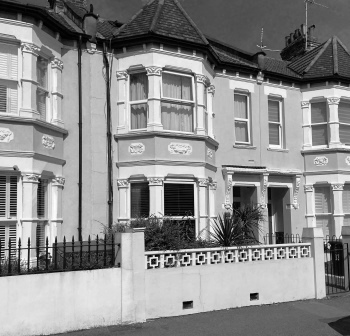
We continue along Salisbury Road passing restaurants and boutiques. There are signs advertising the weekly farmers’ market. Not surprisingly, there is a Gail’s a few blocks up from the station. 
We turn into Lonsdale Road. This was once a back street of stable blocks, but it has now been transformed into a vibrant street filled with creative design hubs, and independent eateries.

Baker
Along here in one of the old stables we find “Don’t Tell Dad” (NW6 6RD). In the middle of July, there is a sign outside, “the locals are all on their yachts, the pastries are all yours.” Founded in 2024 by Daniel Land, it is actually a popular restaurant in the evening but the freshly baked goods can be purchased and taken away during the day.
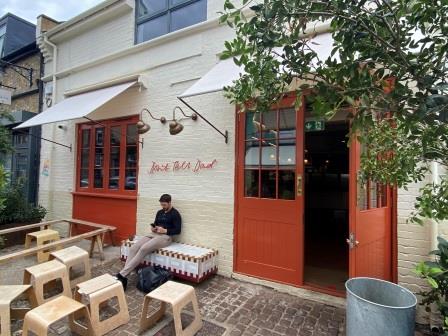
They have a changing monthly bread menu and the current one offers a wide selection including “nectarine & toasted sesame Danish, citrus & cardamom morning buns, gooseberry & buckwheat scones and sun-dried tomato and sunflower seed puffs. It all sounds fabulous.
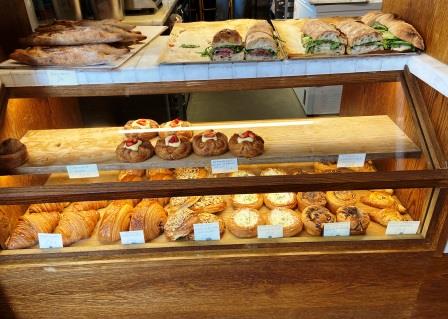
There is plenty of bread available too, white Sourdough, seeded Loaves, baguettes and millet porridge loaves to name a few. The place is obviously popular and visiting in early afternoon, there is not a great deal left. I have actually visited Don’t Tell Dad three times in total, everything I have ever tasted here has been good, tell everyone !

Loo
It is a short walk from the station to lovely Queens Park itself. The vibrant, 30-acre Victorian green space opened in 1887. It is managed by the City of London Corporation. The public toilets are located in the south west part of the park, NW6 6EN.

Kensal Green
Kensal Green (12.13km) opened in October 1916.

Station
Kensal Green is the first station on the ‘New Line’ north of Queen’s Park. It opened later than the line itself; Bakerloo Line trains had been passing through since May 1915. The ‘New Line’ added an extra pair of tracks to the West Coast Main Line (WCML) out of Euston. The WCML had already been quadrupled in the latter part of the nineteenth century and thus the project provided six tracks as far as Watford Junction.
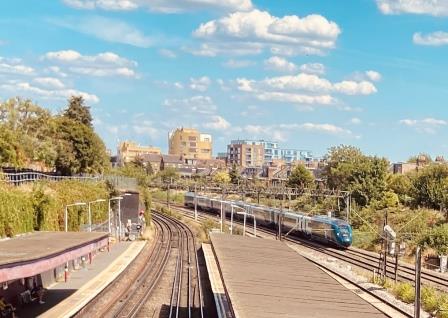
The basic idea was for the London North Western Railway (LNWR), the then operators of the WCML, to introduce electric commuter services from Watford Junction to Euston (and Broad Street in the City) whilst the Bakerloo Line trains would operate alongside them to Elephant and Castle.
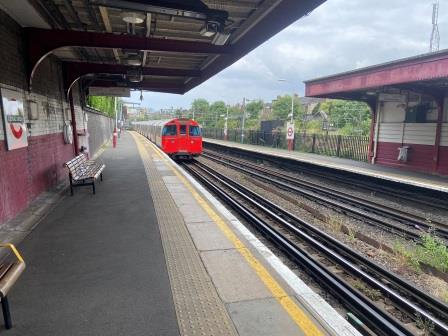
The chosen form of electrification was the Underground’s third rail (with negative centre rail) direct current (DC) system. Voltage was 0riginally 630 volts but is now standardised at 750 volts. The ‘New Line’ quickly received the moniker ‘Watford DC Line’ and this name is still in use today. Since 1966 the parallel WCML has used overhead alternating current (AC) electrification.
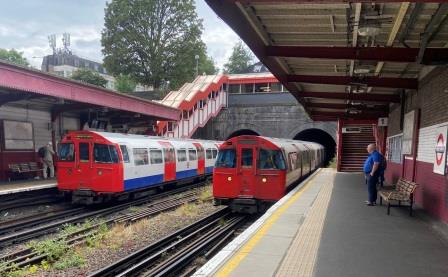
Electric trains have been running between Euston and Watford Junction since 1922. Now part of the London Overground and, since 2024 known as the Lioness line, services now run on a roughly 15 minute frequency. As far as Harrow and Wealdstone the Lioness trains are interspersed with the Bakerloo ones making the same stops.
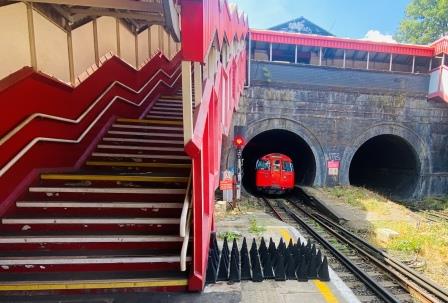
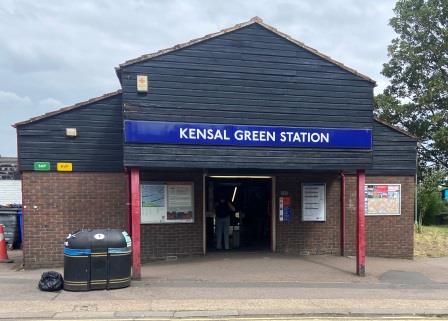
There is a picture of the original station building at Kensal Green on a poster in the foyer of the new station. It was taken in the 1960s when the station, in addition to its Euston and Elephant and Castle services, offered direct trains to Broad Street, adjacent to Liverpool Street in the city. The 1916 building was demolished and a replacement built in 1980. The design, using wooden eaves is unique on the underground network.

Nearby
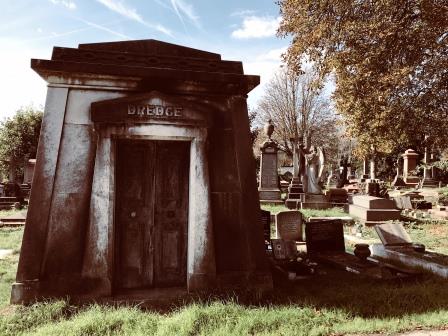
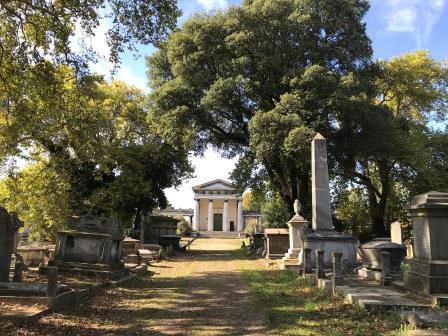
We come out of the station. The entrance to Kensal Green Cemetery, one of the capital’s largest, is just across the road. We walk around along peaceful paths admiring the grand monuments and checking out the gravestones. Isambard Kingdom Brunel is just one of the famous people buried here.
The area immediately around the station feels a little run down and as we walk north along the Harrow Road we pass the derelict Mason’s Arms pub. We keep walking and a little further on there is a group of shops and restaurants, with several aimed at the large Portuguese and Brazilian community who live around here.
Baker
Around five minutes out from the station is The Crazy Baker (697 Harrow Road NW10 5NY) launched by Sophie Grey. The business operates as a wholesaler, take away and there is a little cafe that looks a tremendous place to have breakfast.
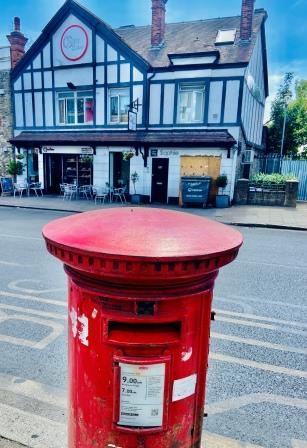
Here, freshly baked, are everyday breads, artisan sourdough, ciabatta, cookies, cakes, and a whole lot more.

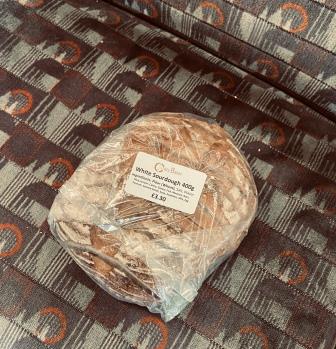
We get a loaf of delicious white sourdough and use some of it to make bruschetta.
Loo
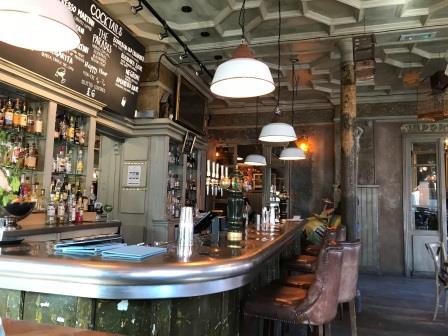
There are toilets in the cemetery with varying opening times, but it might be worth walking in the opposite direction along Harrow Road for a drink or two at “The Paradise by Way of Kensal Green” (19 Kilburn Ln, W10 4AE).

A popular restaurant as well as a bar and nightclub, the place is fitted out bohemian-style with chandeliers, fireplaces and religious antiques. The name comes from G. K. Chesterton’s famous 1913 poem, The Rolling English Road which concludes with the line about going to “Paradise by way of Kensal Green.”
Willesden Junction
Bakerloo Line trains began serving Willesden Junction (13.6 km from Elephant & Castle) in May 1915.

Station
The station here opened on he ‘New Line’ in 1912 with steam-operated trains running north to Harrow. It started to be served by the Bakerloo line trains from Queen’s Park in May 1915 and these were extended along the ‘New Line’ in April, 1917.
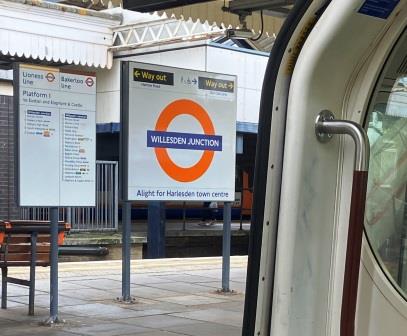
A station was first opened about a half mile north of here on the WCML in 1844 but was replaced with one here in 1866. It did not fully close until 1962.

In 1869 the North London Railway opened a high level station which crosses the WCML at a right angle. Today it forms part of the London Overground’ s Mildmay Line with services to Clapham Junction, Richmond and Stratford.

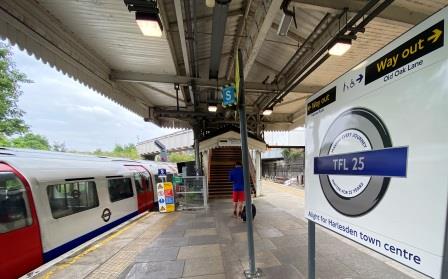
Originally the ‘New Line’ station was built with two through platforms and two London-facing bay platforms, since 2014 it has had three through platforms. Bakerloo line trains normally use the outer platforms 1 and 3.

Nearby
The signs at the station all say “alight for Harlesden town centre” so that is what we do. We walk out of the station and up the approach road past waiting taxis and buses in the process of turning around. We turn right and walk up Station Road.
We pass the Metroline bus depot on the left, they are advertising for drivers, and continue on past fast food outlets and tattoo shops. This is no picturesque ‘village’ suburb, it is altogether more gritty and real. Eventually the road turns a bit more residential before we come to a junction with Acton Lane and we reach the High Street.
Baker
Blakes Bakery (57 High Street, NW10 4NJ) is located just in front of Harlesden’s Jubilee Clock. Blakes is an independent family bakery with a few stores dotted around West London. Formerly known as Tregesers, it can trace its roots back to 1902 and it started to expand 1950s from a single small shop.
PHOTOS
It is the sort of small bakery that is in almost every large town or city up and down the UK. Nothing artisan here, nothing too fancy, just tasty looking bread and cakes.
There are donuts of all kinds, Jam, Sugar, Double Chocolate, Iced Chocolate and White Iced. Belgian Buns, Apple Turnovers, Sultana Scones and a whole lot more
Bread roll, white bread, other bread….
Here too are Sausage Rolls, Bacon & Cheese Puffs, Cheese & Tomato Puffs, Jamaican Patties, Cornish Pasties, Peppered Steak Slices, and Steak & Kidney pies.
Loo
There are toilets at the station on Platform 2 and 3.
Harlesden
Bakerloo Line trains began to serve Harlesden (14.68 km) in April 1917.

Station
The station here opened for LNWR steam operation along the ‘New Line’ from Willesden Junction to Harrow & Wealdstone in 1912. The Bakerloo line trains heading from Willesden Junction to Watford Junction began to serve it five years later. LNWR Electric Trains to Euston and Broad Street began in 1922.

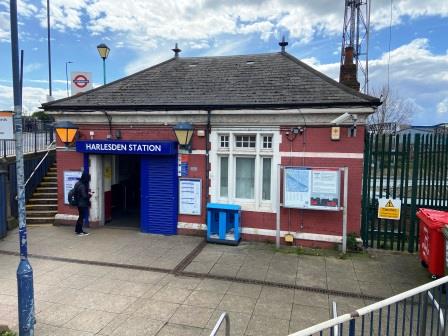
Like most of the other stations along the ‘New Line’, the platform walls at Harlesden are painted in light red and cream. It is a scheme that remains neutral between the brown of the Bakerloo and the orange of the Overground. In common with other similar stations constructed by the LNWR, the main building is a simple red-brick structure with long canopies.
Nearby
We emerge from the station onto the bridge that takes Acton Lane over the WCML. We go left first, heading towards Harlesden. We go a short distance and there is a cluster of shops. Here there is a newsagent, a fish and chip shop, a convenience store and a shop selling electrical appliances.
Heading back in the other direction over the bridge from the station takes us into Park Royal, the largest industrial zone in London. Here more than 40,000 people are at work in warehouses and factories. Within a few minutes of walking we see a National Grid electrical substation, a data centre and an automotive business.
Baker
There is not a bakery in sight. Not a retail one at least. Yet, here right next to the railway tracks is the McVities biscuit factory (Waxlow Rd, NW10 7NY). The largest such factory in Europe and the place where everyone’s favourite Chocolate Digestives are baked.

There is a factory shop too and we go in for a closer look.
Loo
A little walk further down Acton Lane brings us to the Grand Union Canal. Situated right next to the road bridge is the Grand Junction Arms (NW10 7AD).

The pub is housed in a beautiful building dating from the 1860s. The beer garden is massive and it overlooks the Grand Union Canal.

Stonebridge Park
Stonebridge Park began hosting Bakerloo line electric trains in April 1917.
Station
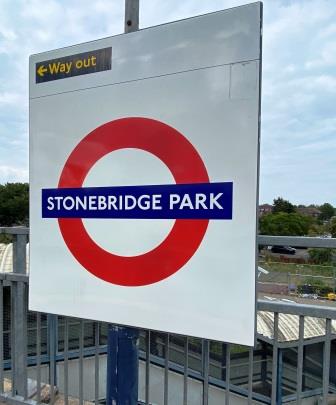
Stonebridge Park was opened to steam-hauled services in June 1912 and began hosting Bakerloo line electric trains in August 1917. The LNWR built a power plant just north of the station to generate electricity for the ‘New Line’. The main depot for Bakerloo Line trains is now located on the site where it used to be.
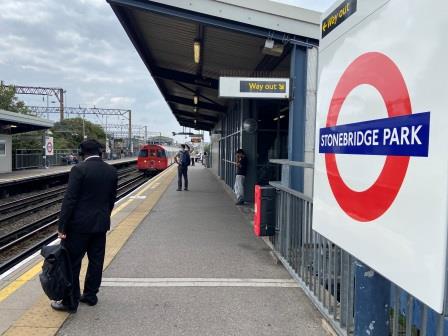
Today, four Bakerloo trains an hour turn around at Stonebridge Park, using the depot to reverse. The service on from here to Harrow and Wealdstone comprises of the remaining four Bakerloo trains and the same number of Lioness Line trains heading to Watford Junction.
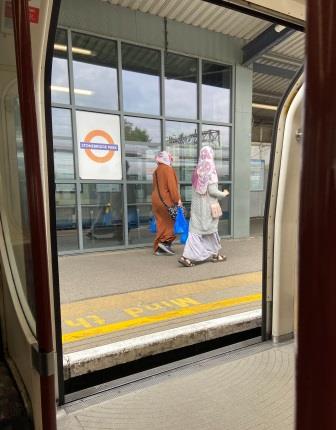
Whilst the platforms and the buildings here are actually 1948 replacements of bomb-damaged originals, the 1912 LNWR booking hall still survives.
Nearby
As we come out of Stonebridge Park station we are confronted by the 21 storey WEM Tower. It was originally built in 1965 as an office block but has been redeveloped into a modern residential complex. It is certainly handy for the Bakerloo Line.
Here though the dominant feature is the six-lane North Circular Road which passes under the railway just south of the station. The road was conceived in the 1910s and largely built in the 1920s and 1930s to bypass central London. It received trunk road status in 1946 and has been getting wider and busier ever since.
We skirt along one of its feeder roads heading west under the tracks back into Park Royal. The Princess Royal Distribution Centre is on our left, the vast Freightliner depot on our right. Around us here it is all industry and warehousing.
Baker and Loo
We give up hope of finding a bakery in the area. There is no pub either, but there is a cafe. It is not just any café either. As we come out from under the railway bridge, we are face to face with the legendary Ace Cafe (Ace Corner, N Circular Road, NW10 7UD).
The Ace first opened in 1938 as a simple rest stop for motorists and truck drivers on the new North Circular Road. It was destroyed in an air raid in 1940 but reopened in 1949. It eventually became a youth culture hotspot in the 1950s and 1960s with gangs of bikers gathering to listen to rock and roll music on the jukebox.
It closed in 1969 but was revived in the late 1990s by enthusiasts. It now operates not just as a diner but also as a community gathering place. It is a kind of pilgrimage site for motorists and it hosts various vehicle meet ups and music nights. It has also spawned a world wide following, with offshoots in Barcelona and Beijing and a website in Japanese.
As we walk across the car park, I wonder if we are the first people ever to come here by train. We get….
PHOTO
 Trains To Beyond