TRAIN # 7 – 23:50 Strasbourg to Paris Est (Continued)
I slept for around five hours in total. Not a bad first attempt, I thought. We arrived at Paris Est on time at 06:03 and then went immediately on the metro to Louvre where some horrible slimy pizza from a café was all we could seem to find for a cheap breakfast.
We went back on the metro to Bastille and strolled down towards Quai de la Rapee. We found a little supermarket to get some provisions for our journey. We crossed the Seine and then walked alongside heavy Parisian traffic, with lots of aggressive horn blowing, to arrive at Paris Austerlitz just after 08:30.
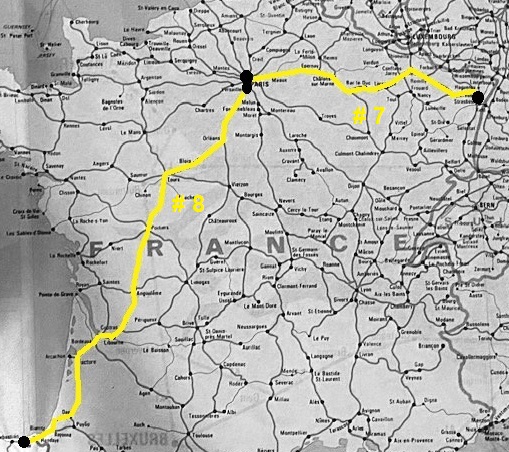
TRAIN # 8 – 09:09 Paris Austerlitz to Irun
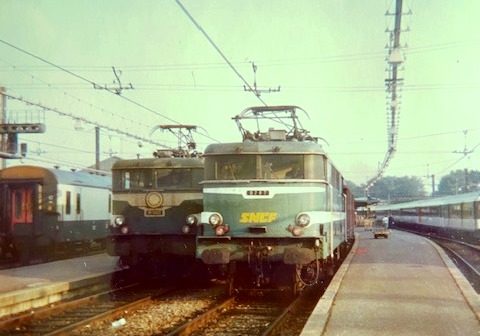
With around twenty minutes to go before the 09:09 departure, we walked to the front of the train and then watched as SNCF Class 9200 electric locomotive (a classic design dating from 1957) number 9287 gently backed down on to the carriages. The 820-km trip down to Irun would be the longest rail journey I had ever made.
I noticed that the Corail coaches were compartment versions rather than the open saloons we had encountered so far. We found window seats in an empty eight-seater compartment and drew the curtains on the corridor side and spread our bags out to dissuade other people from coming in.
Our attempts failed immediately. A man entered and sat down on the corridor side hardly looking up from the book he was reading as he slung his bag on the rack and opened the curtains. Then another man with a rucksack came in and sat opposite the first man. Finally, two girls chatting in French took two of the remaining four middle seats.
With six of us in the compartment, the train pulled out of Austerlitz on its way to Spain. Once it had escaped from the clutches of Paris it started to put on an impressive turn of speed. The ride was very smooth too. About two hours out of Paris the sun began to shine and it looked pretty warm outside.
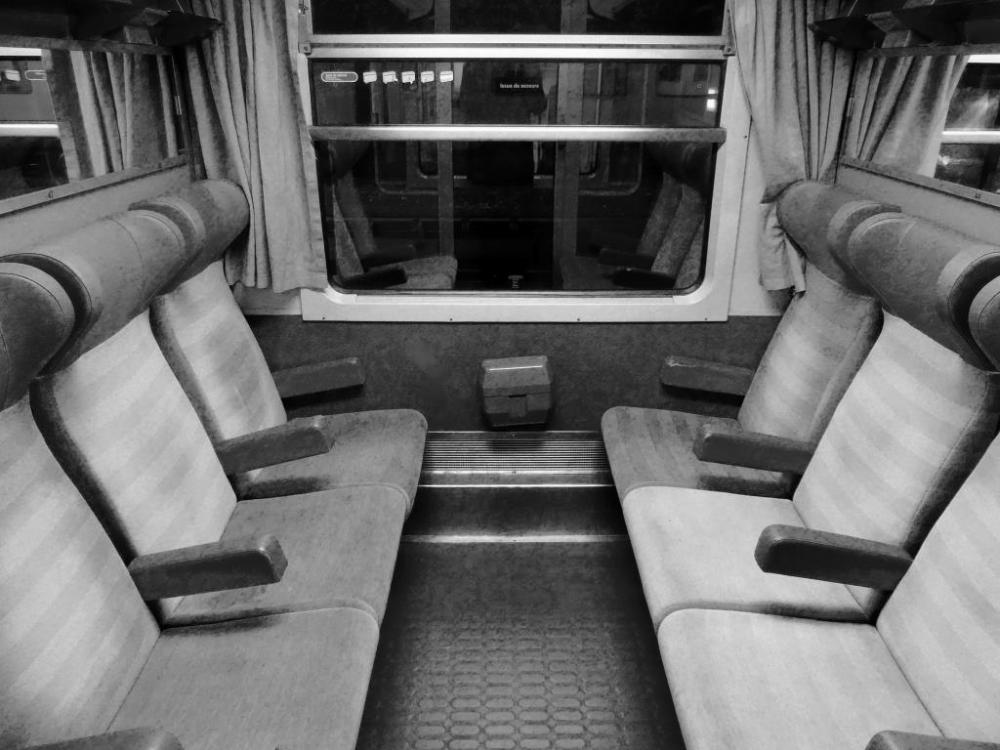
By midday we had all started on lunch. The two French girls were eating sandwiches purchased from a man with a trolley who kept coming up and down the corridor. The guy reading the book, who we had worked out was also French, sat there keeping himself to himself eating a cheese and ham baguette. The guy with the rucksack, who had turned out to be an American, had taken a break from writing his travel diary to tuck into a cheese roll.
We were eating pâté sandwiches and TUC biscuits. We were discussing whether our food would last until Lisbon when one of the girls offered us one of her biscuits. We started talking. They were Francoise and Jolene. Francoise was from Versailles and they were both on their way to Bayonne, where Jolene’s family lived. We talked at length with them and then the American, Scott from Indiana, joined in. The Frenchman continued reading his book.
The train reached Bordeaux around 14:00 and the French guy got off. He was ‘replaced’ by two Finnish girls. All seven of us conversed at length. The two Finns were Interrailing and studying pharmacy back in Helsinki. The two French girls, we now learned, were about to start work for the blood transfusion service at a Paris Hospital.
We arrived at Dax. A short fat French guy got on and took the last place. He was reading the Reader’s Digest and he borrowed a match from my friend to light his cigarette. Scott announced that he was allergic to smoke and went to stand in the corridor.
The sun seemed to be getting brighter and brighter as we went south. Certainly, the track was getting a little bumpier. We reached Bayonne and the French girls got off and then shortly afterwards the Finns left us at Biarritz.
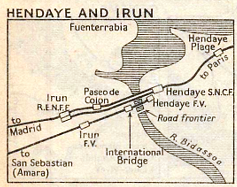
Now with just three of us left we headed towards Hendaye, the Pyrenees and the border. We had another round of pâté and bread and TUC biscuits. Scott offered us some Greek cheese and we took it gratefully. At 16:25 the train arrived on time at Irun, Spain.
TRAIN # 9 – 17:50 Irun to Lisbon
We went through immigration and customs, both French and Spanish, and changed another £10 into Spanish Pesetas. We then walked through to where another train was waiting. The 17:50 departure, standing on tracks built to the wider Spanish (and Portuguese) gauge of 5ft 5in, was to take us on the overnight journey to Lisbon.
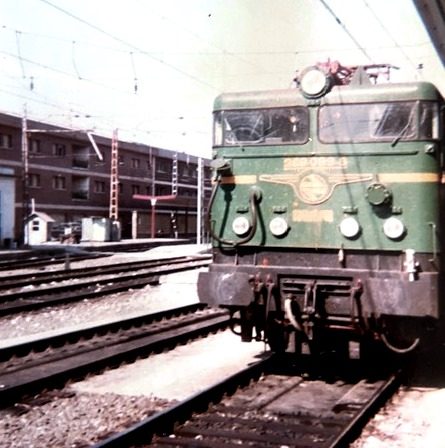
At the head of our train was a Class 269 electric locomotive owned by RENFE, the Spanish state operator. A total of 265 of these units were built in Spain between 1973 and 1985 under licence from Japanese manufacturer, Mitsubishi.
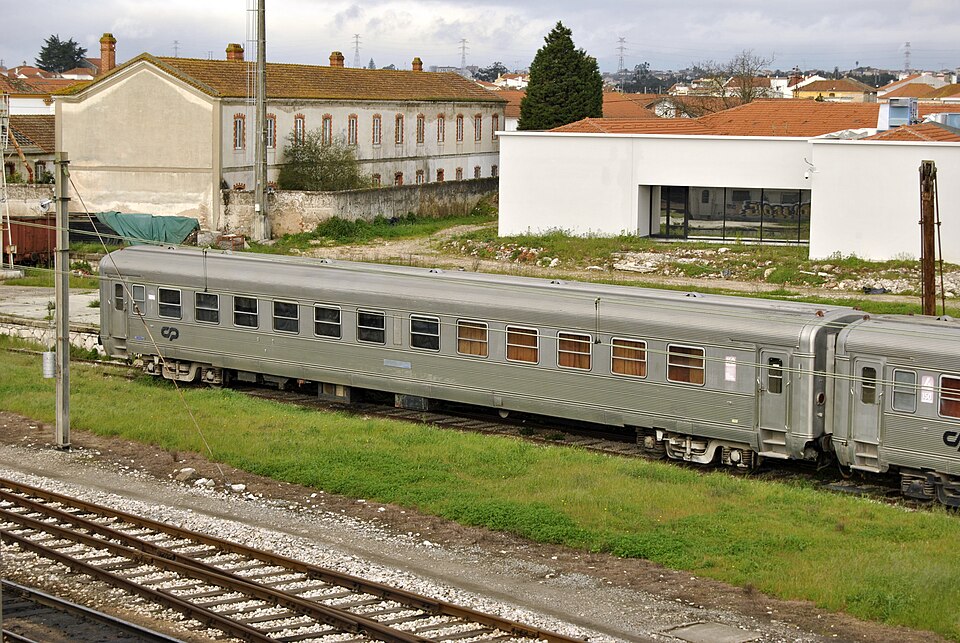
We boarded a compartment in a stainless steel carriage owned by the Portuguese State Railway, CP. Scott, who had accompanied us through the border, joined us. He was only heading as far as San Sebastian, the next stop.
The train we got on was nowhere near as nice as the one we had just got off. It was not air conditioned to start with. There was a drop down window and until the train got going the heat inside was pretty unbearable. The toilet was basically a hole in the floor and a none-too-clean one at that. There was no water available in the basin next to it either.
We had quite a wait for departure, but we eventually set off on time at 17:50. It still felt quite hot. There were no clouds in the sky. As we approached San Sebastian, a group of youths started throwing stones from the side of the track. One came through the window and into the compartment, narrowly missing my head and landing on the floor. The area around the station looked a bit of a dump and it was emitting terrible smells.
Scott got off and then as we pulled out of San Sebastian we realised we were still alone in the compartment. Suddenly the prospects for a decent night’s sleep looked to be improving. The scenery we were passing through now was quite different from France. It was certainly less green. It looked poorer somehow and this made it seem a bit more depressing.
The RENFE conductor checked our tickets and then, allowing us to use up some of our French money, took 60 francs from us as a supplement. It seemed ironic that we were paying extra for a train that was obviously worse in quality and slower than the supplement-free one we had just used in France.
In the distance we heard gun fire and around 20:00 we ground to a halt. The police boarded the train. We waited an hour or so. Outside there was a kind of musty, horrible smell. We suspected it was some kind of manure spread on the fields. Spain was not growing on me.
After a break of around ninety minutes, we continued on. We never worked out what the problem had been. We passed through more mountainous green scenery and along a valley with quite a few tunnels. Looking out of the window I was alarmed to see that people were casually throwing rubbish including empty bottles from the carriage windows on to the track.
Just after nine, we witnessed an outstanding sunset. As we headed west towards Salamanca and the Portuguese border, there was still no one else in the compartment. We rigged it up for sleeping by bringing the seats together and got the sleeping bags out. It was noticeably cooler now. With the window just slightly open the rhythmic noise of the train soon lulled me into a deep sleep.
Forty Years Later….
- SNCF Locomotive 9287 was withdrawn in 2010 and scrapped. Two examples of Class 9200 have been preserved.
- The fastest TGV from Paris Montparnasse to Irun now takes about 4 hours and 40 minutes.
- Smoking was banned on all French trains in 2005.
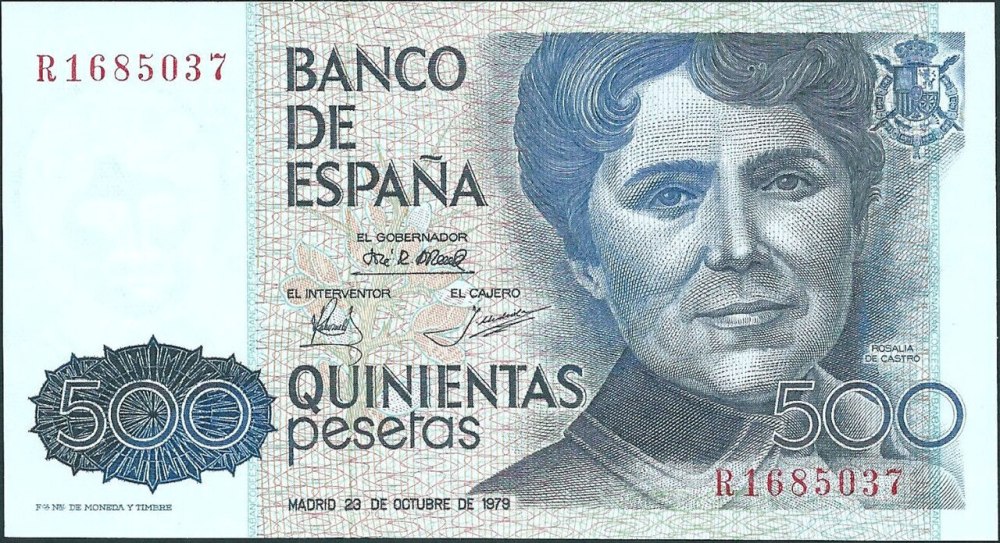
- Spain officially joined the European Communities (now the European Union) on January 1, 1986.
- Physical border controls between Spain and France were removed in 1995 under the Schengen Agreement.
- Euro banknotes and coins replaced the Peseta on January 1, 2002.
- There is no longer any overnight service linking Irun with Lisbon.
- The Class 269 locomotives were gradually withdrawn in the 2010s and none remain in RENFE service.


