Mangaluru to Madgaon
Having arrived from Coimbatore, I stayed in Mangaluru for two nights. On the third morning I boarded India’s latest express train, the Vande Baharat, for the journey along the Konkan Railway to Madgaon.
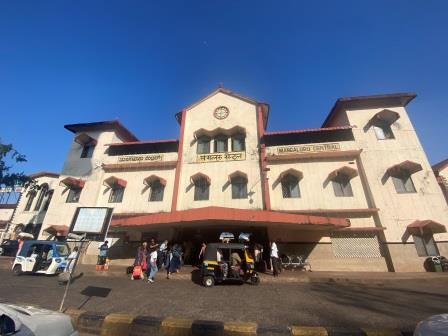
Mangaluru Central
Mangaluru Central had an interesting layout. In all respects it was a terminus but instead of a concourse at right angles to the platforms, the main station building had been built at the side.
The tracks that ran through the main platforms ended in shunt necks at a rock face. This all made sense; locomotives could draw forward and then run around their trains.
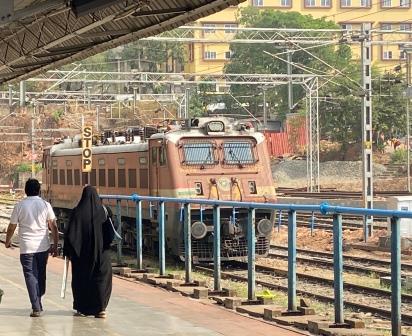
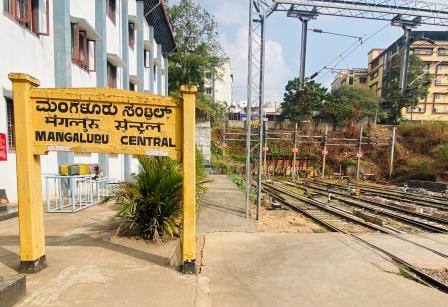
A little footpath ran across this and led to a railway maintenance facility. In most countries this would have been out of bounds to the public, but this was India and lots of people were crossing it.
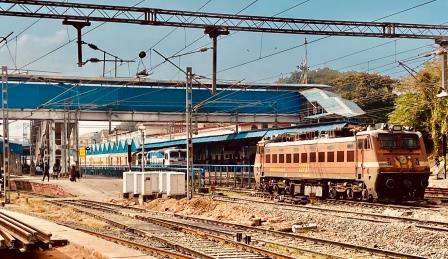
I walked across, past the maintenance shed, through the yard and out of the gate on the other side. The Metro Plaza Hotel was directly opposite. I had found a short cut. From train to room in less than ten minutes.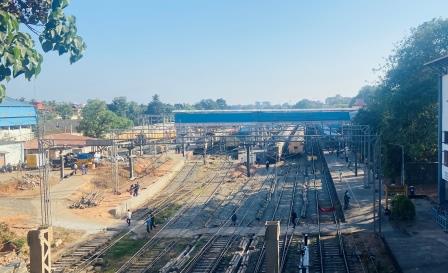
Fish for Dinner
Mangaluru (formerly Mangalore) is a port on the Arabian Sea with a population of around 700,000. The city, known for its beaches, is also home to several historic temples, churches and mosques.
Before handing me my key card for the room, the receptionist at the Metro Plaza apologised if the hot water was not working in the room. It was something they were looking at and a solution would be found before I checked out, he assured me.
In the event, not only was the water working perfectly, but I decided the bathroom, clean and bright, was the nicest one yet. The only problem was the “Prestige” kettle. For some reason, the thing managed to not only boil the water but heat the entire plastic superstructure too. I almost scalded my hand on the handle as I attempted to pour.
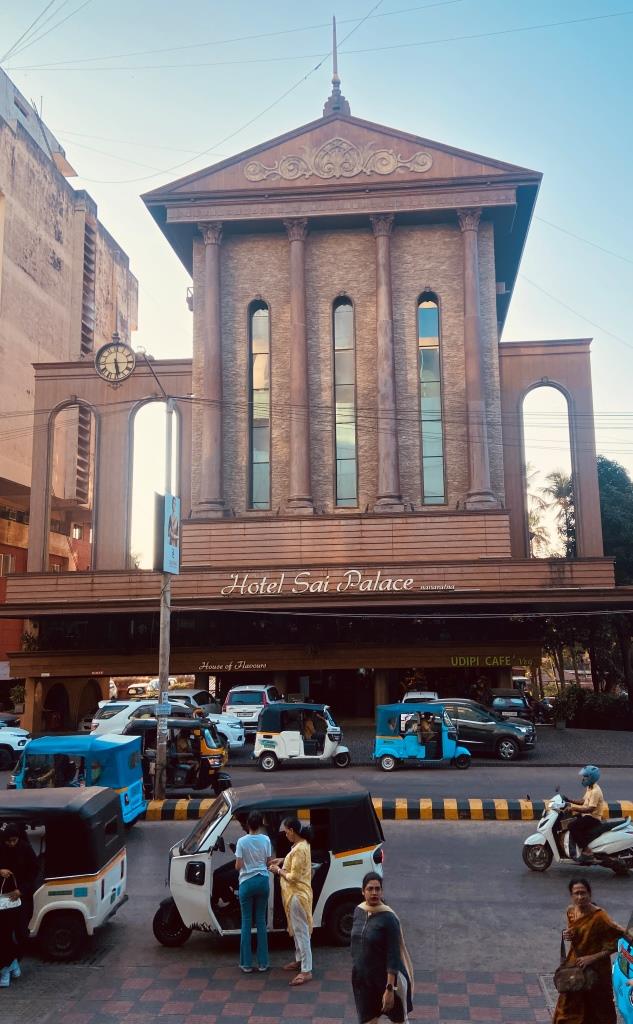
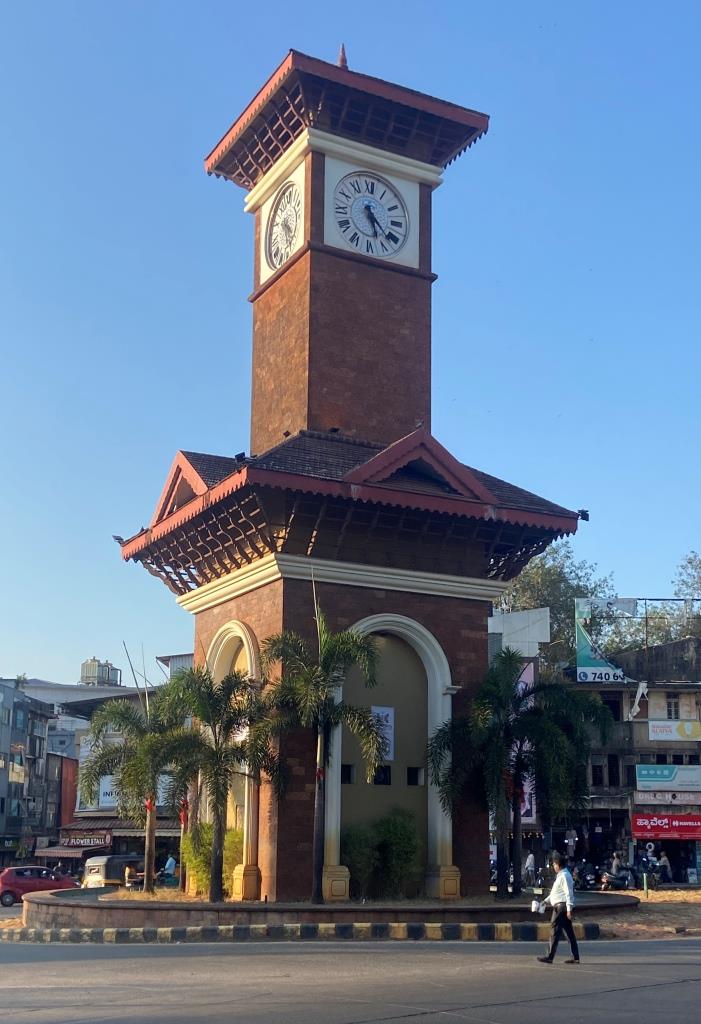
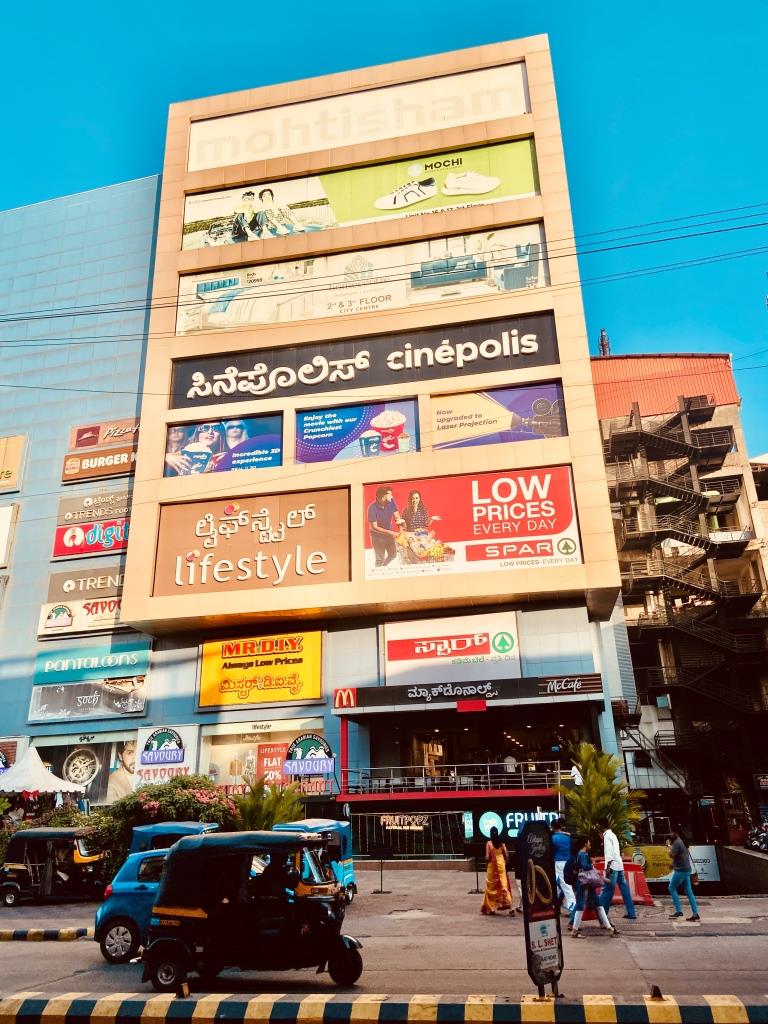
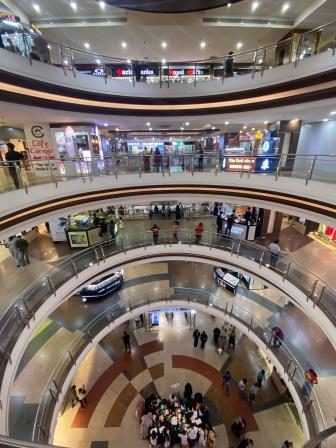
I took myself off for a long walk around the town. I walked up Mother Theresa Road passing an old clock tower and then along KSR road to the main shopping mall. I went up to the top floor of the mall. I got a few provisions from the large SPAR supermarket, still advertising Republic Day bargains, and then relaxed with a coffee in the food court.
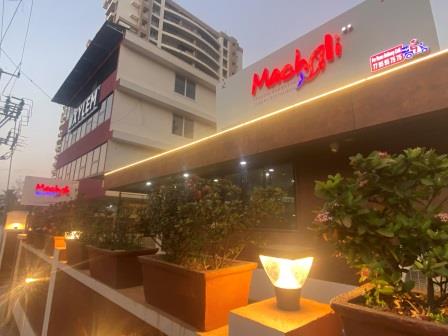
Later, I found Machali, one of the city’s most renowned fish restaurants, a few blocks away. There was quite a crowd of people sitting outside waiting for the place to open at 7pm and I joined them. 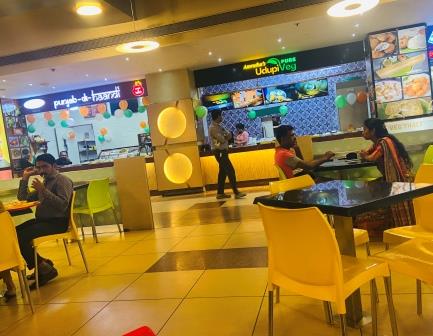
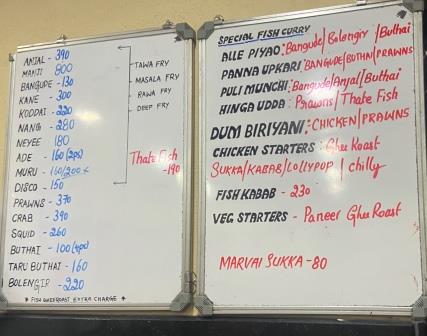
As I waited, I spent time translating the menu and writing the names of fish in my notebook. manji was pomfret, bangube was mackerel and kane was ladyfish. kodai was croaker whilst muru was red snapper. buthai was sardine.
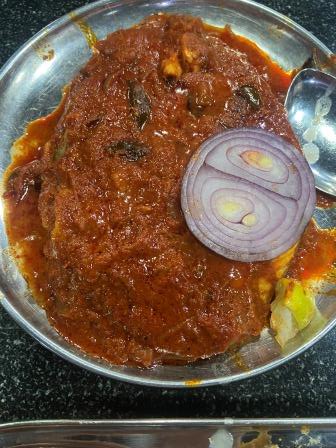
Tawa meant “skin on” , whilst rawa was the way to order “pan fried” and alle piyao was fish in ginger. By the time they opened the doors there were enough people waiting to fill the restaurant. I managed to get a table. I already knew what I wanted, anjal or kingfish.
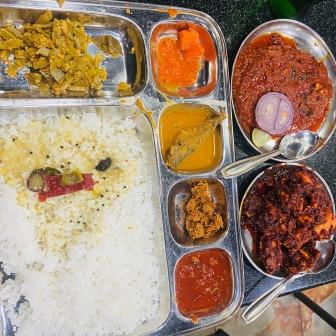
I ordered it with a starter of ghee roasted chicken, another Mangaluru favourite. It all came as part of a giant thali. It was absolutely delicious.
Fish after Breakfast
The next morning, I woke to the rather pleasant sound of train noises from the nearby station. The hot water was still working in the shower and in lieu of asbestos gloves I used a few towels wrapped around the kettle handle to make my morning coffee.
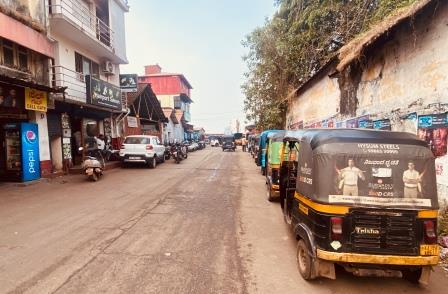
“Everything is fine”, I replied to the receptionist as I was going out. I wondered why nobody else had had the courage to report the faulty kettle.
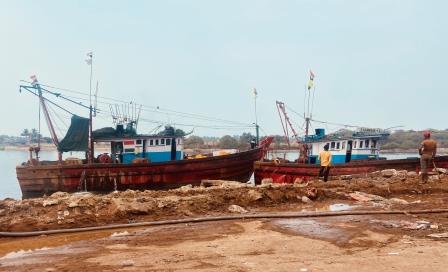
A walk of around thirty minutes took me from the station to the fish markets. The strong smell of fish became apparent long before I got to the shoreline.
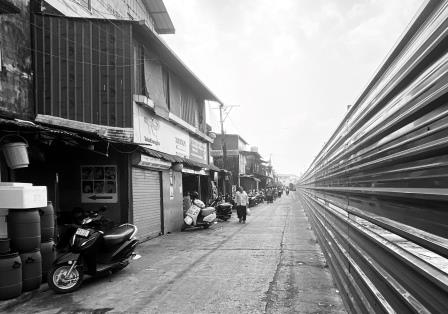
They had erected a long steel fence along the road next to the docks. I walked along it passing little businesses selling nets and supplies and quite a few cafes too.
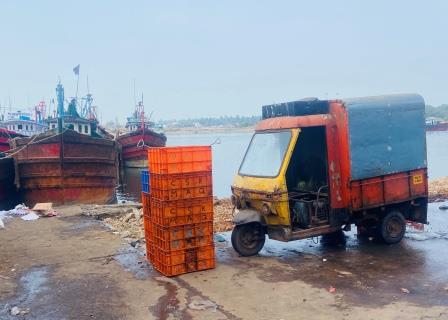
As with any fish market the earlier you visit, the more you get to see. Apparently things get going as early as 4am. In visiting around 8am, it was obvious that I was only seeing the tail end of the action.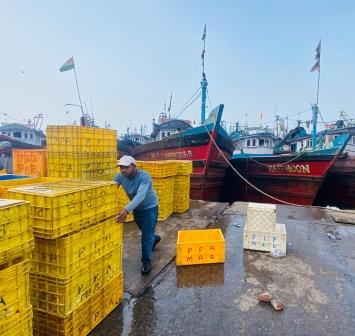
Some of the trading was still going on, but there was certainly a bit of an afterwork vibe too, with some of the traders having breakfast in the cafes.
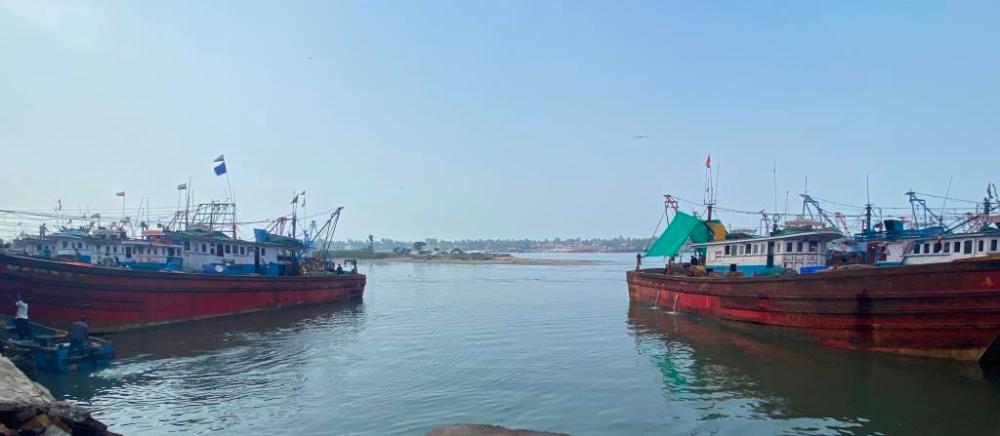
I walked along the shoreline looking at the vast number of boats that were moored there. Afterwards I learned that the fishing fleet here consists of around 1,400 to 1,500 boats.
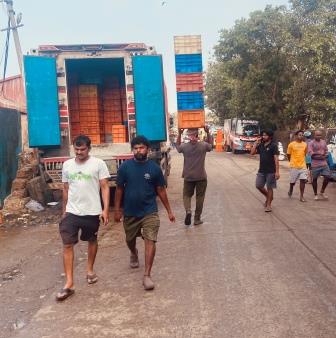
Most of the boats were deep sea craft which tended to go out for a week or more, but there were smaller ones too.
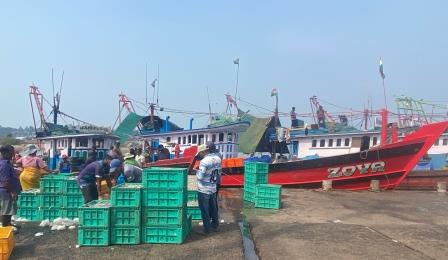
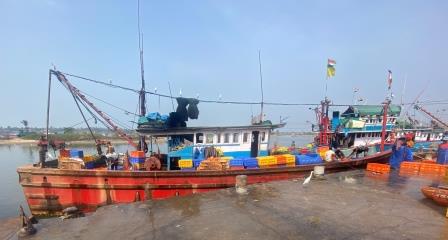
The fish was being put into plastic crates and then sold in areas adjacent to the docks. The place was awash with crates of assorted colours, piled up in rows.
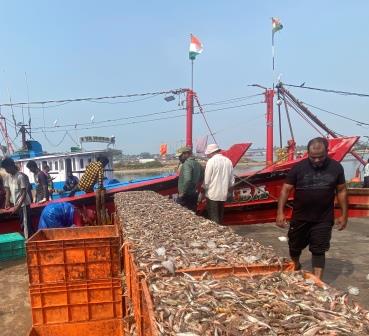
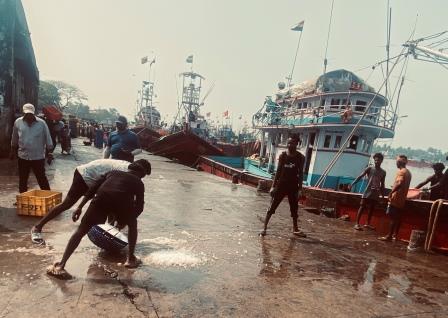
There were actually two markets here. They were effectively large open spaces where sellers gathered around their crates to haggle with the prospective buyers.
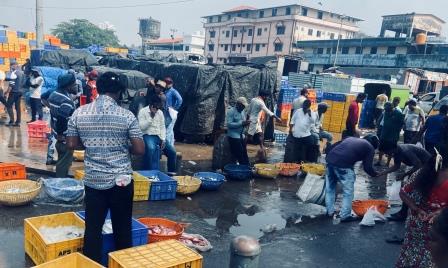
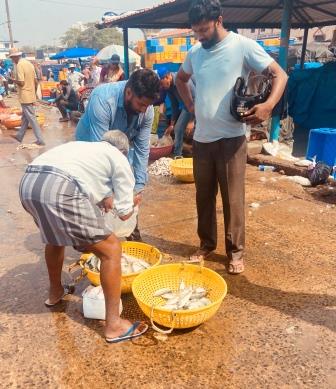
Mangaluru Fish market was first and then Dhakke further down the quayside dealt more with the wholesale side of things.
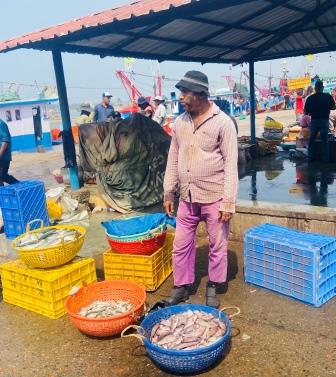
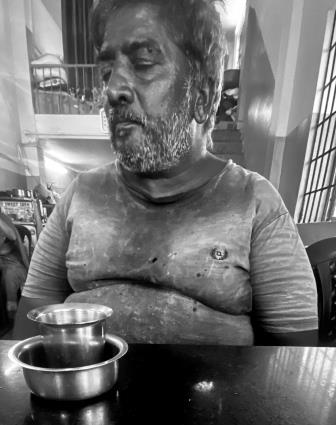
I took myself off for a coffee in a small café. It was full of fisherman and market traders having their breakfasts and looking tired.
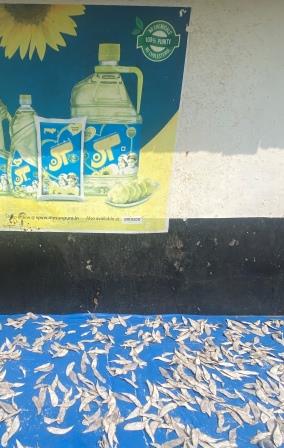
I walked away from the fish markets heading north. First I passed through an area with stores specialising in dried fish and then gradually the smell of fish was replaced by other aromas. I continued on passing more general stores.
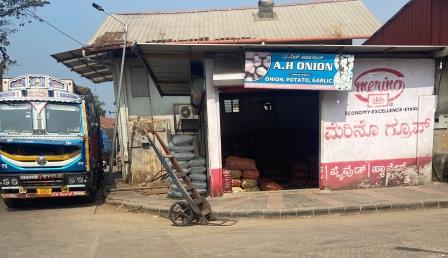
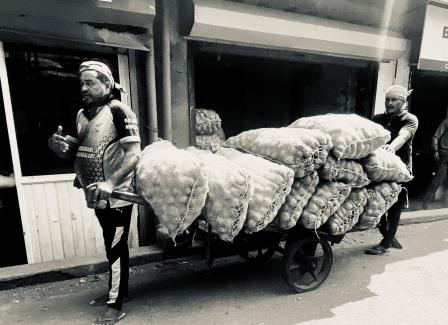
Outside Bismillah traders I watched two guys struggling with a cart loaded with potatoes and then walked on following a guy hauling a trolley full of dates.
I walked past the Zeenath Baksh Juma Masjid, one of Mangaluru’s oldest and most historically significant mosques, and wandered along a few of the lanes nearby.
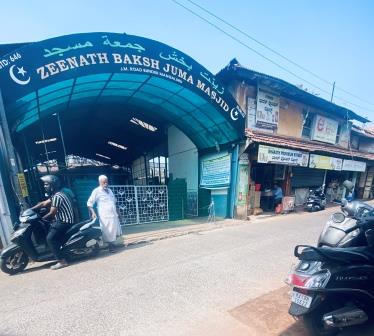
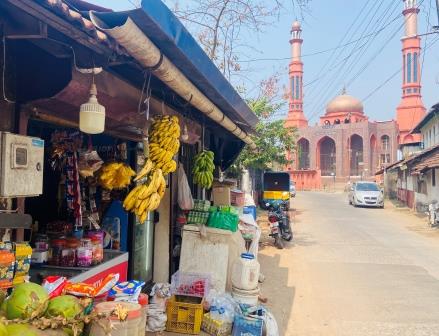
This was one of the most prominent Muslim areas of the city. I continued passing fruit and vegetable stalls, tea shops, stationery and mobile shops and tiny bakeries selling puffs and buns.
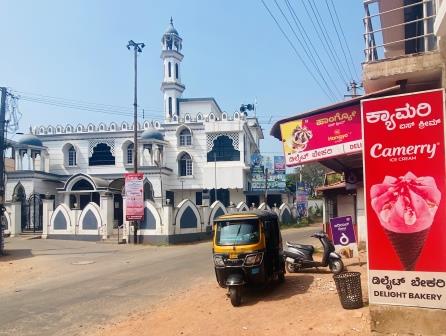
Eventually I was standing in front of the Kudroli Jamia Masjid, one of the most architecturally impressive and well-known mosques in Mangaluru.
Fish for Lunch
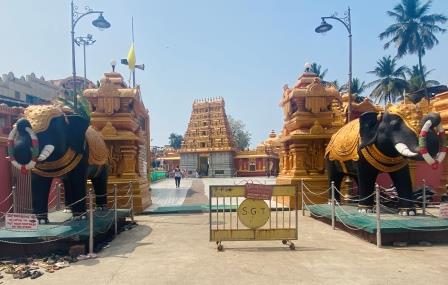
Just a few blocks away from this mosque was the Kudroli Hindu Temple. It was covered in gold-painted decoration and the locals sometimes call it the “Golden Temple of Mangaluru.”
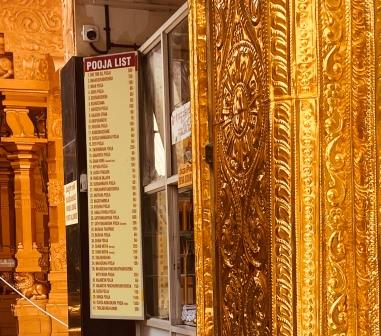
There was a list of the fees for puja (worship) outside. A onetime all-encompassing fee of 500 rupees was top of the list and then there were separate prices for other things.
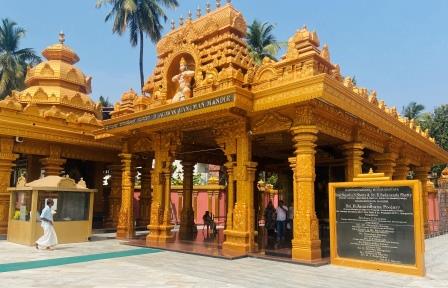
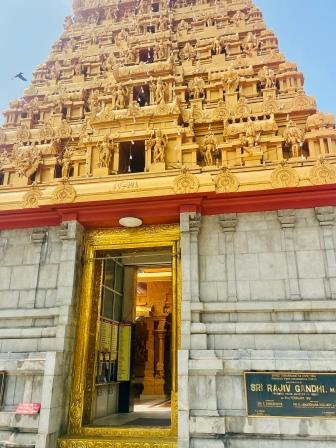
The courtyard was peaceful. Beautifully carved pillars and frescoes. A makeover in 1991 added the iconic golden structures and expanded the temple campus significantly.
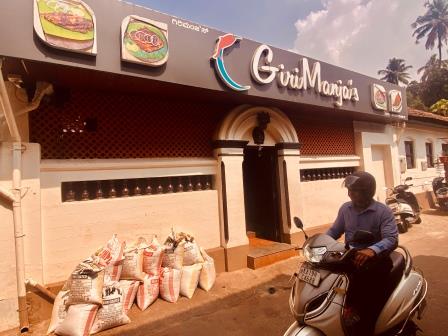
I walked down busy Kulur Ferry Road back into the centre and found Giri Manhas, another fish restaurant. It was filled with a lunch time crowd of locals and I only just managed to get a seat at one of the tables.
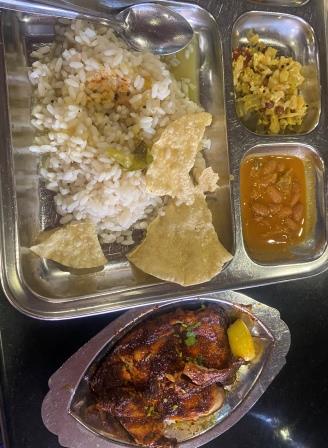
I got out my notebook ready to translate the menu on the wall, but the couple sitting opposite stepped in and recommended the anjal. I decided to go for the same fish as I had had at Machali.
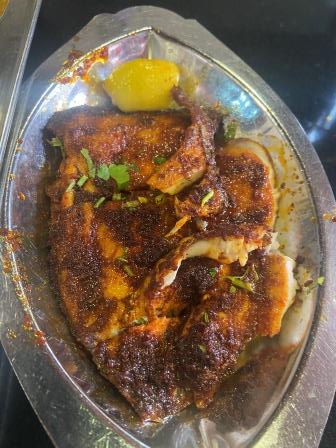
It was presented in a similar way. It was delicious and although it was close, I would concede that this place had the slight edge over Machali. Mangaluru had provided easily the best two meals of the whole trip so far.
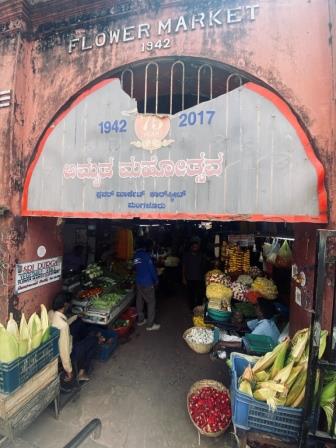
I popped into the local flower market where there were several stalls and small shopkeepers selling fresh blooms. I walked through looking at jasmine, marigolds and roses. They were creating garlands for use in the daily worship ceremonies and festivities.
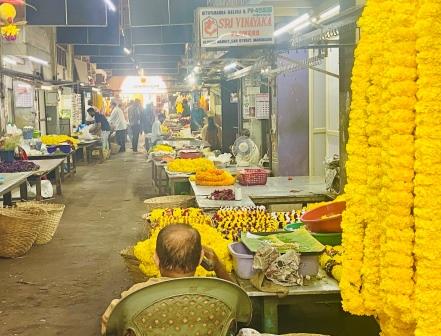
Mangaluru was certainly slower-paced and less chaotic than Bangaluru and Mysuru but it still had quite an active vibe to it.
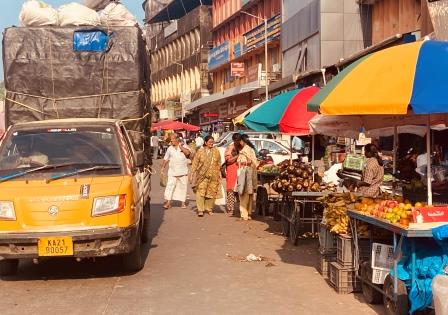
The central business district was primarily centred around Hampankatta with its narrow streets and a mix of modern shops and traditional market stalls.
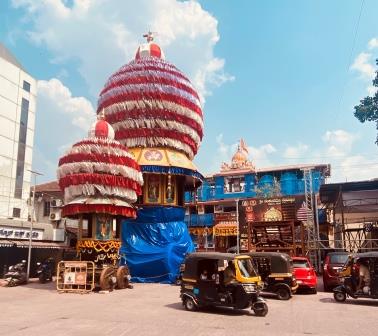
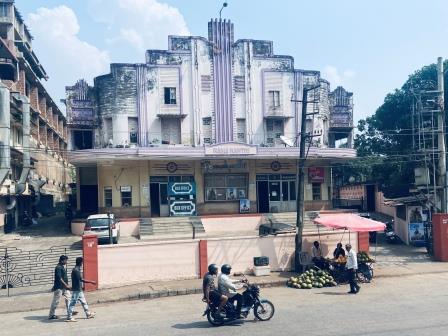
I walked up to the St Aloysius complex. Today it is a university offering undergraduate, postgraduate and research programs in the arts, commerce, science, management, and technology.
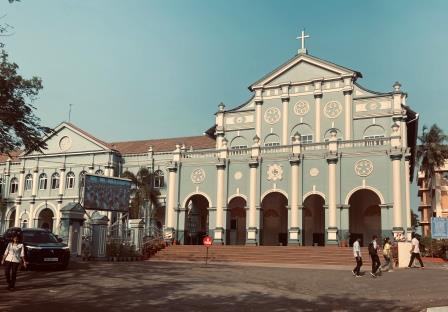
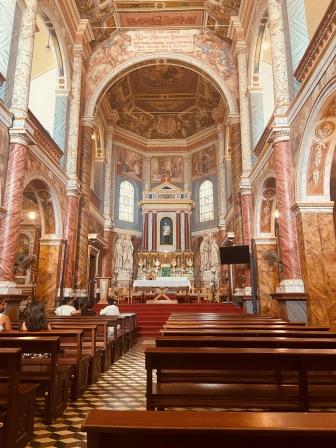
The St Aloysius Chapel was built in the 1880s and is renowned for its magnificent interior paintings. These artworks are unusual in India and are often compared to those in European chapels.
Beach
I decided to head to the beach to watch the sunset. I hailed an auto via the Uber app for a price of 260 Rupees. The driver turned up and refused to take me to the beach for less than 400.
I was not in the mood to quibble, so we set off. After a drive of about ten minutes, we arrived in the parking lot of an apartment building. “I live here”, the driver explained, “I will be back in a minute.”
He emerged more than ten minutes later. I was too polite to ask. We continued to the beach. It took about another twenty minutes.
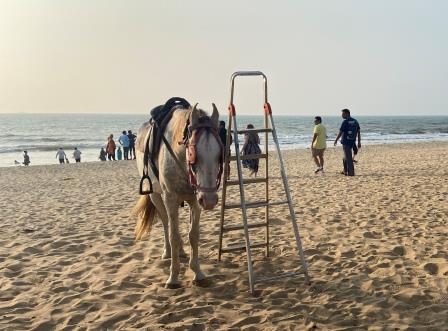
I wandered from the little car park where I had been dropped on to the beach. It was pretty deserted. There were just a few people walking.
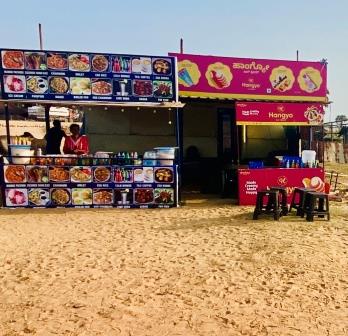
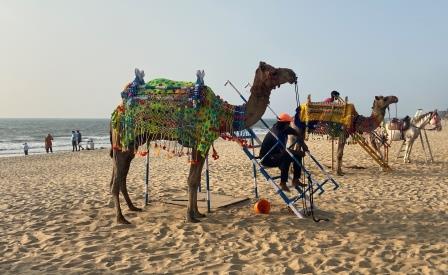
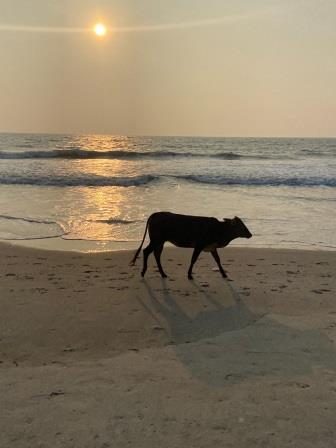
There were a couple of little shacks selling food and two camels and a donkey offering rides. They were not finding any takers. There were plenty of cows walking along the shore by themselves.
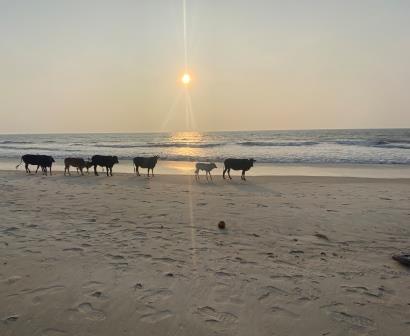
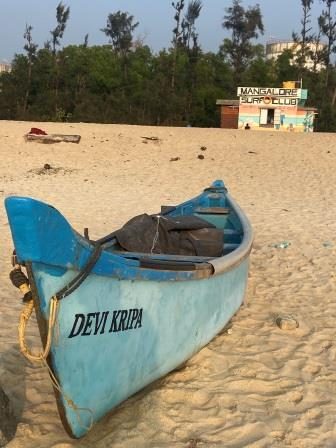
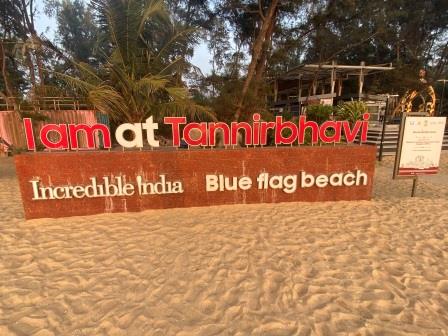
I went for a long walk. I passed the Mangalore Surf Club but it all seemed shuttered and barred. Eventually I came to Tannirbhavi, which as the signs announced, was a Blue Flag Beach.
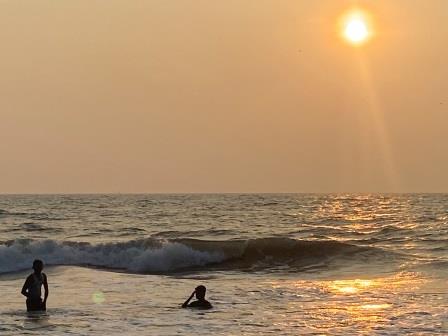
More people had gathered to watch the sun go down and I joined them. I ended up chatting to a doctor who lived in the city and was taking the afternoon off. As we watched the sun disappear, he told me all about being a GP in Mangaluru.
Once the sun had disappeared everyone started to leave. I wandered back to the road. I approached the first vehicle in a line of autos. The conversation went something like this….
“Mangaluru Central Station, and will you use the meter ?”
“Yes, 450 rupees?”
“on the Meter ?”
“Yes, on the meter at 1.5 the regular rate”
“So, if the meter shows 260, I only pay 390 ?
“Yes, you pay exactly 450”.
It was all good humoured and I could not be bothered negotiating, so we settled for “1.5 on the meter with a minimum fee of 450.”
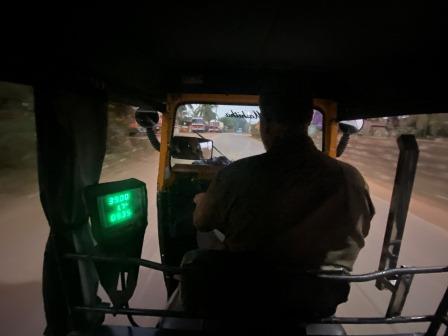
The trip was going well until about twenty minutes in there was a loud clang and we ground to a halt. The back wheel arch had fallen off. The driver jumped out to retrieve it just before it was crushed under the bus that was following us. He asked me to sit with it on my knee for the rest of the journey. The meter showed 280 at the end of the trip. I paid my 450 dutifully and wished the driver good luck in repairing his vehicle.
Train #20646 MAO Vande Bharat Express
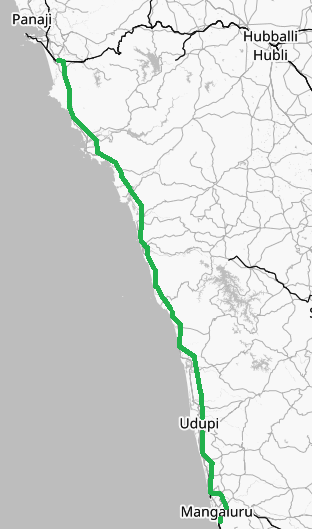
The #20646 MAO Vande Bharat Express service runs from Mangaluru Central to Madgaon, Goa, a distance of 320km. It runs every day except Thursdays. It departs at 08:20, stops only at Udupi and Kawar and is due to arrive in Madgaon at 13:10.
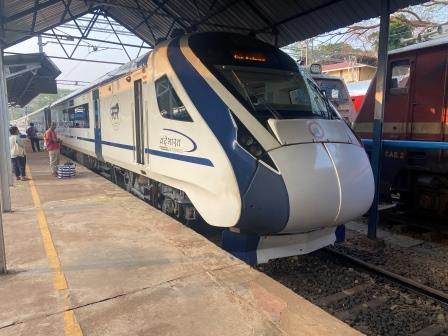
I checked out of the Metro Plaza and walked onto the station platform and, following the signs, soon found my train on platform 1A. The Vande Bharat in its gleaming blue and white livery was unmistakable. With more than thirty minutes to go, it was not available for boarding.
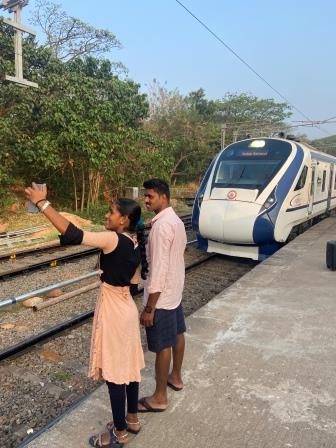
I walked to the end of the platform to take a photograph and found that I was not alone. There were a few people taking selfies in front of the train. Around 100 of these 180 km/h capable trains have already been built and they are gradually being introduced across India on day routes. A sleeper version has also just been launched too.
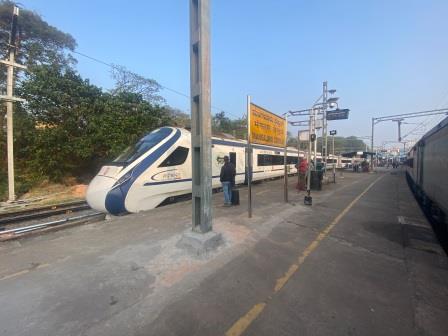
Some of the Vande Bharat sets (it means “salute to India”) have sixteen or even twenty coaches but this one had just eight. It offered regular chair and executive class both with food included in the fare. From the front the coaches were labelled C7-C3, E1, C2 and right at the rear, where I would be sitting, C1.
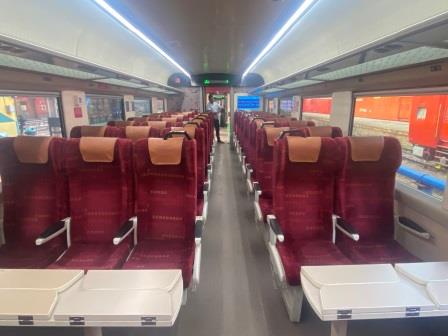
The doors opened about fifteen minutes before departure. Inside, the train was welcoming. The maroon seats were particularly attractive and laid out as 2 plus 3 in regular chair and 2 plus 2 in executive class. I found my seat next to the window. The train was filling up fast.
I was handed a copy of a newspaper written in Kanada, and as I was working out what to do with it, I got a copy of The Hindu (English language) newspaper as well. It seemed everyone else was getting the same treatment.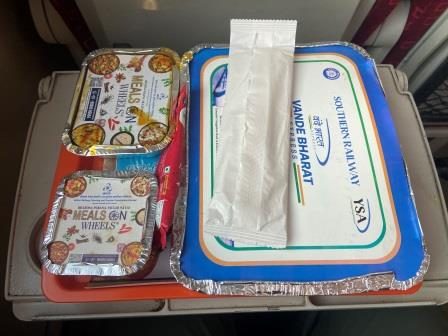
The build quality of the train was impressive. There was power to every seat, a foot rest and a fold down table large enough to hold a laptop. At the end of the carriage were two separate electronic displays. One of them was giving all sorts of information about the first stop. There was also a speedometer display. We set off.
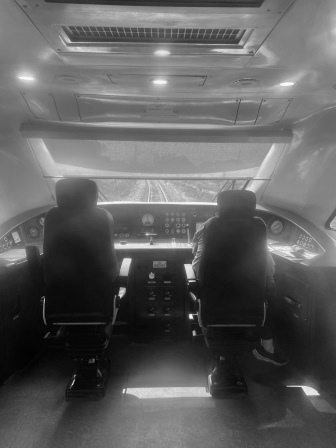
The conductor came around with his tablet device and made sure everyone was sitting in the correct seat. I offered to show my ticket but he smiled and made a note on his touchscreen.
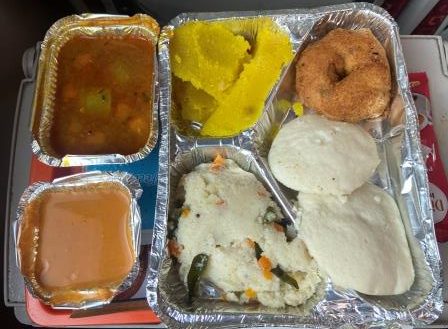
We were only just passing Mangaluru Junction, just a few kilometres into the journey, when the breakfast was delivered. Presented in the familiar “meals on wheels” foil trays, I got delicious vada, Idli and various sauces to dip them in. The whole thing was great and it came with a sachet of powdered Masala tea for which the attendant then delivered a cup of hot water. There was a “Fun Cup” eggless vanilla cupcake too.
The attendant was hard working. He cleared the breakfast trays away, cleaned up the carriage a bit and then he was back again offering pot noodles for sale.
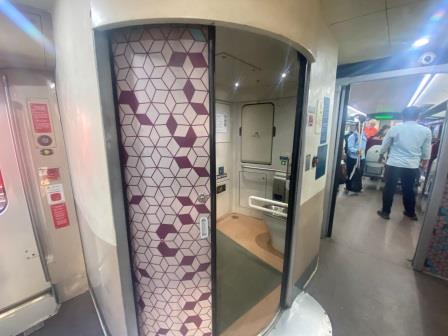
Unlike any of the other Indian trains I had travelled on, the Vande Bharat had announcements. I was not sure if this was a good thing though. As we got going, and subsequently after every station, there were warnings and explanations. The toilet was eco-friendly; there were smoke detectors and the train doors were all automatic. We were warned not to get off before the train had stopped. That would have been difficult to do given the doors were automatic ! This was supplemented by information flashing across the screen at the end of the carriage. We were not to keep our luggage unattended, nor were we to smoke or consume liquor.
The Indians seem to be big on making sure there was always someone to complain to. The number to call for AC related complaints flashed across the screen but it was too fast It ended in 304, I think. Problems with the catering were dealt with by another number which I am sure ended in 411.
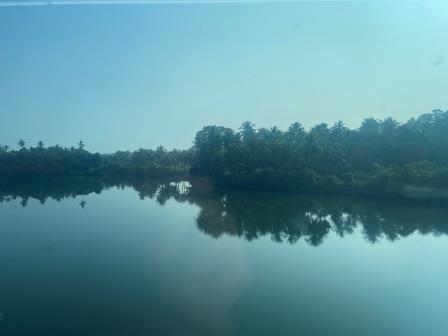
The speedometer was working well. We went slowly at first, just 41 km/h, then a short burst to 120 km/h, then slowly again. The line we were traversing included a lot of single track so there was a bit of stopping to wait for other trains coming in the other direction. 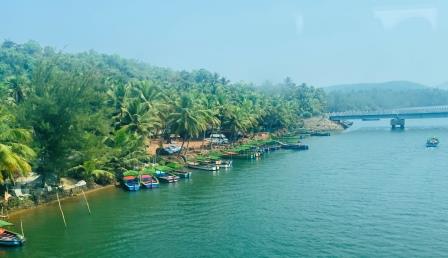
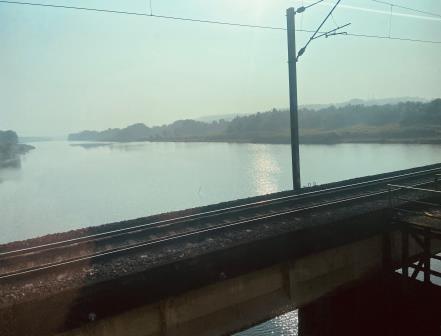
We were on the Konkan Railway which stretches for 741 Kilometres along India’s west coast connecting Mumbai with Mangaluru. The major engineering feat includes 91 tunnels and more than 2,000 bridges and viaducts. The line was constructed from both ends to finally meet in Goa. It opened throughout in May 1998 and was electrified between 2015 and 2022. Efforts are now being made to double it where possible.
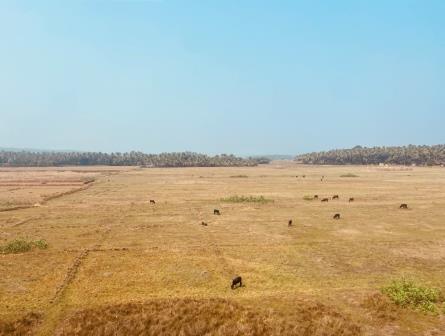
We stopped at Udupi, arriving there a full twenty minutes ahead of schedule. An older guy came and sat next to me. Before we had even set off again he had been served his breakfast. He did not get an elaborate tray like I had received, but just a small cardboard carton that had a stylised logo of the Vande Bharat on the side. He sensed my interest as I watched him examine the contents, there was a chocolate bar, a muesli bar and a carton of apple juice. He smiled and offered me the apple juice and we immediately got talking.
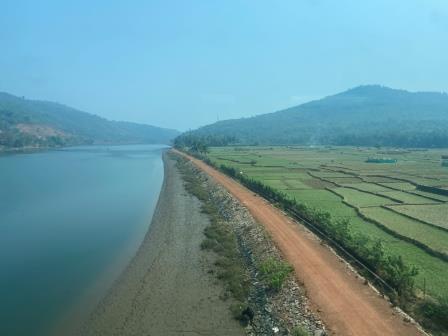
He lived in Udupi; he was a retired cotton trader who had lived in Qatar and in China. He was alone now and retired although he still sold a few coconuts from his farm. He was off to a family wedding in Goa. His daughter lived in London and he insisted we call her and speak to her on the phone. She was surprised to speak to me, but she sounded genuinely nice.
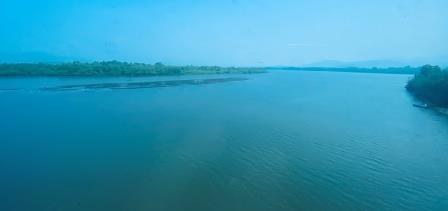
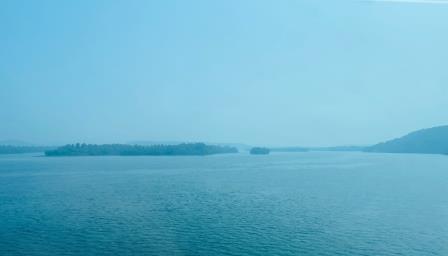
He did not quite live alone. There was a dog, who he showed me on the video camera and we took it in turns to shout hello through the camera, until the dog worked out what was happening. It was a bit bizarre travelling alongside the Arabian Sea laughing together as we shouted at a dog on a mobile phone.
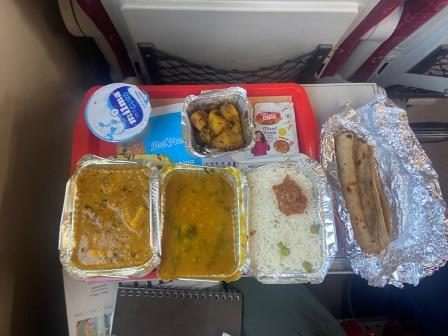
Lunch was delivered about 12 noon; this was really generous considering that we had already had breakfast not long since and there was only another hour to go. I was presented with another “meals on wheels” tray. There was a paneer dish, a dal dish and a rice dish, some curd and chapatis. This was followed by a tub of delicious Amal vanilla ice cream.
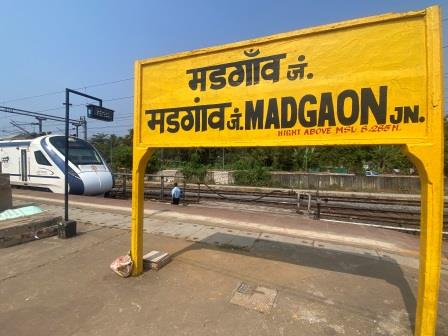
We continued on and eventually pulled into Madgaon eight minutes late. There was another Vande Bharat train at the other end of the same platform. It had just terminated having arrived from Mumbai. 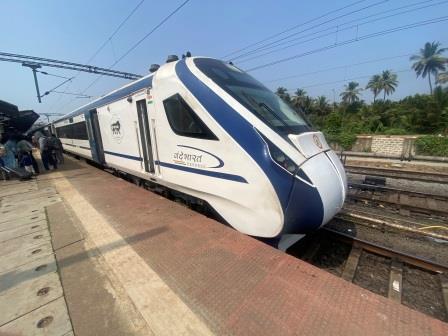
I was extremely impressed with my experience on India’s latest express. It will be interesting to see whether they can fettle the track a bit more and get these highly capable trains travelling a little faster between the major cities. 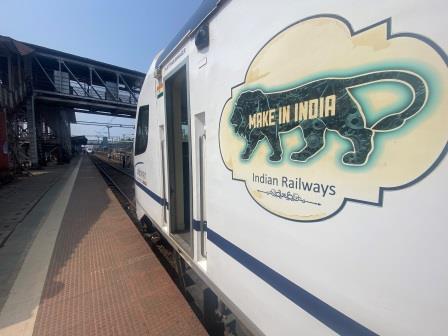
Continue the journey soon on – #10104 – Mandovi Express (Madgaon, Goa)

 Trains To Beyond